Angle of intersection
Recall that the graph of a linear function is a straight line with slope . The (smaller) angle between this straight line and the -axis is the arc tangent of the slope: . This is a direct consequence of the trigonometric relations (SOHCAHTOA) for the slope triangle, as is shown in the figure below.
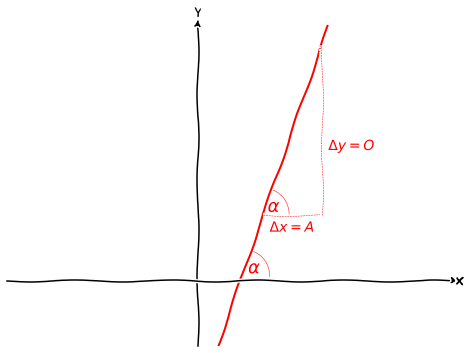
Indeed, we have seen
Convert slope to angles.
Also remember, that:
- The arc tangent is also called inverse tangent, written .
- If the calculator is in degree mode, the angle is in degrees; if the calculator is in radian mode, the angle is in radians.
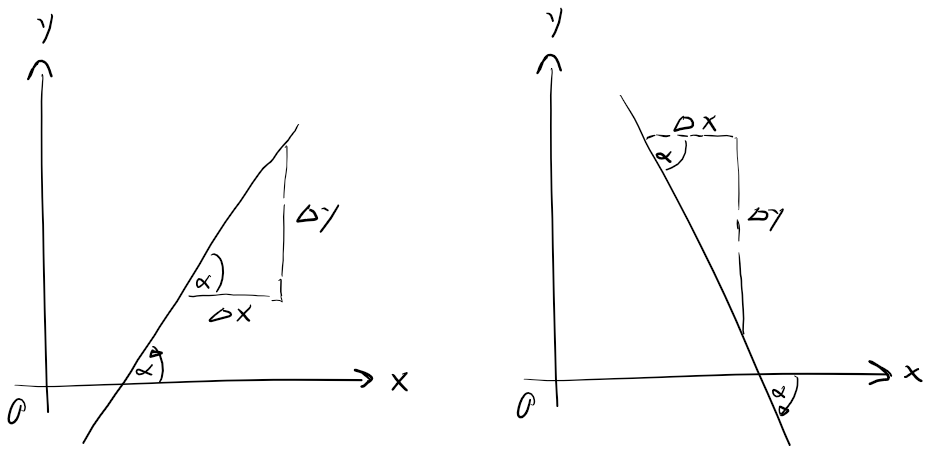
- For a positive slope , is positive (below, left); for a negative slope , is negative (below, right). A negative angle means you measure downwards or clockwise.
-
In the left figure above, assume that and . In the right figure above, assume that and . Calculate the angle for both cases.
-
Consider the two linear functions and . Draw the two graphs, and calculate their smallest angle of intersection with the -axis. Also, indicate these angles on the picture.
Solution
- Left: . Right: Note that because we go down on the slope triangle. . Thus the angle is , measured downwards or clockwise.
- Figures are not shown. and (thus the angle is , measured downwards or clockwise).
Motivation
Consider a function , and assume that the graph (generally a curved line) intersects the -axis at some point. We want to know the angle between the -axis and the curve at this point. With the help of the tangent, we can define what we mean by this.
Consider a function that intersects the -axis at some point . The angle between the graph of and the -axis at this point is defined as the angle between the tangent to the graph of at this point and the -axis. We call this angle the angle between the graph and the x-axis.
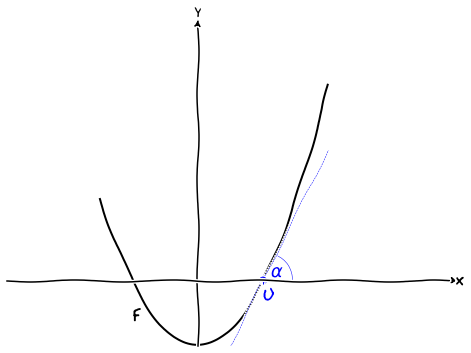
Consider a function and the tangent to the graph of at . The angle between the tangent and the -axis is
Angle between the graph and the x-axis
Proof
The proof should be clear. The tangent has the slope .
The graph above is given by the function . Find both angles of intersection of the graph with the -axis.
Solution
- Find the -intercepts: and .
- The derivative for calculating the slope of the tangent at is . Thus the slope of the tangent at is , and the slope of the tangent at is .
- The angle at is . Thus the angle is if measured clockwise.
- The angle at is .
Consider two functions and whose graphs intersect at (see figure below). The angle between graphs is defined as the (smaller) angle between the tangents to the graphs of and at .
To determine , it is helpful to first find the angles and between the -axis and the tangents (see figure below).
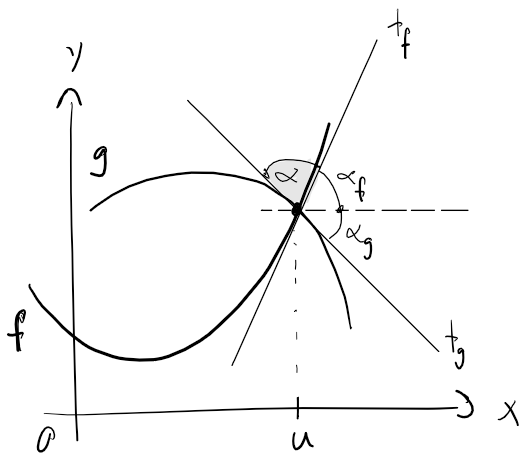
Assume that in the figure above, the slopes of the tangents and are given by and . Determine the angle of intersection .
Solution
We have and . Thus, .
- Determine the angles of intersection between the -axis and the graph of :
- Determine all the angles of intersection between the two graphs and :
- and
- and
- Consider the function .
-
Find the angle of intersection with the -axis.
-
Find all points on the graph where the tangent intersects the -axis at an angle of .
-
Solution
-
- At , the angle is , and at , the angle is .
- The derivative is . At , the slope is and ; at , the slope is and ; and at , the slope is and .
-
- At , it is . At , it is .
- At , it is , and at , it is .
-
- At , the angle is .
- Find such that .