Scientific notation

The scientific notation is a useful way of writing very large or very small numbers (small in the sense of being close to 00). Scientists use this notation a lot because many things in our universe are described by either incredibly large or small numbers. Here are some examples:

Example 1: Big: the universe

If we look up at night, we see many, many stars (about 25002500). But indeed, that is just the local neighbourhood of our galaxy (see small circle).
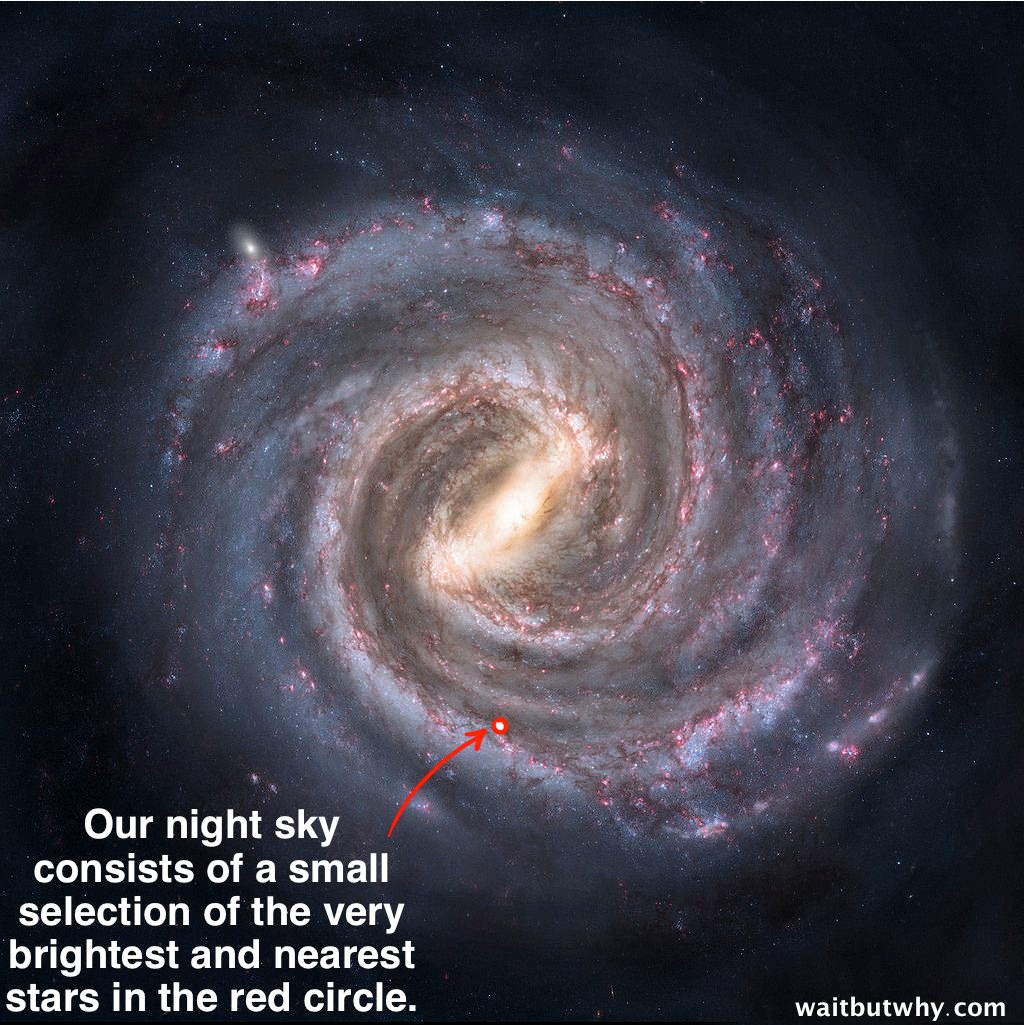
The (observable) universe

  • contains about 100000000000000000000000231\underbrace{00000000000000000000000}_{23} stars.

    Note: To put it differently, for every grain of sand in our world there are about 1000010 000 (!) stars out there. And it is estimated that for every grain of sand there are 100100 earth like planets in the universe ... so where are all the aliens? This is called the Fermi-Paradox.

  • has a diameter of 88000000000000000000000022km88\underbrace{0000000000000000000000}_{22} km

  • has a total mass of 15000000000000000000000000000000000000000000000000000052kg15\underbrace{0000000000000000000000000000000000000000000000000000}_{52} kg

Example 2: Small: the atom

Depending on the type, an atom has a

  • radius 0.0000000000103m0.\underbrace{0000000000}_{10}3 m
  • mass 0.0000000000000000000000002416605kg0.\underbrace{000000000000000000000000}_{24}16605 kg

It should be clear that writing such large or small numbers containing so many zeros is hard to read. It is very easy to miss a zero, for example. That is where powers of ten ("Zehnerpotenzen") come into play. Powers of ten are powers with base 1010, that is, 10n10^n where nn is an integer. These powers have a lot of zeros as well, e.g.

104=10000103=1000102=100101=10100=1101=0.1102=0.01103=0.001104=0.000110100=10...010010100=0.0...0991\begin{array}{lll} 10^4 = & 10000\\ 10^3 = & 1000\\ 10^2 = & 100\\ 10^1 = & 10\\ \mathbf{10^0 =} & \mathbf{1}\\ 10^{-1} = & 0.1\\ 10^{-2} = & 0.01\\ 10^{-3} = & 0.001\\ 10^{-4} = & 0.0001\\ &\\ 10^{100}= & 1\underbrace{0...0}_{100}\\ 10^{-100}= & 0.\underbrace{0...0}_{99}1 \end{array}

Some of these power of tens even have special names, e.g.

How does this help in our problem of representing very large or very small numbers? Well, for example take the two numbers 2400024000 and 0.000240.00024. Both of these numbers can be written with the help of powers of ten in the following way, which we call the scientific notation:

24000=2.410000=2.410424000 = 2.4 \cdot 10000 = 2.4 \cdot 10^4 0.00024=2.40.0001=2.41040.00024 = 2.4 \cdot 0.0001 = 2.4 \cdot 10^{-4}

Note that we could have also written the number 2400024000 as

24000=241000=2410324000 = 24 \cdot 1000 = 24 \cdot 10^3

or as

24000=0.24100000=0.2410524000 = 0.24 \cdot 100000 = 0.24 \cdot 10^5

but this is not called scientific notation because the number in front of the power of ten (the coefficient) is not between 11 and 1010. Let's give a formal definition:

Definition 1

The scientific notation is of the form

c10nc\cdot 10^n

or

c10nc\cdot 10^{-n}

where cc is a real number between 11 and just smaller than 1010 (c[1,10[)c\in[1,10[)) and n0,1,2,...n\in {0,1,2,...}.

The value nn indicates, how many steps to the left or to the right you have to move the decimal point. For example,

24000.0=2400.00101 (step 1)=240.000102 (step 2)=24.0000103 (step 3)=2.40000104 (step 4)0.00024=00.0024101 (step 1)=000.024102 (step 2)=0000.24103 (step 3)=00002.4104 (step 4)\begin{array}{lll} 24000\mathbf{.}0 & = & 2400\mathbf{.}00\cdot 10^1 \text{ (step 1)}\\ & = & 240\mathbf{.}000 \cdot 10^2 \text{ (step 2)}\\ & = & 24\mathbf{.}0000 \cdot 10^3 \text{ (step 3)}\\ & = & 2\mathbf{.}40000 \cdot 10^4 \text{ (step 4)}\\ &\\ 0\mathbf{.}00024 &= & 00\mathbf{.}0024\cdot 10^{-1} \text{ (step 1)}\\ &= & 000\mathbf{.}024 \cdot 10^{-2} \text{ (step 2)}\\ &= & 0000\mathbf{.}24 \cdot 10^{-3} \text{ (step 3)}\\ &= & 00002\mathbf{.}4 \cdot 10^{-4} \text{ (step 4)}\\ \end{array}
Exercise 1

Express the numbers we used in the examples using scientific notation.

  1. Number of stars in universe:

    100000000000000000000000.0100000000000000000000000.0
  2. Diameter of universe:

    880000000000000000000000.0km880000000000000000000000.0 km
  3. Mass of universe:

    150000000000000000000000000000000000000000000000000000.0150000000000000000000000000000000000000000000000000000.0
  4. Atom radius:

    0.0000000003m0.0000000003 m
  5. Atom mass

    0.00000000000000000000000016605kg0.00000000000000000000000016605 kg
Solution
  1. 110231\cdot 10^{23}
  2. 8.81023km8.8 \cdot 10^{23} km
  3. 1.51053kg1.5\cdot 10^{53} kg
  4. 31010m3 \cdot 10^{-10} m
  5. 1.66051025kg1.6605\cdot 10^{-25} kg
Exercise 2

Express in scientific notation:

  1. 4034000040340000

  2. 291000291000

  3. 345.1345.1

  4. 55

  5. 0.0003020.000302

  6. 0.000012340.00001234

Solution
  1. 40340000.0=4.03410740340000.0=\underline{4.034\cdot 10^{7}}
  2. 291000.0=2.91105291000.0=\underline{2.91\cdot 10^{5}}
  3. 345.1=3.451102345.1 = \underline{3.451\cdot 10^2}
  4. 5=51005 = \underline{5\cdot 10^0}
  5. 0.000302=3.021040.000302 = \underline{3.02\cdot 10^{-4}}
  6. 0.00001234=1.2341050.00001234 = \underline{1.234\cdot 10^{-5}}
Exercise 3

Express as a decimal number:

  1. 3.2321053.232\cdot 10^5

  2. 3.2321053.232\cdot 10^{-5}

  3. 2.030051032.03005 \cdot 10^{3}

  4. 2.030051032.03005 \cdot 10^{-3}

  5. 210201.410192\cdot 10^{20} \cdot 1.4\cdot 10^{-19}

Solution
  1. 3.2320000105=323200.00=3232003.2320000\cdot 10^5 = 323200.00=\underline{323\,200}
  2. 000003.232105=0.00003232000003.232\cdot 10^{-5} = \underline{0.00003232}
  3. 2.03005103=2030.052.03005 \cdot 10^{3} = \underline{2030.05}
  4. 2.03005103=0.002030052.03005 \cdot 10^{-3} = \underline{0.00203005}
  5. 210201.41019=21.4102019=282\cdot 10^{20} \cdot 1.4\cdot 10^{-19} = 2\cdot 1.4\cdot 10^{20-19}=\underline{28}.
Exercise 4
  1. How many atoms, roughly, form a human body of mass 70kg70 kg?
  2. Determine the geometrical mean of the mass of the sun by first converting the numbers into scientific notation:
ms=1989000000000000000000000000000kgm_s=1 989 000 000 000 000 000 000 000 000 000 kg

and the mass of a proton

mp=0.0000000000000000000000000016726kgm_p=0.0000000000000000000000000016726 kg

Note: the geometric mean of two numbers aa and bb is ab\sqrt{a\cdot b}

Solution
  1. number of atoms is 70ma=701.66051025=701.660511025=701.66051025=42.151025=4.215101025=4.2151026\frac{70}{m_a}=\frac{70}{1.6605\cdot 10^{-25}} = \frac{70}{1.6605}\cdot \frac{1}{10^{-25}} = \frac{70}{1.6605} \cdot 10^{25} = 42.15 \cdot 10^{25} = 4.215\cdot 10 \cdot 10^{25} = \underline{4.215\cdot 10^{26}}

  2. ms=1989000000000000000000000000000.0kg=1.9891030kgm_s=1989000000000000000000000000000.0 kg = 1.989\cdot 10^{30} kg, and mp=0.0000000000000000000000000016726kg=1.67261027kgm_p=0.0000000000000000000000000016726 kg = 1.6726\cdot 10^{-27} kg.

    Thus, msmp=1.98910301.67261027=1.9891.672610301027=3.327103m_s\cdot m_p = 1.989\cdot 10^{30}\cdot 1.6726\cdot 10^{-27}=1.989\cdot 1.6726 \cdot 10^{30}\cdot 10^{-27}=3.327\cdot 10^3.

    The geometric mean is therefore 3.327103=57.67kg\sqrt{3.327\cdot 10^3}=\underline{57.67 kg} (the mass of a human body, more or less).

Exercise 5

Convert into units of bytes, meters, or kilograms (the end result has to be in scientific notation).

  1. 1.31.3 gigabyte

  2. 0.7620.762 micrometer

  3. 0.1020.102 g

  4. 10200001020000 km

Solution
  1. 1.31.3 gigabyte = 1.3109\underline{1.3 \cdot 10^9} bytes
  2. 0.7620.762 micrometer = 0.762106m=7.62101106m=7.62107m0.762\cdot 10^{-6} m = 7.62\cdot 10^{-1}\cdot 10^{-6} m = \underline{7.62\cdot 10^{-7} m}
  3. 0.1020.102 g = 0.102103kg=1.02101103kg=1.02104kg0.102 \cdot 10^{-3} kg = 1.02 \cdot 10^{-1} \cdot 10^{-3} kg = \underline{1.02 \cdot 10^{-4} kg}
  4. 10200001020000 km = 1020000.0103m=1.02106103m=1.02109m1020000.0 \cdot 10^3 m =1.02\cdot 10^6 \cdot 10^3 m = \underline{1.02 \cdot 10^9 m}