Logarithmic functions

The logarithmic function takes as input a value xx, and the output is the logarithm of this xx, e.g. f(x)=log10(x)f(x)=\log_{10}(x)

input xfrule: log10(x)output y\begin{array}{cr} \text{input } x & \\ \huge \downarrow & \\ \boxed{\huge f} & \text{rule: } \log_{10}(x)\\ \huge\downarrow &\\ \text{output } y & \end{array}

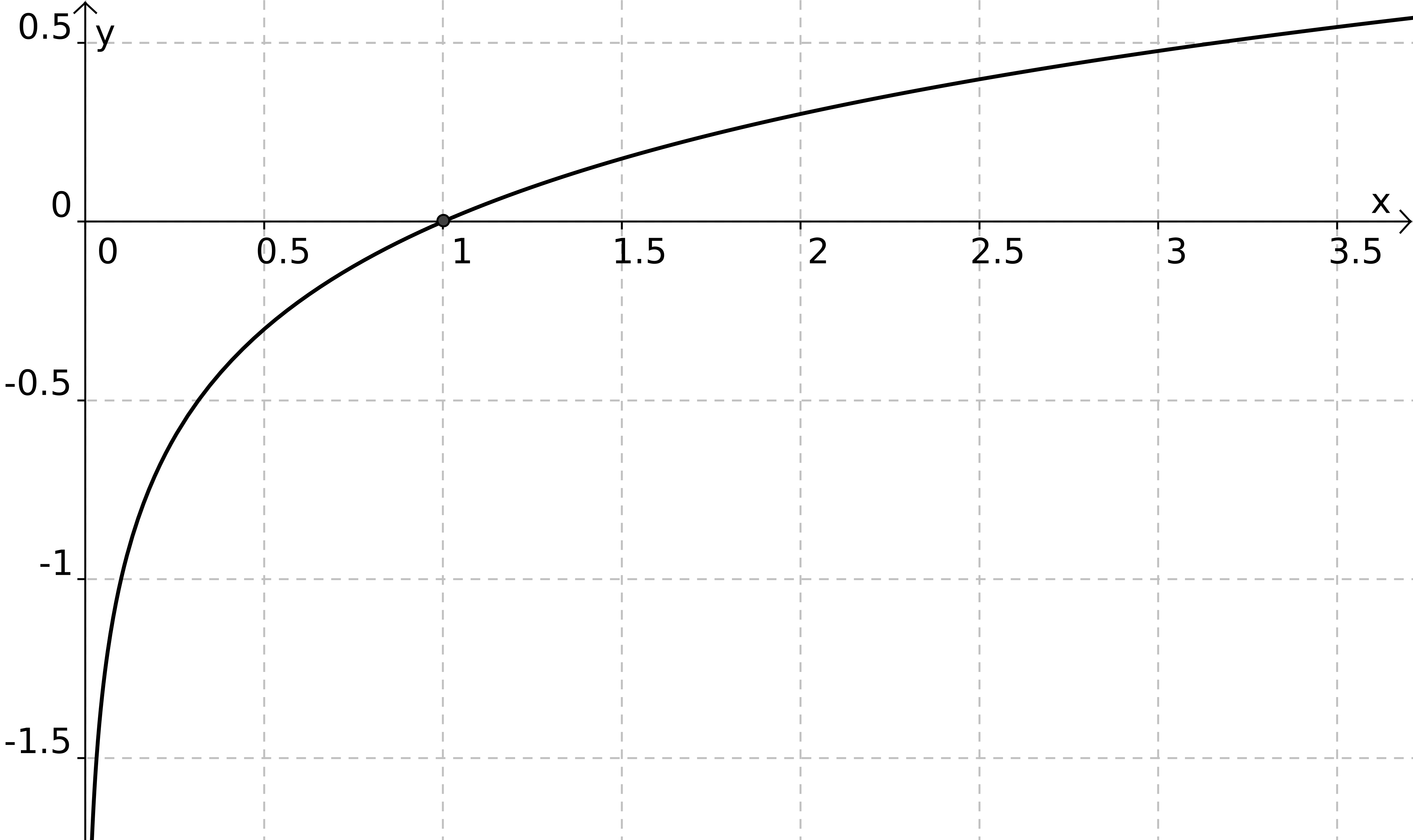
A good way to draw the graph of the logarithmic function is by choosing nice input values, so that the value is easy to calculate, e.g.

xy=log10(x)0.0120.1110101100210003\begin{array}{l|l} x & y=\log_{10}(x)\\\hline 0.01 & -2\\ 0.1 & -1\\ 1 & 0\\ 10 & 1\\ 100 & 2\\ 1000 & 3\\ \end{array}

The resulting graph is shown below. The logarithm is one of the slowest increasing graphs (walking from left to right) - in the case of base 1010, it increases by 11 in height for every 00 you add to the xx value: 1,10,100,1000,...1, 10, 100, 1000, ....

Exercise 1

Determine the xx- and yy-intercept of the graph f(x)=logb(x)f(x)=\log_{b}(x) for any base b>0b>0.

Solution

The yy-intercept is at f(0)=logb(0)f(0)=\log_b(0). As input zero does not produce any output, their is not yy-intercept, and the graph never touches or crosses the yy-axis. Indeed, as f(x)f(x) does not exist for any negative value of xx, the graph stays on the right side of the yy-axis.

To find the xx-intercept, we have to find an input xx such that

f(x)=logb(x)=0f(x)=\log_b(x)=0

and clearly this is the case for x=1x=1. So every logarithm has x=1x=1 as xx-intercept.

Exercise 2
Q1

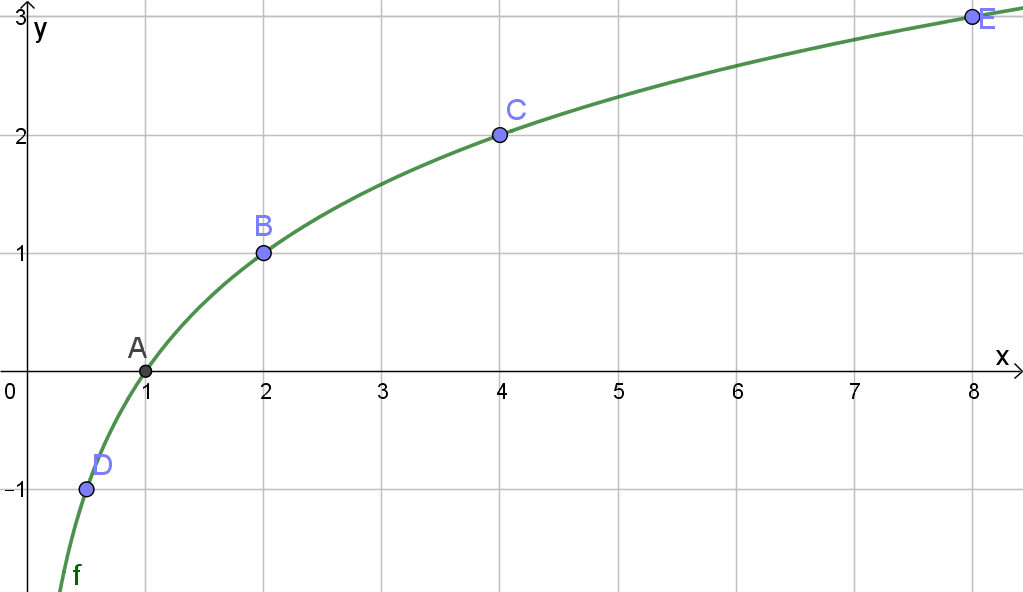
Sketch the graph of the function f(x)=log2(x)f(x)=\log_2(x).

Q2

Determine the xx-intercept of the function

  1. f(x)=log6(x)1.2f(x)=\log_6(x)-1.2

  2. g(x)=3log2(x)12g(x)=3^{\log_2(x)}-12

Solution
A1
A2
  1. Find xx with

    f(x)=log6(x)1.2=0f(x)=\log_6(x)-1.2=0

    Let's solve this equation:

    log6(x)1.2=0+1.2log6(x)=1.26()6log6(x)=61.2x=8.585...\begin{array}{lll} \log_6(x)-1.2&=&0 \quad\vert +1.2\\ \log_6(x)&=&1.2\quad\vert 6^{()}\\ 6^{\log_6(x)}&=&6^{1.2}\\ x&=&\underline{8.585...} \end{array}
  2. Find xx with

    g(x)=3log2(x)12=0g(x)=3^{\log_2(x)}-12=0

    Let's solve this equation:

    3log2(x)12=0+123log2(x)=12log3(.)log3(3log2(x))=log3(12)log2(x)=log3(12)2()2log2(x)=2log3(12)x=4.7960...\begin{array}{lll} 3^{\log_2(x)}-12&=&0 \quad\vert +12\\ 3^{\log_2(x)}&=&12\quad\vert \log_3(.)\\ \log_3(3^{\log_2(x)})&=&\log_3(12)\\ \log_2(x)&=&\log_3(12)\quad\vert 2^{()}\\ 2^{\log_2(x)}&=&2^{\log_3(12)}\\ x&=& \underline{4.7960...} \end{array}