Degrees and radians
We discuss two methods for describing the position of a point on a circle (see figure below): we can use the angle (whose unit is degrees and the symbol , this is nothing new), or we can use the arc length (which is new, the unit is radians and the symbol is rad).
It is similar to expressing the length of a road in meters or kilometres. The length of the road is the same, but we use different units to express this same length. Degrees and radians are also just two different units to express the same thing: the position of a point on a circle.
Unit circles
So assume we have a point on a circle, where we restrict ourselves to unit circles (radius ). The circumference of the unit circle is
Also, define the point furthest to the right on the circle as the starting point, and draw a horizontal and vertical axis through the center of the circle.
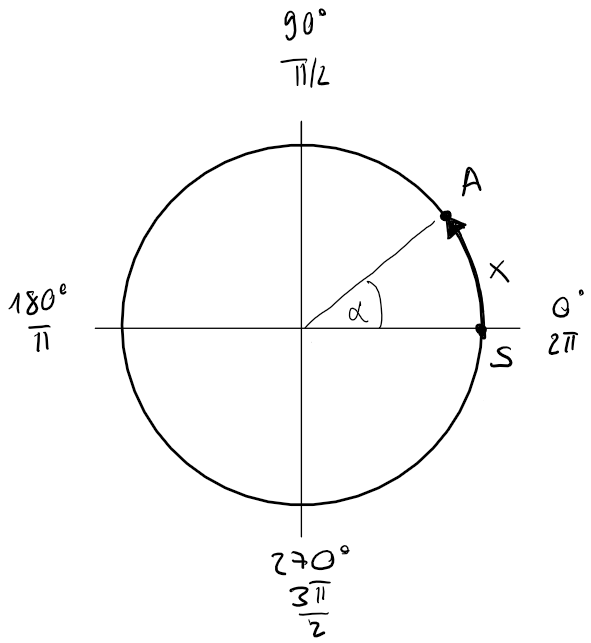
We can describe the position of relative to using two measurements:
Angle
We determine the angle given by the origin of the circle and the two points and (see figure above). Angles are expressed in degrees (symbol ), where corresponds to a full rotation.
Example: Point in the figure above is at about degrees or at about .
Arc length
We determine the length of the arc from to . The arc length is expressed in radians (symbol ), where corresponds to a full rotation.
Example: Point in the figure above is at about radians or at about .With we can also say that is at about radians or at about .
-
While angles are always written with a , for radians we normally skip the : point is at or at or at .
-
For a positive angle or a positive arc length we start at and walk in counterclockwise direction, for negative angles and arc lengths we walk in clockwise direction.
-
The position of a point on the circle can be described by an infinite number of degrees or radians. For example, point at is also at or . The same point is also at , or radians.
-
Conversion degrees radians (rule of three): If point is at , we have
-
Conversion radians degrees (rule of three): If point is at radians, we have
Thus, the general conversion formulas are as follows:
-
Draw a unit circle in a coordinates system, such the centre of the circle is at . Show that the points , , , , , , , and are on a unit circle, and express their location in degrees and radians.
-
Draw a unit circle and indicate a point on the unit circle at , , , and .
-
Draw a unit circle and indicate a point on the unit circle at , , , , , and .
-
Indicate a point at on the unit circle. Express this location in degrees.
-
Indicate a point at on the unit circle. Express this location in radians.
Solution