Orthogonal vectors

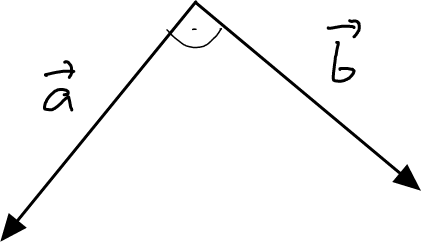
Two (non-zero) vectors a\vec{a} and b\vec{b} are called orthogonal (or perpendicular), written

ab\vec{a} \perp \vec{b}

if the angle between the vectors is a right angle (that is, α=90\alpha = 90^\circ.

Recall that cos(α)=0\cos(\alpha)=0 if, and only if α=90,270,...\alpha=90^\circ, 270^\circ, ..., so if, and only if the angle is a right angle. And because of the angle formula

cos(α)=abab\cos(\alpha)=\frac{\vec{a}\bullet \vec{b}}{\vert\vec{a}\vert\cdot \vert\vec{b}\vert}

the following important theorem follows:

ab if, and only if, ab=0\boxed{\vec{a} \perp \vec{b}\text{ if, and only if, } \vec{a}\bullet \vec{b}=0}
Example 1

The vectors (234)\left(\begin{array}{r} 2\\ 3\\ 4 \end{array}\right) and (043)\left(\begin{array}{r} 0\\ -4\\ 3 \end{array}\right) are orthogonal, because

(234)(043)=20+3(4)+43=0\left(\begin{array}{r} 2\\ 3\\ 4 \end{array}\right) \bullet \left(\begin{array}{r} 0\\ -4\\ 3 \end{array}\right)=2\cdot 0+ 3\cdot(-4)+ 4\cdot 3 =0
Exercise 1
Q1

Are the vectors (123)\left(\begin{array}{r} 1\\ -2\\ 3 \end{array}\right) and (213)\left(\begin{array}{r} 2\\ 1\\ -3 \end{array}\right) orthogonal?

Q2

Find at least one non-zero vector that is orthogonal to a=(312)\vec{a}=\left(\begin{array}{r} 3\\ 1\\ -2 \end{array}\right). How many such vectors exist and what geometrical object is formed by all these vectors if attached to the origin?

Q3

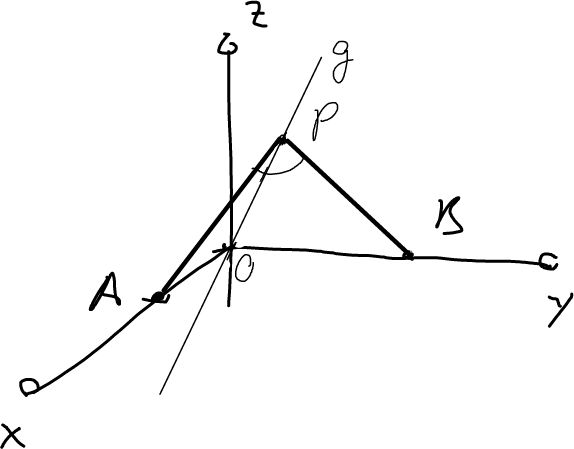
Consider the points A(200)A(2\vert 0\vert 0) and B(030)B(0 \vert 3 \vert 0), and the straight line gg that passes through the origin and has direction v=(011)\vec{v}=\left(\begin{array}{r} 0\\ 1\\ 1 \end{array}\right). Find all points PP on gg such that the segments APAP and BPBP form a right angle.

Solution
A1

(123)(213)=12+(2)1+3(3)0\left(\begin{array}{r} 1\\ -2\\ 3 \end{array}\right) \bullet \left(\begin{array}{r} 2\\ 1\\ -3 \end{array}\right)=1\cdot 2+ (-2)\cdot 1+ 3\cdot (-3) \neq 0, so not orthogonal.

A2

Find vector b\vec b with

ab=3bx+by2bz=0\vec a \bullet \vec b=3b_x+b_y-2b_z=0

e.g. bx=0,by=1b_x=0, b_y=1, thus bz=0.5b_z=0.5 or bx=1,by=1b_x=1, b_y=1, thus bz=2b_z=2, and so on. Just assign bxb_x and bzb_z some numbers, and then calculate bzb_z from the equation above. Clearly, there are infinitely many such vectors.

A3

Find point P(xyz)P(x\vert y\vert z) with PP on gg and APBP\overrightarrow{AP} \perp \overrightarrow{BP} (see figure).

  1. As PP on gg, there is a scalar cc with

    P=O+cv\vec P = \vec O +c\cdot \vec v (xyz)=(000)+c(011)=(0cc)\left(\begin{array}{r} x\\ y\\ z \end{array}\right) = \left(\begin{array}{r} 0\\ 0\\ 0 \end{array}\right) + c\cdot \left(\begin{array}{r} 0\\ 1\\ 1 \end{array}\right) = \left(\begin{array}{r} 0\\ c\\ c \end{array}\right)

    and thus

    x=0y=cz=c\begin{array}{r} x=0\\y=c\\z=c \end{array}
  2. From APBP\overrightarrow{AP} \perp \overrightarrow{BP} follows

    APBP=0\overrightarrow{AP} \bullet \overrightarrow{BP} =0 (2cc)(0c3c)=0\left(\begin{array}{r} -2\\ c\\ c \end{array}\right)\bullet \left(\begin{array}{r} 0\\ c-3\\ c \end{array}\right) = 0 0+c(c3)+c2=00+c(c-3)+c^2 = 0 2c23c=02c^2-3c=0

    Solving this quadratic equation we get c1=0c_1=0 and c2=1.5c_2=1.5. It follows P1=(000)P_1=\underline{(0 \vert 0 \vert 0)} and P2=(01.51.5)P_2=\underline{(0\vert 1.5\vert 1.5)}.