Planes

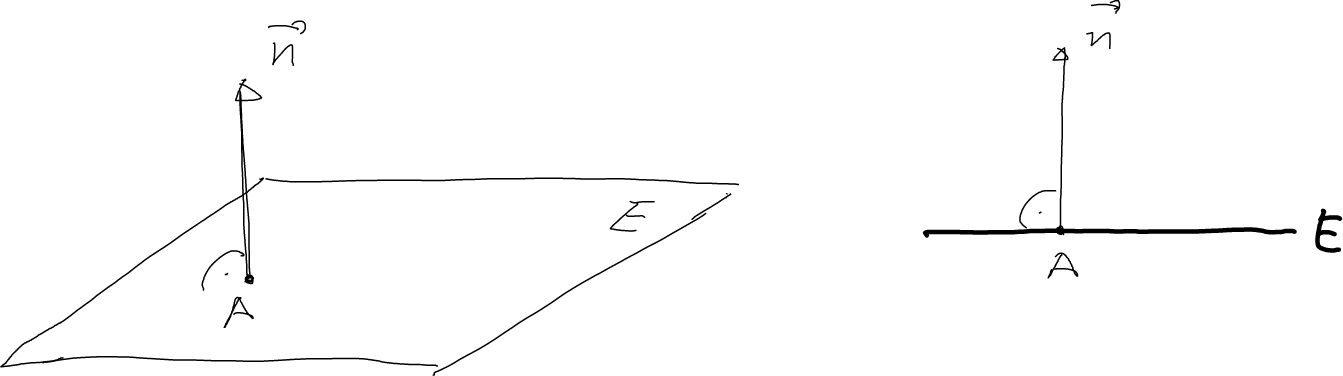
The position of a given plane EE in space is completely determined by a point AA on this plane, and any vector n\vec n that forms a right angle with the plane. This vector is called a normal vector of EE.

Note:

Make sure you understand the following examples.

Example 1
  1. The plane containing point A(001)A(0\vert 0\vert 1) and with normal vector n=(001)\vec{n}=\left(\begin{array}{r} 0\\ 0\\ 1 \end{array}\right) is parallel to the xyxy-plane.

  2. The plane containing point A(001)A(0\vert 0\vert 1) and with normal vector n=(0010)\vec{n}=\left(\begin{array}{r} 0\\ 0\\ -10 \end{array}\right) is the same plane as above.

  3. The yzyz-plane has the normal vector n=(100)\vec{n}=\left(\begin{array}{r} 1\\ 0\\ 0 \end{array}\right) or n=(0.100)\vec{n}=\left(\begin{array}{r} -0.1\\ 0\\ 0 \end{array}\right) or n=(140.32100)\vec{n}=\left(\begin{array}{r} 140.321\\ 0\\ 0 \end{array}\right).

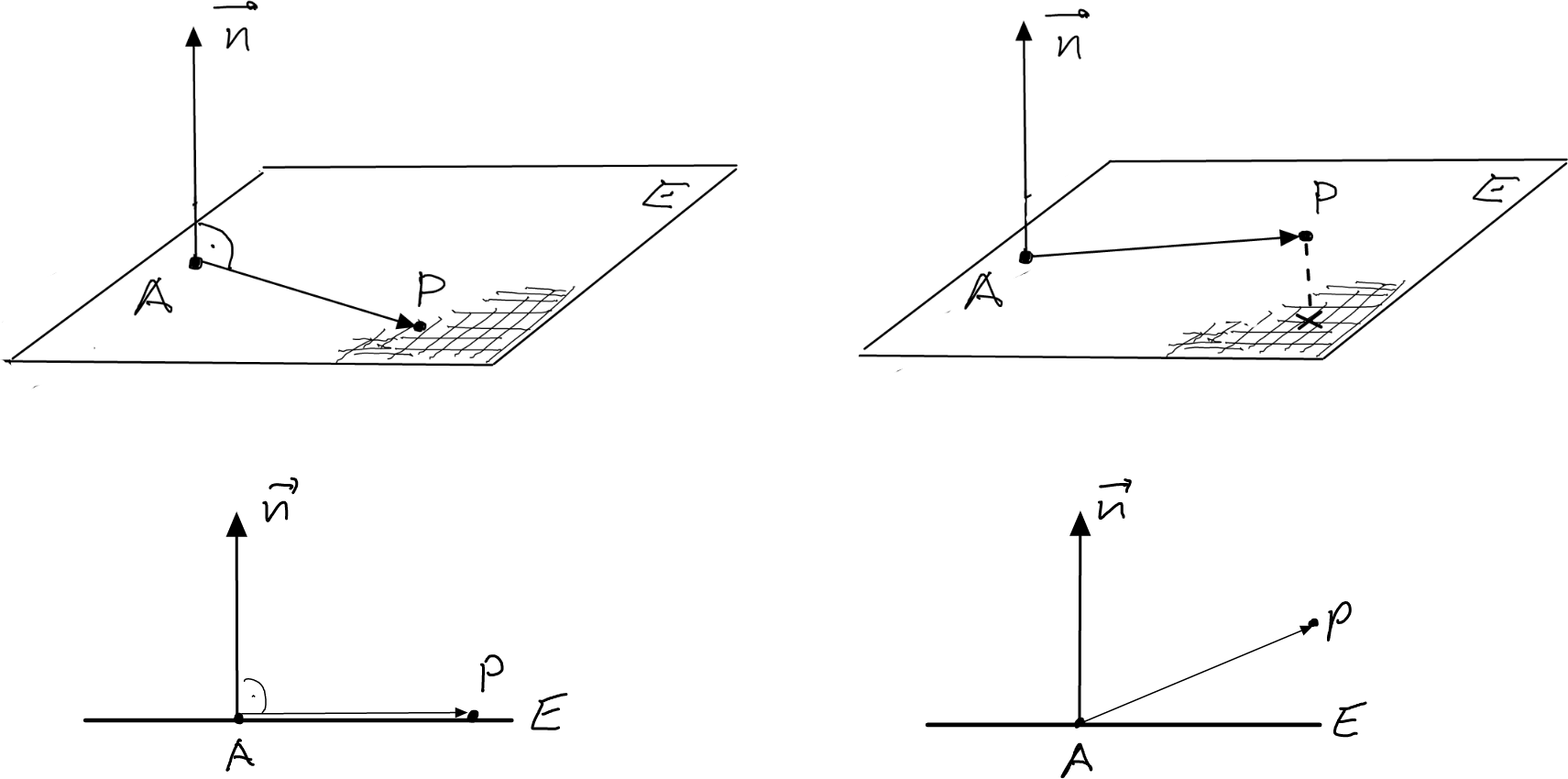
Consider a plane EE containing point AA and with normal vector n\vec n. How can we decide if some other point PP in also on the plane?

From the figure below we see that

PE if APn\boxed{P \in E\,\text{ if }\, \overrightarrow{AP} \perp \vec{n}}

Note that APn\overrightarrow{AP} \perp \vec{n} if

APn=(PA)n=0=(PxAxPyAyPzAz)(nxnynz)=0=(PxAx)nx+(PyAy)ny+(PzAz)nz=Pxnx+Pyny+Pznz(Axnx+Ayny+Aznz)=0\begin{array}{rll} \overrightarrow{AP} \bullet \vec{n} &=& (\vec{P}-\vec{A})\bullet \vec n=0\\ &=& \left(\begin{array}{r} P_x-A_x\\ P_y-A_y\\ P_z-A_z \end{array}\right)\bullet \left(\begin{array}{r} n_x\\ n_y\\ n_z \end{array}\right)=0\\ &=& (P_x-A_x)n_x+(P_y-A_y)n_y+(P_z-A_z)n_z\\ &=& P_x n_x + P_y n_y + P_z n_z -(A_x n_x+A_y n_y+A_z n_z)=0 \end{array}

So PP is in the plane EE if, and only if

nxPx+nyPy+nzPz=nxAx+nyAy+nzAz=d\boxed{n_x P_x + n_y P_y + n_z P_z=\underbrace{n_x A_x + n_y A_y + n_z A_z}_{=d}}

This is called the normal equation of the plane. Let us summarise:

Theorem 1

A plane EE with normal vector n\vec n contains point AA. Assume they are given, that is, we know their coordinates and components. A point P(xyz)P(x\vert y\vert z) is on EE if, and only if, its coordinates fulfil the normal equation

nxx+nyy+nzz=dn_x x+ n_y y+ n_z z = d

where dd is calculated as follows:

d=nxAx+nyAy+nzAzd=n_x A_x + n_y A_y + n_z A_z

Note that, as AA and n\vec{n} are known, so is the number dd.

Example 2

A plane EE passes through the point A(101)A(1\vert 0\vert 1) and has normal vector n=(745)\vec n=\left(\begin{array}{r} 7\\ -4\\ 5 \end{array}\right). Is point P(312)P(3\vert 1\vert 2) in EE?

Solution

Method 1: No, because

APn=(311021)(745)=144+5=150\overrightarrow{AP} \bullet \vec{n} = \left(\begin{array}{r} 3-1\\ 1-0\\ 2-1 \end{array}\right) \bullet \left(\begin{array}{r} 7\\ -4\\ 5 \end{array}\right) = 14-4+5=15\neq 0

thus AP⊥̸n\overrightarrow{AP} \not\perp \vec{n}.

Method 2: All points (xyz)(x\vert y \vert z) on EE fulfil the normal equation

nxx+nyy+nzz=dn_x x +n_y y+ n_z z= d

where nx=7,ny=4n_x=7, n_y=-4 and nz=5n_z=5 and dd is calculated as follows:

d=Axnx+Ayny+Aznz=71+(4)0+51=12\begin{array}{lll} d &=& A_x n_x + A_y n_y + A_z n_z\\ &=& 7\cdot 1+ (-4)\cdot 0+ 5\cdot 1 = 12 \end{array}

Thus, the normal equation is

7x4y+5z=127 x -4 y+ 5 z= 12

Inserting the coordinates of PP into the equation, we get

73+(4)1+52=27127\cdot 3+ (-4)\cdot 1+ 5\cdot 2 = 27 \neq 12

so PP is not in EE.

Example 3

A plane EE contains the point A(231)A(2\vert 3\vert -1) and has normal vector

n=(238)\vec n=\left(\begin{array}{r} 2\\ -3\\ 8 \end{array}\right)

Write down the normal equation of EE. Use the normal equation to find out if point U(1.540.5)U(1.5\vert 4\vert -0.5) in EE.

Solution

d=22+(3)3+8(1)=13d=2\cdot 2+(-3)\cdot 3+ 8\cdot (-1)=-13. Thus a point (xyz)(x \vert y\vert z) is in EE if, and only if

2x3y+8z=132x -3y + 8z = -13

This last equation is the normal equation of EE. To check if UU is in EE, we can insert its coordinates into the normal equation:

21.534+8(0.5)=132\cdot 1.5 - 3\cdot 4+8\cdot (-0.5)=-13

So yes, UU is in EE.

Example 4

A plane EE has the normal equation

5x2y+6z=25x-2y+6z=2

Find a normal vector of EE. Also, one point in EE.

Solution

A normal vector is

n=(526)\vec n=\left(\begin{array}{r} 5\\ -2\\ 6 \end{array}\right)

Any point P(xyz)P(\vert x \vert y \vert z) with

5x2y+6z=25x-2y+6z=2

is in EE. So for example, let's use x=0x=0 and y=1y=1, so we have to find zz with

02+6z=20-2+6z=2

and it follows z=23z=\frac{2}{3}. Thus, one point in EE is P(0123)P(0\vert 1\vert \frac{2}{3}).

Exercise 1
Q1

A plane EE passes through the point A(141)A(1\vert 4 \vert 1) and has normal vector (845)\left(\begin{array}{r} 8\\ 4\\ 5 \end{array}\right).

  1. Write down the normal equation of EE.
  2. Find another point QQ in EE.
Q2

A plane FF contains the point A(300)A(3\vert 0\vert 0) and has normal vector n=(632)\vec{n}=\left(\begin{array}{r} 6\\ 3\\ 2 \end{array}\right).

  1. Write down the normal equation of FF.
  2. Is the point P(123)P(1\vert 2\vert 3) in FF?
  3. Is the point Q(246)Q(2\vert 4\vert 6) in FF?
  4. Where does FF intersect the y-axis?
Q3

Find a normal vector of EE, and also a point in EE:

  1. 2x+4yz=1-2x+4y-z=1
  2. 3x+3y+3z=33x+3y+3z=3
  3. x+y+z=0x+y+z=0
  4. x+y=3x+y=3
  5. z=1z=1
Q4

A plane EE contains the point C(241)C(2\vert 4\vert -1) and has normal vector n=(10520)\vec{n}=\left(\begin{array}{r} 10\\ -5\\ 20 \end{array}\right).

  1. Find the normal equation of EE.
  2. Decide if point P(132)P(1\vert 3\vert -2) is in EE.
Q5

The normal equations of two planes are shown below. Are the planes parallel?

3x2y4z=63x-2y-4z=66x+4y+8z=5-6x+4y+8z=5
Solution
A1
  1. The normal equation is 8x+4y+5z=d8x+4y+5z=d, where d=8+16+5=29d=8+16+5=29. Thus, we have

    8x+4y+5z=298x+4y+5z=29

    Every point (xyz)(x\vert y\vert z) which fulfils this equation is in EE.

  2. Choose, for example, x=0,y=0x=0, y=0, and thus 5z=295z=29 and therefore z=5.8z=5.8. One point in EE is therefore Q(005.8)Q(0\vert 0\vert 5.8).

A2
  1. The normal equation is 6x+3y+2z=d6x+3y+2z=d, where d=36=18d=3\cdot 6=18. Thus, we have

    6x+3y+2z=186x+3y+2z=18
  2. Insert the coordinates of P(123)P(1\vert 2\vert 3) into the normal equation, and check if the result is d=18d=18:

    61+32+23=186\cdot 1+3\cdot 2+2\cdot 3=18

    Indeed, so PFP \in F.

  3. Insert the coordinates of Q(246)Q(2\vert 4\vert 6) into the normal equation, and check if the result is d=18d=18:

    62+34+26186\cdot 2+3\cdot 4+2\cdot 6 \neq 18

    So Q∉FQ \not\in F.

  4. Let us denote the intersection point by SS. As SS is on the yy-axis, it must have the coordinates S(0Sy0)S(0\vert S_y\vert 0). As SS is in FF, it must fulfil the normal equation of FF:

    0+3Sy+0=180 +3\cdot S_y+0 =18

    It follows that Sy=6S_y=6. So FF intersects the yy-axis at y=6y=\underline{6}.

A3
  1. 2x+4yz=1-2x+4y-z=1, thus n=(241)\vec n = \left(\begin{array}{c} -2\\ 4\\ -1\end{array}\right), e.g. P(111)EP(1\vert 1\vert 1)\in E.
  2. 3x+3y+3z=33x+3y+3z=3, thus n=(333)\vec n = \left(\begin{array}{c} 3\\ 3\\ 3\end{array}\right), e.g. P(102)EP(-1\vert 0\vert 2)\in E.
  3. 1x+1y+1z=01 x+1 y+1 z=0, thus n=(111)\vec n = \left(\begin{array}{c} 1\\ 1\\ 1\end{array}\right), e.g. P(000)EP(0\vert 0\vert 0)\in E.
  4. 1x+1y+0z=31 x+1 y+0 z=3, thus n=(110)\vec n = \left(\begin{array}{c} 1\\ 1\\ 0\end{array}\right), e.g. P(21100)EP(2\vert 1\vert 100)\in E.
  5. 0x+0y+1z=10x+0y+1z=1, thus n=(001)\vec n = \left(\begin{array}{c} 0\\ 0\\ 1\end{array}\right), e.g. P(10.410001)EP(10.4\vert 1000\vert 1)\in E.
A4
  1. Normal equation: 10x5y+20x=2010x-5y+20x=-20.

  2. Insert P(132)P(1\vert 3\vert -2) into the equation and check if result is 20-20:

    10153+20(2)2010\cdot 1-5\cdot 3+20\cdot(-2)\neq -20

    So P∉EP \not\in E.

A5

Two planes are parallel if their normal vectors are collinear. Normal vector of first plane is n=(324)\vec n = \left(\begin{array}{c} 3\\ -2\\ -4\end{array}\right), normal vector of second plane is m=(648)\vec m = \left(\begin{array}{c} -6\\ 4\\ 8\end{array}\right). They are collinear, so the planes are parallel.