Calculus - Basic functions 2

Q1: Types of functions

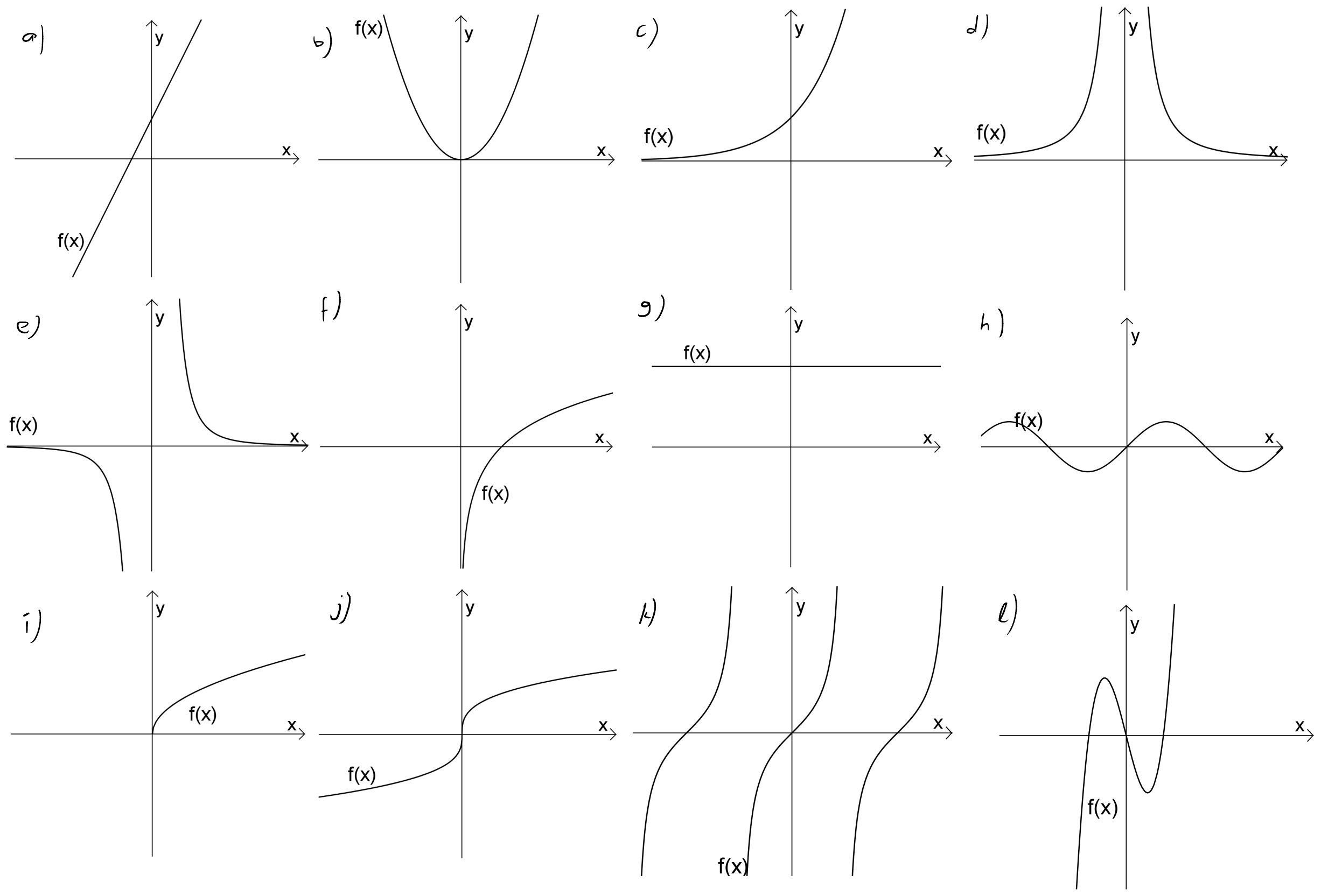
Match each graph below to one of the basic functions shown in the list (there are more functions in the list than there are graphs).

2,2,2x+1,2x+1,2x1,2x1,x2,x3,x2,x32, -2, 2x+1, -2x+1, 2x-1, -2x-1, x^2, x^3, x^{-2}, x^{-3} x1/2,x1/3,ex,ln(x),sin(x),cos(x),tan(x),x34x,x24xx^{1/2}, x^{1/3}, e^x, \ln(x), \sin(x), \cos(x), \tan(x), x^3-4x, x^2-4x

Also, determine for each function (a)-(l) the xx-intercepts, yy-intercept, the derivative and the antiderivative.
Show
Solution 1

We denote the antiderivative by FF, the yy-intercept by y0y_0 and the xx-intercept(s) by x0,x1,...x_0, x_1, ...

1a)

f(x)=2x+1f(x)=2x+1, y0=1,x0=0.5y_0=1, x_0=-0.5, f(x)=2f^\prime(x)=2, F(x)=x2+xF(x)=x^2+x

1b)

f(x)=x2f(x)=x^2, x0=y0=0x_0=y_0=0, f(x)=2xf'(x)=2x, F(x)=13x3F(x)=\frac{1}{3}x^3

1c)

f(x)=exf(x)=e^x, y0=1y_0=1, f(x)=exf'(x)=e^x, F(x)=exF(x)=e^x

1d)

f(x)=x2=1x2f(x)=x^{-2}=\frac{1}{x^2}, f(x)=2x3=2x3f'(x)=-2x^{-3}=-\frac{2}{x^3}, F(x)=x1=1xF(x)=-x^{-1}=-\frac{1}{x}

1e)

f(x)=x3=1x3f(x)=x^{-3}=\frac{1}{x^3}, f(x)=3x4=3x4f'(x)=-3x^{-4}=-\frac{3}{x^4}, F(x)=12x2=12x2F(x)=-\frac{1}{2}x^{-2}=-\frac{1}{2x^2}

1f)

f(x)=ln(x)f(x)=\ln(x), x0=1x_0=1, f(x)=1xf'(x)=\frac{1}{x}, F(x) skip, not requiredF(x)\text{ skip, not required}

1g)

f(x)=2=2x0f(x)=2=2x^0, y0=2y_0=2, f(x)=0f'(x)=0, F(x)=2xF(x)=2x

1h)

f(x)=sin(x)f(x)=\sin(x), y0=0y_0=0, x0=0,x1=±π,x2=±2π,...x_0=0, x_1=\pm\pi, x_2=\pm 2\pi, ..., f(x)=cos(x)f'(x)=\cos(x), F(x)=cos(x)F(x)=-\cos(x)

1i)

f(x)=x1/2=xf(x)=x^{1/2}=\sqrt{x}, x0=y0=0x_0=y_0=0, f(x)=12x1/2=12xf'(x)=\frac{1}{2}x^{-1/2}=\frac{1}{2\sqrt{x}}, F(x)=23x3/2=23x3F(x)=\frac{2}{3}x^{3/2}=\frac{2}{3}\sqrt{x^3}

1j)

f(x)=x1/3=x3f(x)=x^{1/3}=\sqrt[3]{x}, x0=y0=0x_0=y_0=0, f(x)=13x2/3=13x23f'(x)=\frac{1}{3}x^{-2/3}=\frac{1}{3\sqrt[3]{x^2}}, F(x)=34x4/3=34x43F(x)=\frac{3}{4}x^{4/3}=\frac{3}{4}\sqrt[3]{x^4}

1k)

f(x)=tan(x)f(x)=\tan(x), y0=0,x0=0,x1=±π,x2=±2π,...y_0=0, x_0=0, x_1=\pm\pi, x_2=\pm 2\pi, ... (because tan(x)=sin(x)cos(x)\tan(x)=\frac{\sin(x)}{\cos(x)}).

To find the derivative, we apply the product rule and chain rule to the function

f(x)=tan(x)=sin(x)cos(x)=sin(x)(cos(x))1f(x)=\tan(x)=\frac{\sin(x)}{\cos(x)}=\sin(x)\cdot (\cos(x))^{-1}

thus

f(x)=cos(x)(cos(x))1+sin(x)(1)(cos(x))2(sin(x))=1+sin(x)2cos(x)2=1+tan(x)2\begin{array}{lll} f'(x)&=&\cos(x)\cdot(\cos(x))^{-1}\\ &+&\sin(x)\cdot (-1)(\cos(x))^{-2}\cdot (-\sin(x))\\ &=&1+\frac{\sin(x)^2}{\cos(x)^2}\\ &=&1+\tan(x)^2 \end{array}

Calculating the antiderivative is more difficult, and you do not have to know how to do this.

1l)

f(x)=x34xf(x)=x^3-4x, y0=f(0)=0y_0=f(0)=0. To find x0x_0, we write f(x)=x(x24)=0f(x)=x(x^2-4)=0, and it follows x0=0,x1=±2x_0=0, x_1=\pm 2. f(x)=3x24f'(x)=3x^2-4, F(x)=14x4412x2=14x42x2F(x)=\frac{1}{4}x^4-4\frac{1}{2}x^2=\frac{1}{4}x^4-2x^2

Q2: From the graph to the function equation

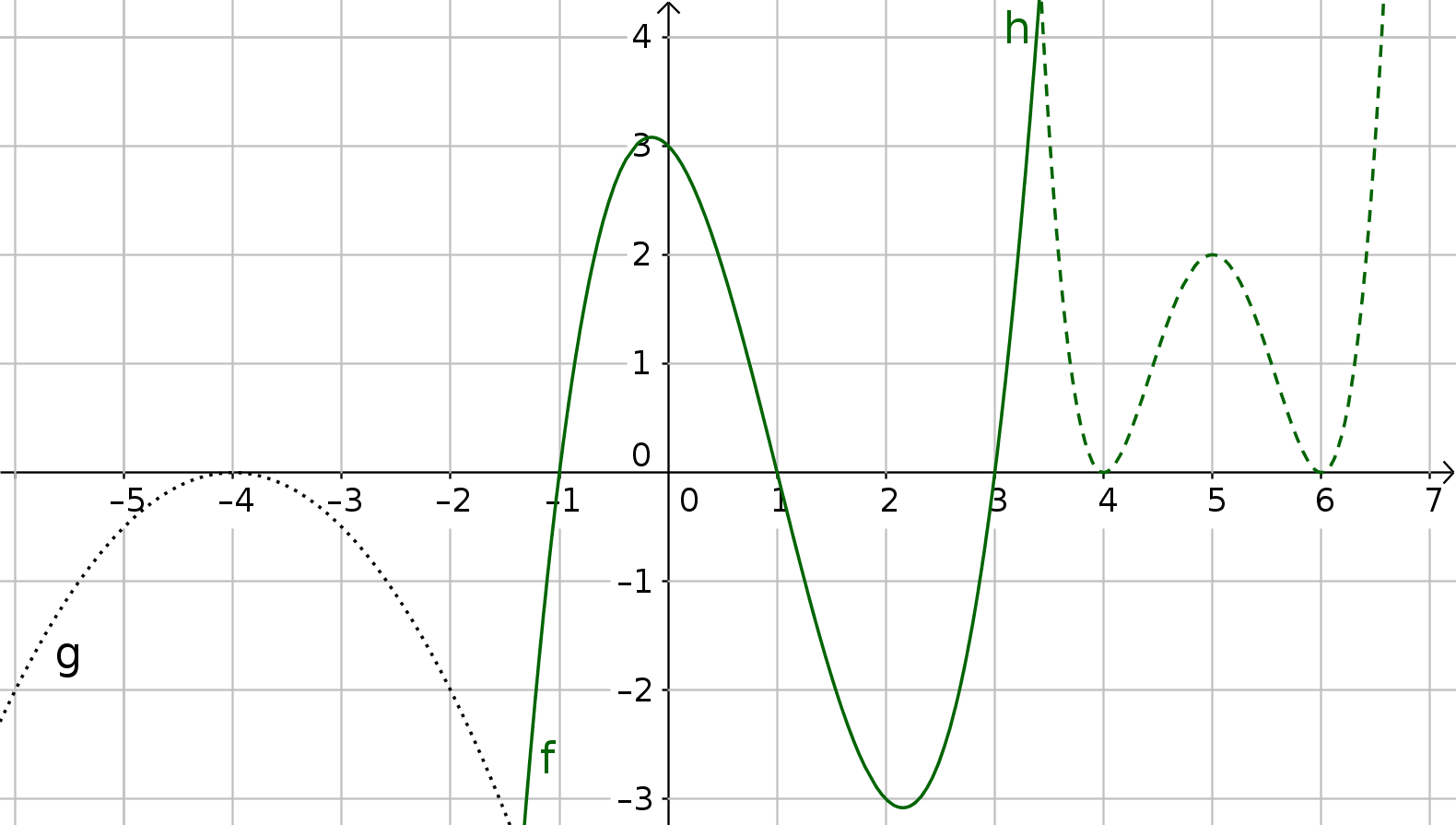
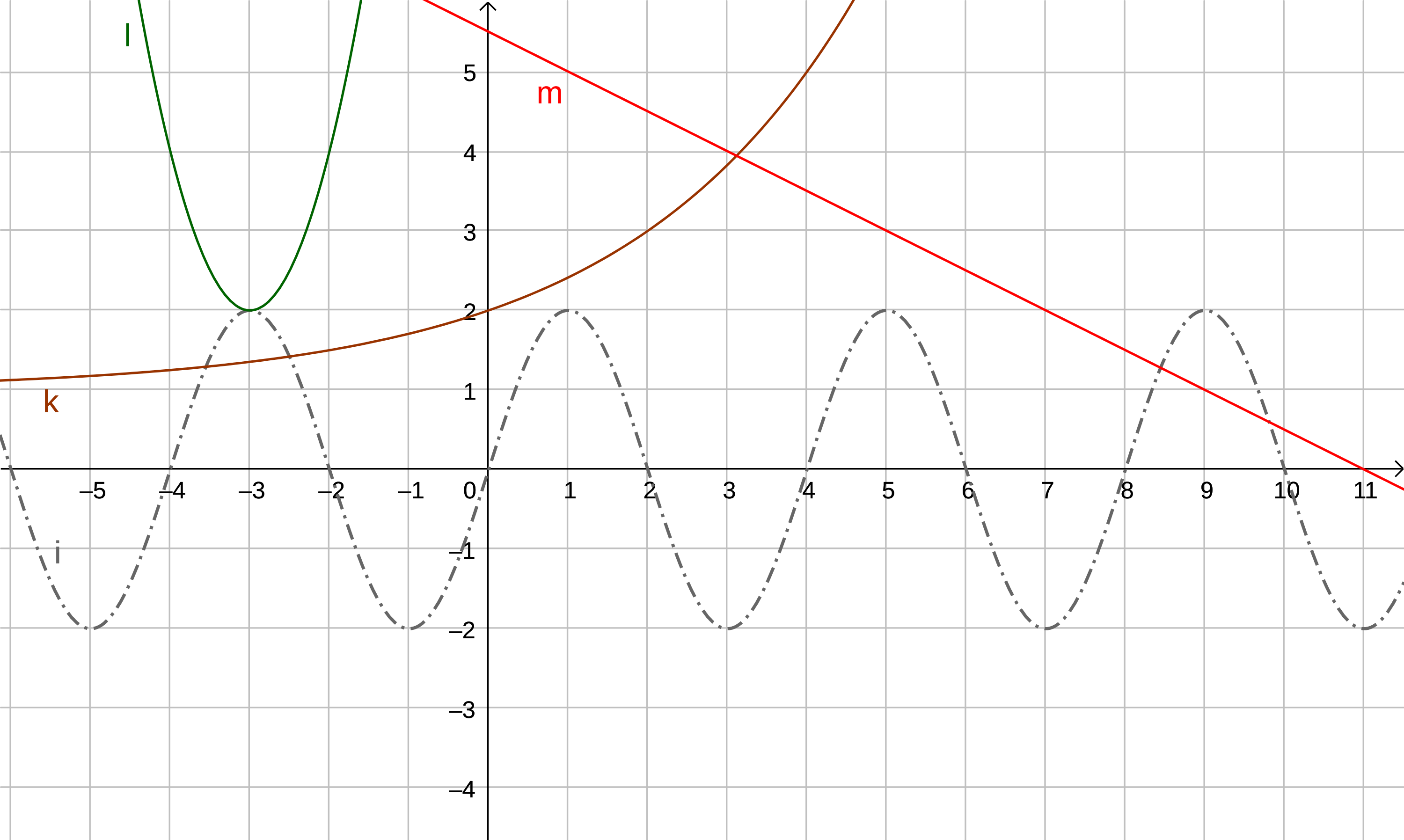
Shown below are the graphs of several functions. If it is a power function or a polynomial, the smallest possible exponent was used. Determine the function equations of each graph.
Show
Solution 2
2f)

Polynomial: f(x)=a(x+1)(x1)(x3)f(x)=a(x+1)(x-1)(x-3). From f(0)=3f(0)=3 follows a(1)(1)(3)=3a=1a(1)(-1)(-3)=3\rightarrow a=1.

2g)

Polynomial or quadratic function (the graph is a parabola): g(x)=a(x+4)2g(x)=a(x+4)^2 (the square because the graph touches the xx-axis at 4-4). Because of g(2)=2g(-2)=-2 follows a(2)2=2a=0.5a(2)^2=-2\rightarrow a=-0.5

2h)

Polynomial: h(x)=a(x4)2(x6)2h(x)=a(x-4)^2(x-6)^2 (squares because of touch points). Because h(5)=2h(5)=2 follows a(1)2(1)2)=2a=2a(-1)^2(1)^2)=2\rightarrow a=2

2i)

Sine function, but scaled in xx-direction by some factor uu, f(x)=2sin(ux)f(x)=2\sin(ux):

f(0)=sin(u0)=0f(2)=sin(u2)=0f(4)=sin(u4)=0...\begin{array}{lll} f(0)&=&\sin(u\cdot 0)=0\\ f(2)&=&\sin(u\cdot 2)=0\\ f(4)&=&\sin(u\cdot 4)=0\\ ... \end{array}

Because we know that

sin(0)=0sin(π)=0sin(2π)=0...\begin{array}{lll} \sin(0)&=&0\\ \sin(\pi)&=&0\\ \sin(2\pi)&=&0\\ ... \end{array}

choose uu such that

f(0)=sin(u00)=0f(2)=sin(u2π)=0f(4)=sin(u42π)=0...\begin{array}{lll} f(0)&=&\sin(\underbrace{u\cdot 0}_{0})=0\\ f(2)&=&\sin(\underbrace{u\cdot 2}_{\pi})=0\\ f(4)&=&\sin(\underbrace{u\cdot 4}_{2\pi})=0\\ ... \end{array}

thus it is u=π2u=\frac{\pi}{2}. It is f(x)=sin(π2x)f(x)=\sin(\frac{\pi}{2}x). Note that the graph is also stretched in yy-direction by factor 22, so we have the final result

f(x)=2sin(π2x)f(x)=2\sin(\frac{\pi}{2}x)
2k)

Exponential function passing through the points A(02)A(0|2) and B(23)B(2|3). If we interpret these points as an exponential growth process,

quantity y23time x02\begin{array}{r|l|l} \text{quantity }y & 2 & 3 \\\hline \text{time }x & 0 & 2 \end{array}

We get a growth rate of u=3/2=1.5u=3/2=1.5, and thus we have

k(x)=21.5x/2k(x)=2\cdot 1.5^{x/2}
2m)

Linear function: m(x)=ax+bm(x)=ax+b with slope a=12=0.5a=\frac{-1}{2}=-0.5. Thus we have

m(x)=0.5x+bm(x)=-0.5x+b

To find bb, we note that m(1)=5m(1)=5, and thus 0.51+b=5-0.5\cdot 1+b=5, and thus b=5.5b=5.5. It is

m(x)=0.5x+5.5m(x)=-0.5x+5.5
2l)

Quadratic function.

Approach 1: Because of lack of xx-intercepts, we take the approach

l(x)=ax2+bx+cl(x)=ax^2+bx+c

We have (see graph)

f(3)=29a3b+c=2f(-3)=2 \rightarrow 9a-3b+c=2f(2)=44a2b+c=4f(-2)=4 \rightarrow 4a-2b+c=4f(4)=416a4b+c=4f(-4)=4 \rightarrow 16a-4b+c=4

From equation (1) follows c=29a+3bc=2-9a+3b and inserting this into equations (2) and (3) we get

4a2b+29a+3b=45a+b=24a-2b+2-9a+3b=4 \rightarrow -5a+b=216a4b+29a+3b=47ab=216a-4b+2-9a+3b=4\rightarrow 7a-b=2

And from these two equations follows b=2+5ab=2+5a and therefore

7a25a=2a=27a-2-5a=2 \rightarrow a=2

and thus b=2+52=12b=2+5\cdot 2=12 and c=292+312=20c=2-9\cdot 2+3\cdot 12=20. Thus we have

l(x)=2x2+12x+20l(x)=\underline{2x^2+12x+20}

Approach 2: We shift the graph down by 22, so that it touches the xx-axis at 3-3. This graph also passes through the point (22)(-2|2). Thus, for this shifted graph we have

L(x)=a(x+3)2L(x)=a(x+3)^2

and

L(2)=2a(1)2=2a=2L(-2)=2 \rightarrow a(1)^2=2\rightarrow a=2

Thus we have L(x)=2(x+3)2L(x)=2(x+3)^2. Shifting the graph up by 22, we then get

l(x)=2(x+3)2+2l(x)=\underline{2(x+3)^2+2}

Indeed, if we expand, we get the result from the first approach:

2(x+3)2+2=2(x2+6x+9)+2=2x2+12x+202(x+3)^2+2=2(x^2+6x+9)+2=2x^2+12x+20
Q3: Transformation of graphs
  1. Consider the function f(x)=x2f(x)=x^2 and the related function shown below.By what geometrical operations (shift, reflect, stretch) can the graphs of gg, hh, ii, jj and kk be obtained from the graph of ff? If you do not know, draw the graphs (using a calculator or a table of values) to find out.
    1. g(x)=2x2g(x)=2x^2
    2. g(x)=x2+1g(x)=x^2+1
    3. g(x)=x2g(x)=-x^2
    4. g(x)=(x1)2g(x)=(x-1)^2
  2. Can you state the general rules? That is, by what geometrical operation applied to the graph of ff do I get the graph of gg? foperation?gf \xrightarrow[]{\text{operation?}}g
    1. g(x)=2f(x)g(x)=2 f(x)
    2. g(x)=f(x)+1g(x)=f(x)+1
    3. g(x)=f(x)g(x)=-f(x)
    4. g(x)=f(x1)g(x)=f(x-1)
Show
Solution 3
  1. stretch of graph ff in yy-direction by factor 22
  2. shift up of graph ff by 11
  3. reflect graph ff about xx-axis
  4. shift right of graph ff by 11
Q4: Equations

Solve without calculator:

  1. 3x+2=5x13x+2=5x-1
  2. 2x23x=02x^2-3x=0
  3. 2x26x=42x^2-6x=-4
  4. 2x34x=02x^3-4x=0
  5. 0.5x=0.5x10.5\sqrt{x}=0.5x-1
  6. 2x2/3+1=192x^{2/3}+1=19
  7. 32(x2)/3=243\cdot 2^{(x-2)/3}=24
  8. 4log10(2x+1)=84\log_{10}(2x+1)=8
  9. (x21)e10x=0(x^2-1)e^{10x}=0
Show
Solution 4
  1. All xx on one side, numbers on other side: 2x=3x=1.52x=3 \rightarrow x=1.5
  2. Quadratic equation, so midnight formula, or simpler, factor out xx: x(2x3)=0x1=0,x2=1.5x(2x-3)=0 \rightarrow x_1=0, x_2=1.5
  3. Quadratic equation, midnight formula: 2x26x+4=0x1,2=6±36324x1=2,x2=12x^2-6x+4=0 \rightarrow x_{1,2}=\frac{6\pm\sqrt{36-32}}{4}\rightarrow x_1=2, x_2=1
  4. Factor out 2x2x: 2x(x22)=0x1=0,x2=±22x(x^2-2)=0 \rightarrow x_1=0, x_2=\pm \sqrt{2}
  5. Divide both sides by 0.50.5: x=x2\sqrt{x}=x-2 and then square both sides: x=(x2)2=x24x+4x=(x-2)^2=x^2-4x+4. This is a quadratic equation: x25x+4=0x^2-5x+4=0. Using the midnight formula, we get x1=1x_1=1 and x2=4x_2=4. Inserting into the original equation, we see that only x=4x=4 works.
  6. Subtract both sides by 11, and then divide both sided by 22: x2/3=9x^{2/3}=9. Then raise both sides by 32\frac{3}{2}: (x2/3)3/2x=93/227\underbrace{(x^{2/3})^{3/2}}_{x}=\underbrace{9^{3/2}}_{27} It follows x=27x=27 (another solution is x=27x=-27).
  7. Divide both sides by 33: 2(x2)/3=82^{(x-2)/3}=8. Apply log2(.)\log_2(.) on both sides: log2(2(x2)/3)(x2)/3log2(2)=log2(8)3\underbrace{\log_2(2^{(x-2)/3})}_{(x-2)/3\cdot\log_2(2)} =\underbrace{\log_2(8)}_{3} Because of log2(2)=1\log_2(2)=1 and log2(8)=3\log_2(8)=3 we get the equation x23=3\frac{x-2}{3}=3 and it follows x=11x=11.
  8. Divide both sides by 4: log10(2x+1)=2102=2x+1\log_{10}(2x+1)=2 \rightarrow 10^2=2x+1, thus it follows x=49.5x=49.5
  9. As e(...)>0e^{(...)}>0, it must by x21=0x=±1x^2-1=0\rightarrow x=\pm 1.