Calculus - Basic problems 2
Q1: Basics of derivative and integral
Consider the function . You want to know the slope of the tangent to the graph of at . You also want to know the area enclosed by the graph of , the x-axis, and the vertical line at . Let's have a look at the different ways we can do this:
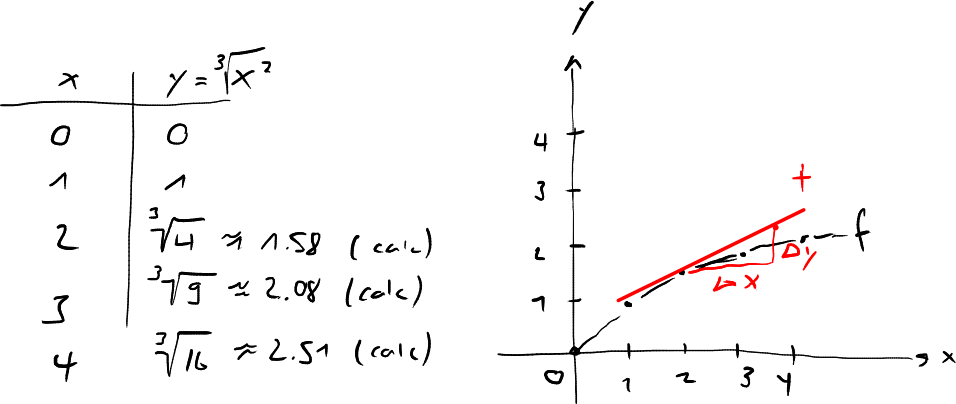
- Give a rough estimate of the slope by drawing the graph of the function (e.g. use a table of values to draw the graph).
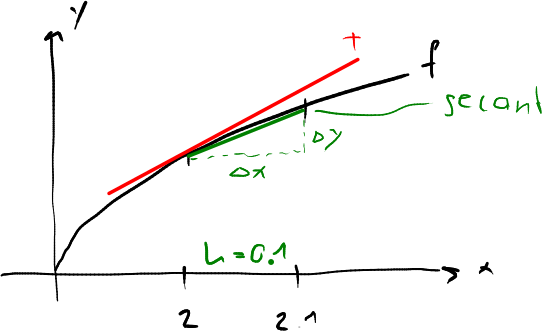
- Give a very good estimate of the slope using the difference quotient (secant ...).
- Determine the exact slope using the power rule for differentiation.
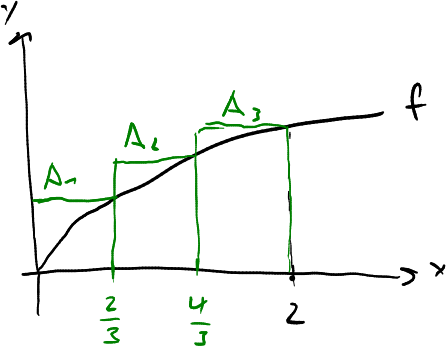
- Give a rough estimate of the area using 3 bars.
- Give a very good estimate of the area using the numerical integral function of the calculator (the calculator simply using many very thin bars ...).
- Determine the exact area using the theorem of calculus (antiderivative).
Show
Solution 1
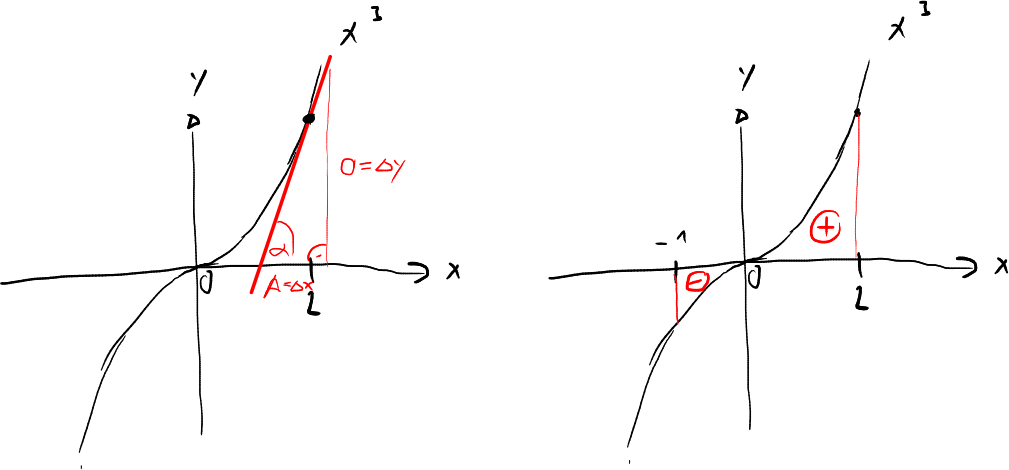
- Draw the graph and the tangent at (see below). Based on the figure, the slope of the tangent is
- We approximate the tangent by a secant by moving to the right by (see figure). The slope of the secant is an approximation of the slope of the tangent (the smaller the displacement , the better is the approximation). Using the slope triangle, we get for the slope of the secant
With and , we get
- The exact slope can be calculated using the rules of differentiation. With , we get
and thus
- Using three bars, the width of each bar has to be , and thus we get for the three bar areas:
Thus, an approximation of the area under the curve is
- Using the calculator, we get for the area under the curve:
- The exact value can be calculated using the fundamental theorem of calculus. The antiderivative of is
and thus
Note that the numerical estimate of the integral using the calculator (see 5) is normally really close to the exact value.
Q2: Tangents and areas
Consider the function .
- Find the slope of the tangent to the graph of at .
- Determine the angle in degrees between this tangent and the x-axis.
- Determine the equation of this tangent.
- Find the point where the graph of has a tangent of slope .
- Determine the definite integral .
- Determine the area enclosed by the x-axis, the graph of , and the vertical lines at and .
Show
Solution 2
The derivative of is , and the antiderivative is .
- The slope of the tangent at is
- The angle is (SOHCAHTOA, see graph at the bottom, left):
Thus,
- The equation of the tangent is a linear function: where the slope . Thus, it is
To find (the -intercept), we use the fact, that the tangent touches the graph of at , that is, we have
and thus
Thus, the equation of the tangent is .
- Find with
It follows . Thus, there are two tangents to the graph of with slope . One is at and .
- We have
- The integral gives the signed area. To find the area, we have to determine the area below the -axis and the one above the -axis individually (see figure below, right):
and
Thus, the area is .
Q3: Can you take the derivative of every function?
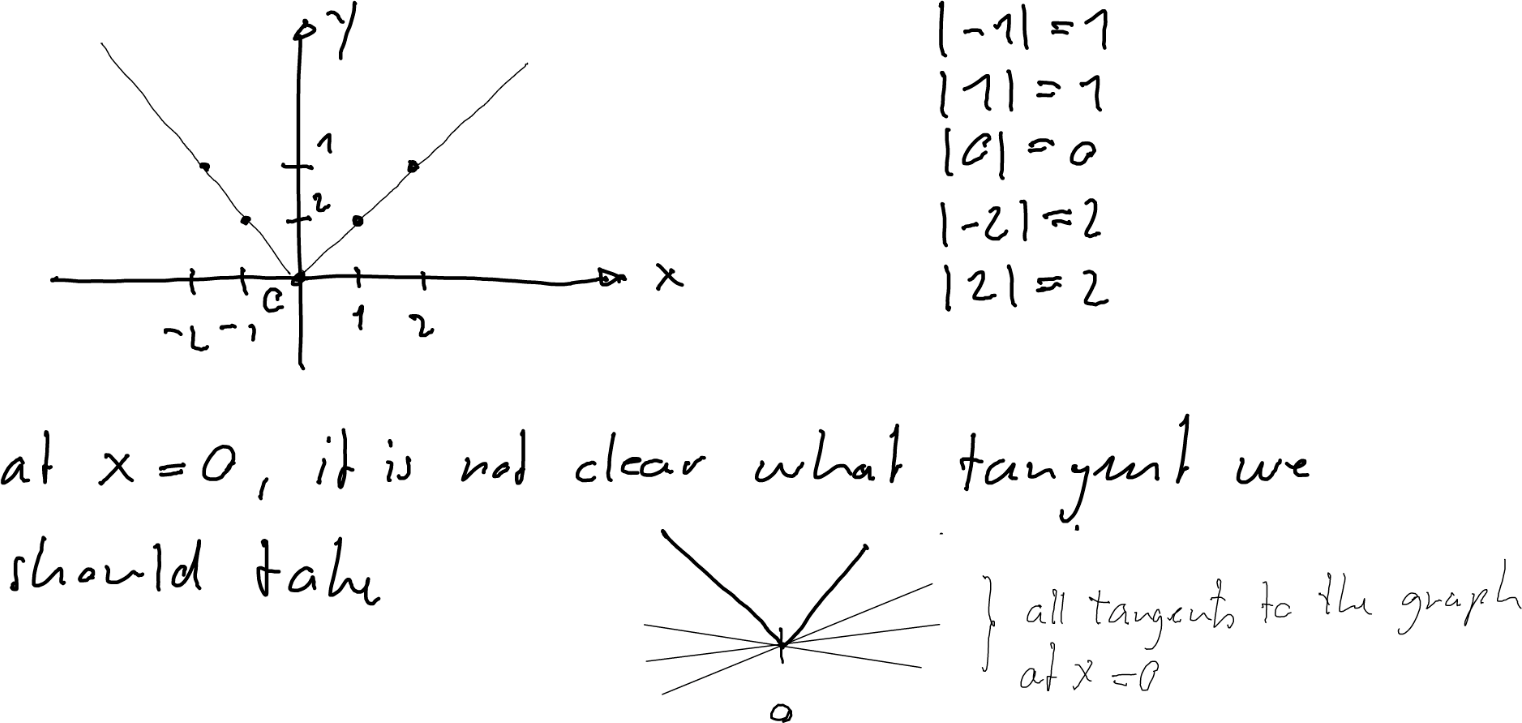
At which point has the function no derivative? Draw the graph and explain. Note: is called the absolute value of . It is the positive part of any number . For example and .
Show
Solution 3
See the figure below. At there is no single tangent to the graph of . Thus, in this case it is not clear what show be. We say that is not differentiable at . Everywhere else we can determine .
Q4: Differential rules
- State the 4 basic rules you can use to find the derivative of a function.
- Take the derivative of the following functions:
- for all
Show
Solution 4
- The four basic rules are
- Power rule:
- Sum rule:
or with coefficients and :
- product rule:
- chain rule:
- It is
-
-
-
-
-
-
-
- (chain rule)
- (chain rule)
- (product rule) or
-
-
- (product rule)
- (product rule)
- (chain rule)
- (chain rule)
- (chain rule)
- (chain rule). You can also use the product rule ... .
- (product rule and chain rule)
- (chain rule)
- (product rule and chain rule)
- (product rule and chain rule)
Q5: Integrals
- State the general rule for finding the antiderivative of a power function , and prove it.
- Find the antiderivative of the following power functions:
- for all
- Determine the following (definite) integrals using the fundamental theorem of calculus:
Show
Solution 5
Let's denote by the antiderivative of .
- It is
-
-
-
-
-
-
-
-
- The fundamental theorem of calculus:
-
-
-
-
-
-
Q6: Higher order derivatives, stationary points and inflection points
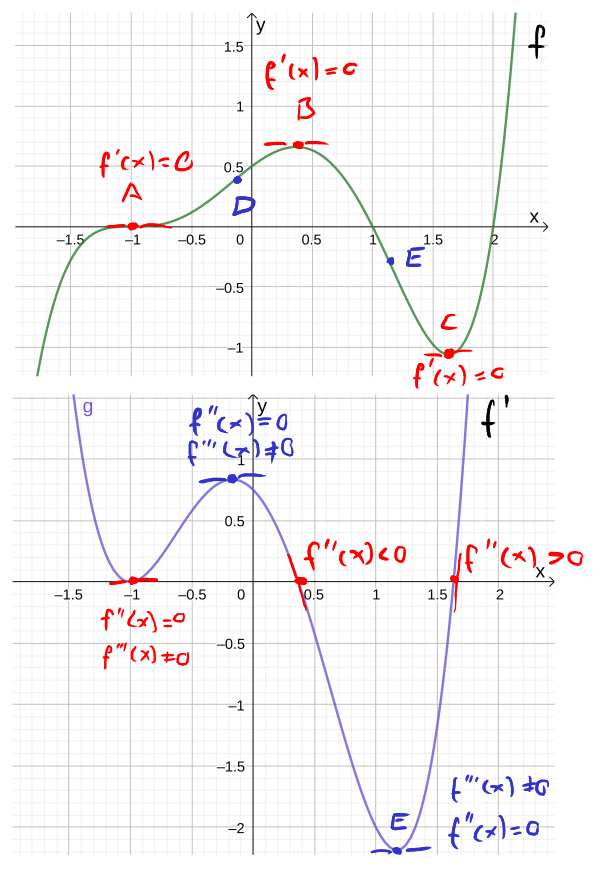
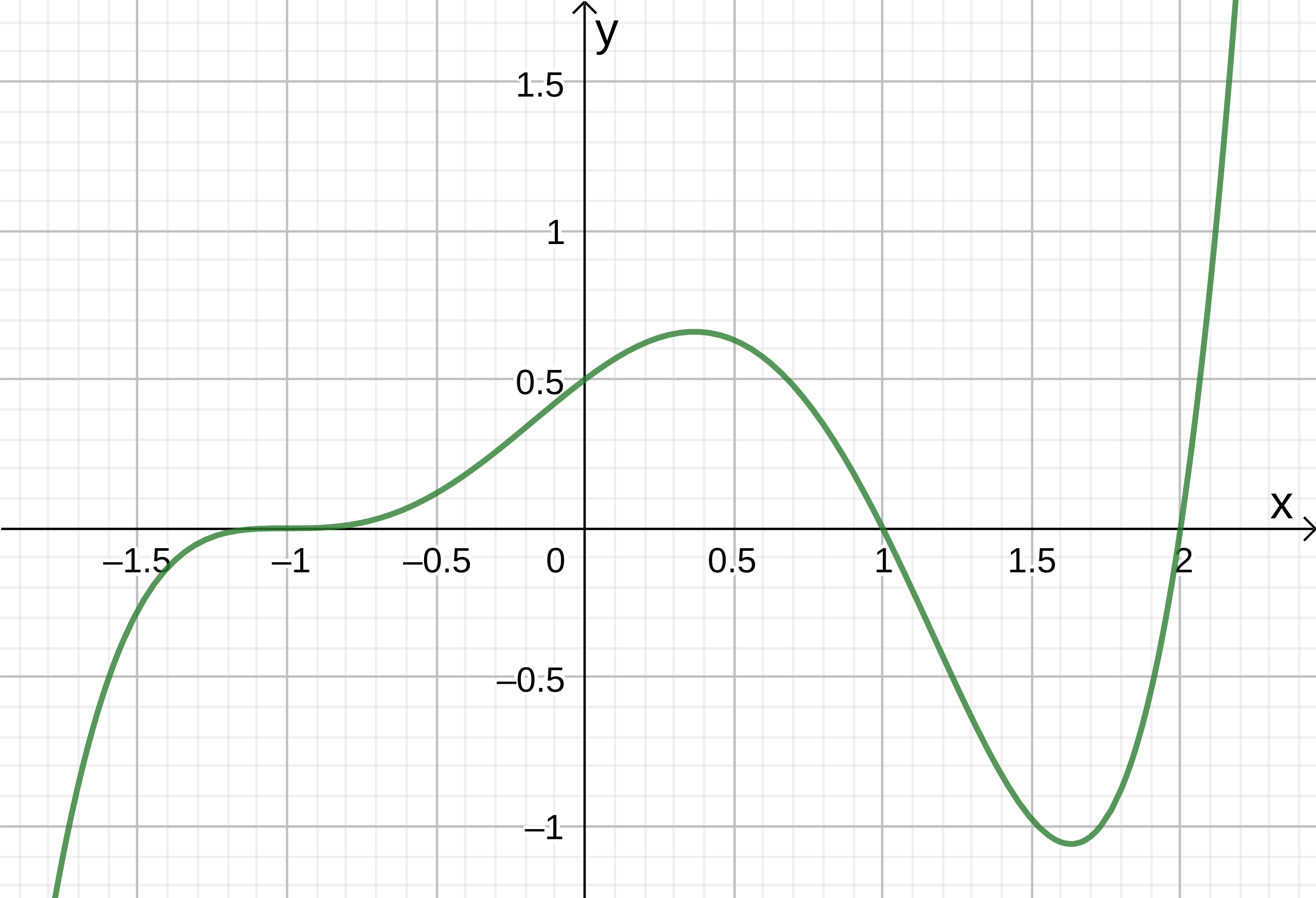
The graph of a function is shown below. Copy the graph.
- What are stationary points? What are inflection points? Indicate them on the graph below. Also, classify the stationary points as local maximum, local minimum, and saddle points.
- Sketch the graph of the first derivative. Use this graph to derive conditions for a local maximum, local minimum, saddle point and inflection point.
- Consider the function . Find the stationary points and classify them using the higher order derivatives. Also, find the inflection points.
As a side note: the graph of the figure below has the function equation .
Show
Solution 6
- It is
- A point on the graph of where the tangent is horizontal is called a stationary point of . It is a local maximum if it is the top of the hill, and a local minimum if it the bottom of a valley. It is a saddle point if it looks like a saddle, that is, it goes downwards if moving to the left and upwards if moving to the right (or vice versa). In the figure below, is a saddle point, is a local maximum and a local minimum.
- A point on the graph of where the slope of the tangent reaches its locally highest (or locally lowest) slope is called an inflection point of . Saddle points are inflection points and stationary points. In general, inflection points do not have to be stationary points. In the graph below, points , and are inflection points.
- From the sketch of the first derivative, we see the following for a point on the graph of :
-
If it might be a flat saddle point, local maxima or local minima. Draw the graph to decide.
- . , , .
- stationary points: Find with
thus and . The stationary points are and .
- local max/min/saddle pt? so is not a local extrema. Because we see that is a saddle point. . Thus, is a local max.
- Inflection points? Find with
thus and . The point at is a saddle point (see above). The point at is also an inflection point, because . Its coordinates are .