The probability function of RVs
We start with the definition of the probability distribution.
Consider a random variable of a random experiment, where can take on the possible (output) values . The set of probabilities
is called the probability function of . This because we can think of as a function with input values and output values .
The function
where the input is a real number is called the cumulative distribution function of . is the probability that the random variable takes on a value of or smaller. That is, it is the probability, that an output of the experiment has the value .
Warning
Some books refer to the probability function as a probability distribution or probability density function, and to the cumulative disitribution function as a distributuion function. So stay flexible ... .
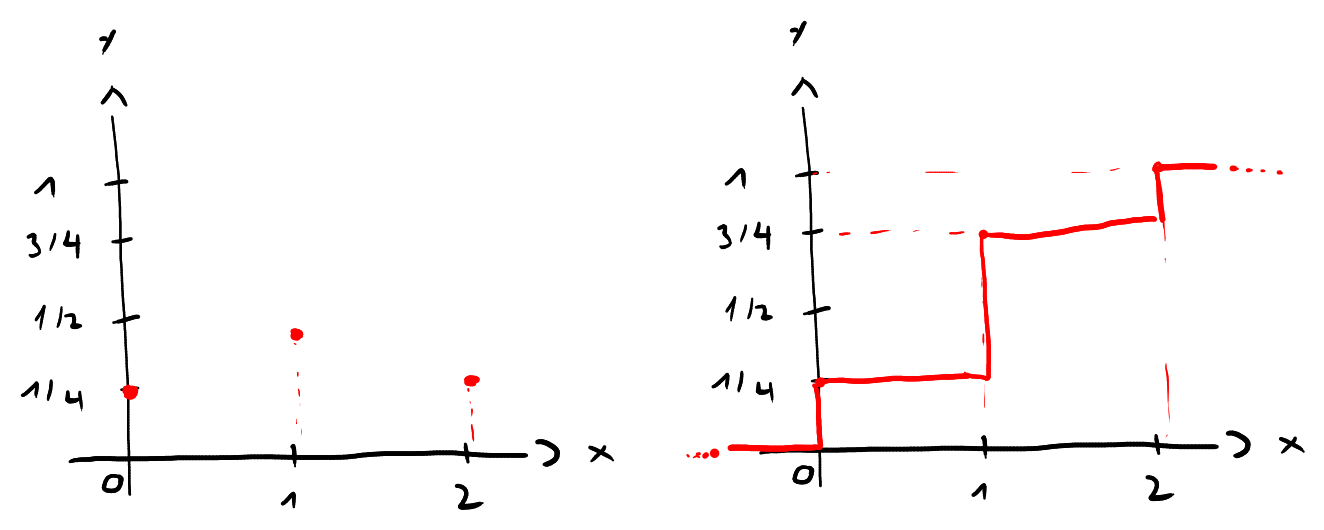
We often draw the probability function in a coordinate system, where the values are indicated along the -axis, and the probabilities along the -axis. For the cumulative distribution function we draw, as always for functions, the input along the -axis and the output along the -axis. Here is an example:
A fair coin is flipped twice. The random variable is ="number of heads".
-
Determine the probability function of , and draw the function in a coordinate system.
-
Draw the cumulative distribution function .
Solution
The possible values of are , where
As this is a Laplace experiment, we have the following probability function of :
(see figure below, left).
The cumulative distribution function is the probability that the number of heads is equal or less than . For example,
and so on. It is a staircase function, where the jumps occur at the values and . See the figure below, right.
As the events are pairwise mutually exclusive, and actually form a partition of the sample space , we have the following important properties:
Consider the probability function of a random variable . We have the following:
-
For arbitrary values of , e.g. and it is
-
The sum of all probabilities of the probability function is :
-
is the sum of all probabilities with . Thus, if for a given exactly the values , then
Proof
The proof is straight forward.
-
This follows from the fact that the events are pairwise mutually exclusive.
-
Follows from statement 1, and the fact that the union of all those events form the sample space , so we have
-
Follows from statement .
A fair die is rolled twice. Consider the random variable ="sum of the two numbers".
-
Determine the possible values of .
-
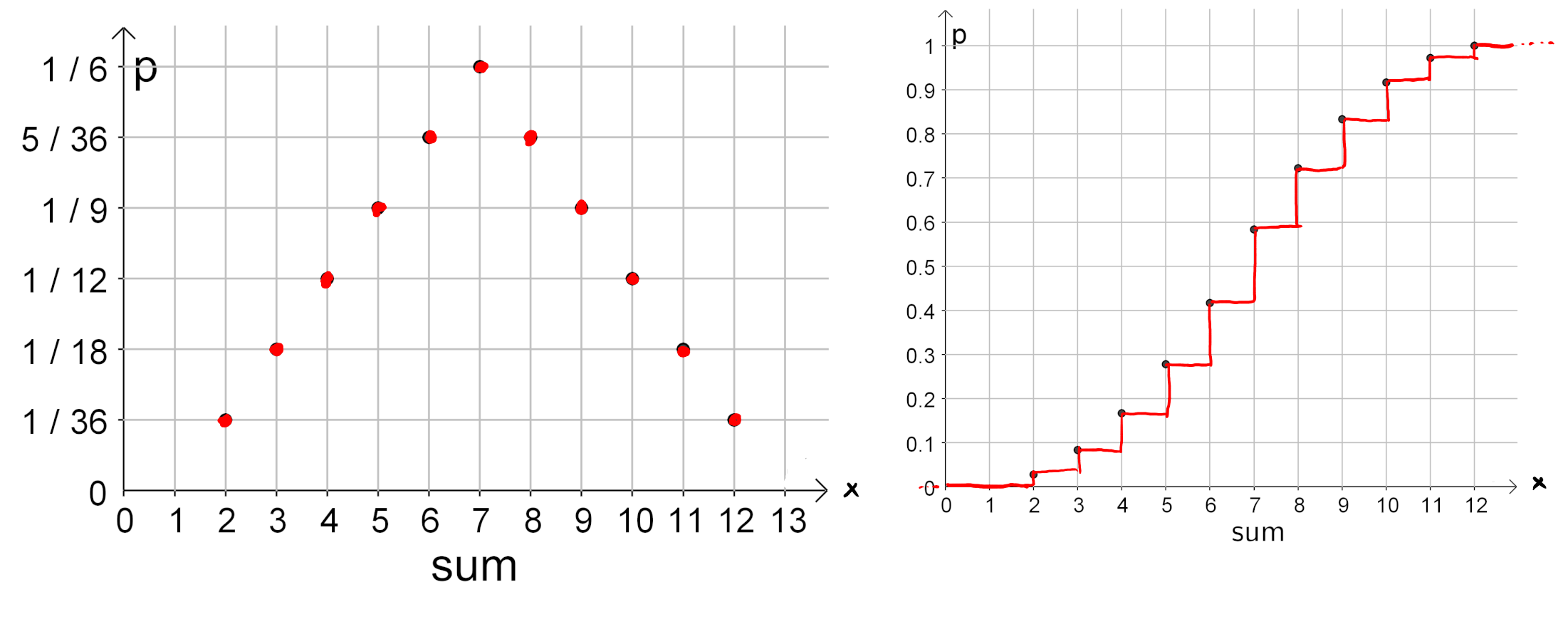
Determine and draw the probability function of .
-
Determine
-
Draw the graph of .
Solution
The sample space is
-
Possible outputs of :
-
The probability function is (for a figure see below)
-
We have
-
The graph of is shown below. It helps to calculate the points of the graph where it jumps:
The probabilities , , form the probability function of a random variable . Determine the value and the probabilities.
Solution
As , it follows
Solve for (midnight formula), we get and . As probabilities are not possible, we have to exclude from the solutions. So , and .