The area between two curves
So far we can determine the area between a curve and the -axis. Now we generalise this a bit, and determine the area between two curves.
Consider the two functions
and
What is the area of the region that is enclosed by these two functions (shaded area in the figure below)?
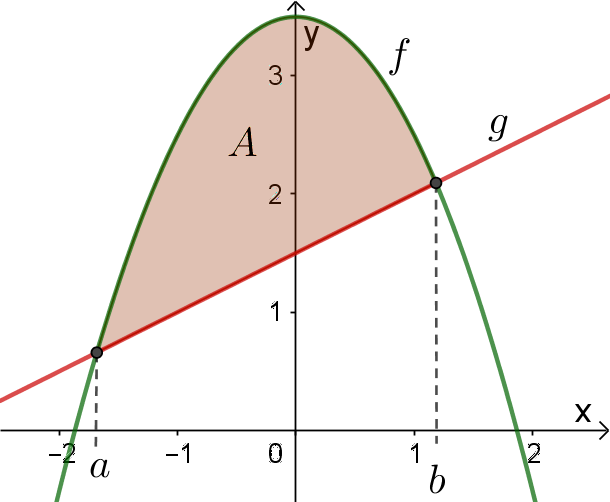
The idea is straight forward, we simple determine the area under the upper curve (figure below, left) and subtract from it the area under the lower curve (figure below). Try yourself, then go to the solution for help.
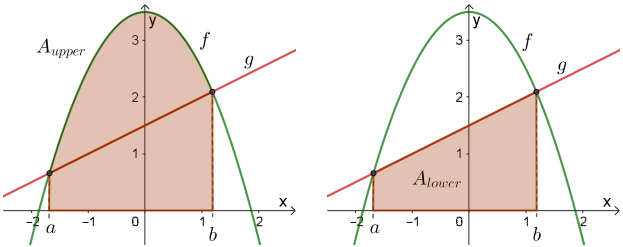
Solution
To find the integration limits and , we have to determine the -coordinates of the intersection points between the graphs and . So, find with
Applying the midnight formula, we obtain and . We also need the antiderivative of
and this is
The area of the shaded region
But what if the region between the curves is given as in the example below, to the left? We cannot subtract anymore the area beneath the lower graph from the area beneath the upper graph. In principle we could just go ahead and divide the region into smaller subregions in such a way that we could determine their areas using integrals. While this works, it is normally time consuming. Luckily, there is a much simpler way (see the figure below):
Shift the two graphs (and therefore the region) upwards by the same constant , where has to be large enough so that the whole region will be above the -axis. See the figure below (right). The area stays the same, but now we can work out the area as already discussed above.
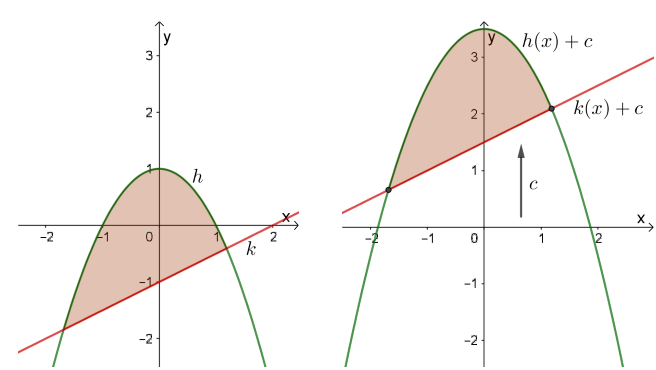
The shifted functions are
The shifted area is then:
Note that we have used the theorem about weighted sums to get from the first line to the second line in the equation.
The constant has no influence on the result at all, as it cancels. So, we actually do not have to shift at all!
Let's summarise all these findings in a theorem.
Consider two functions, where the graph of is above the graph of from to on the -axis. The (normal) area between the two graphs is
Area between upper and lower curve.
- Determine the area enclosed by the functions and .
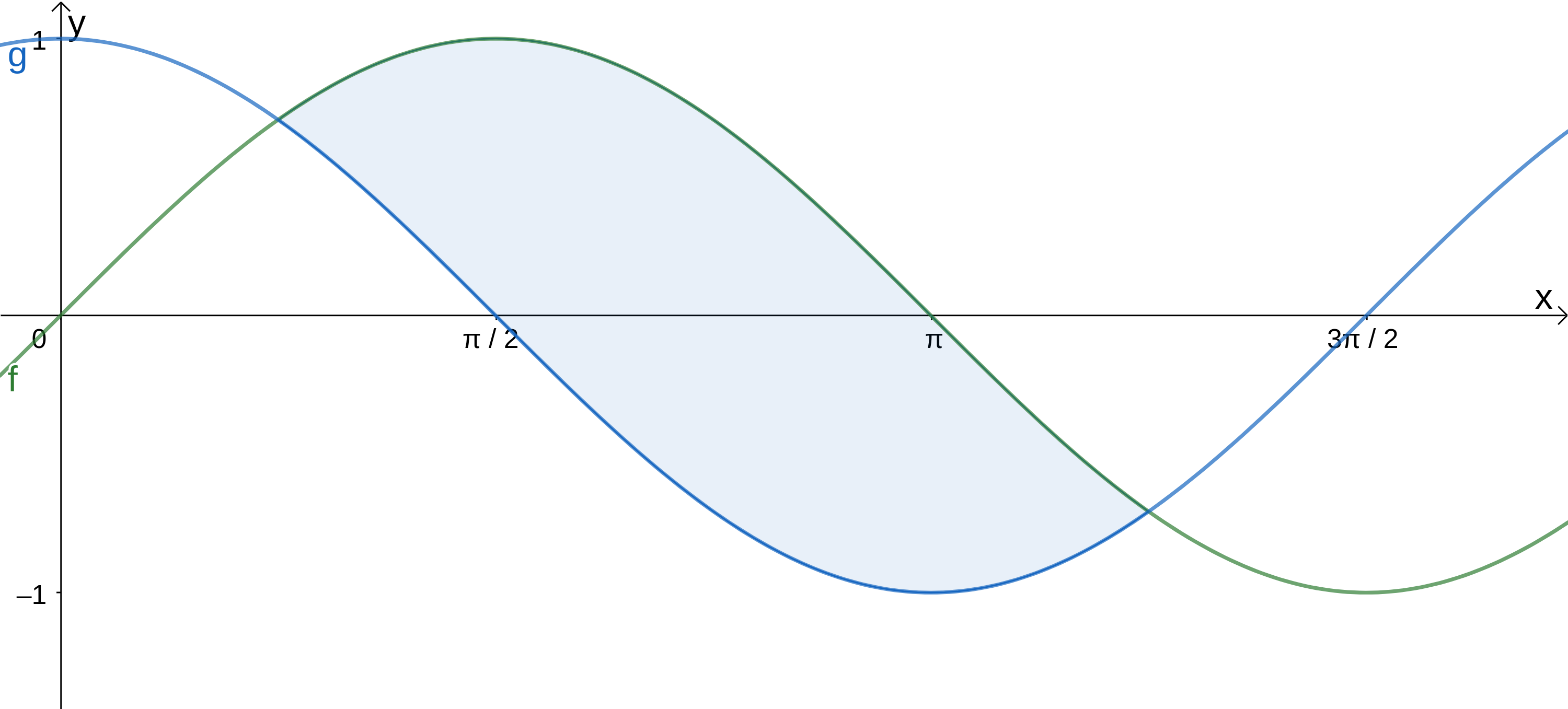
- Determine the area enclosed by the functions and (see figure).
- Consider two polynomials of degree (shown below). Determine the area enclosed by these two functions.
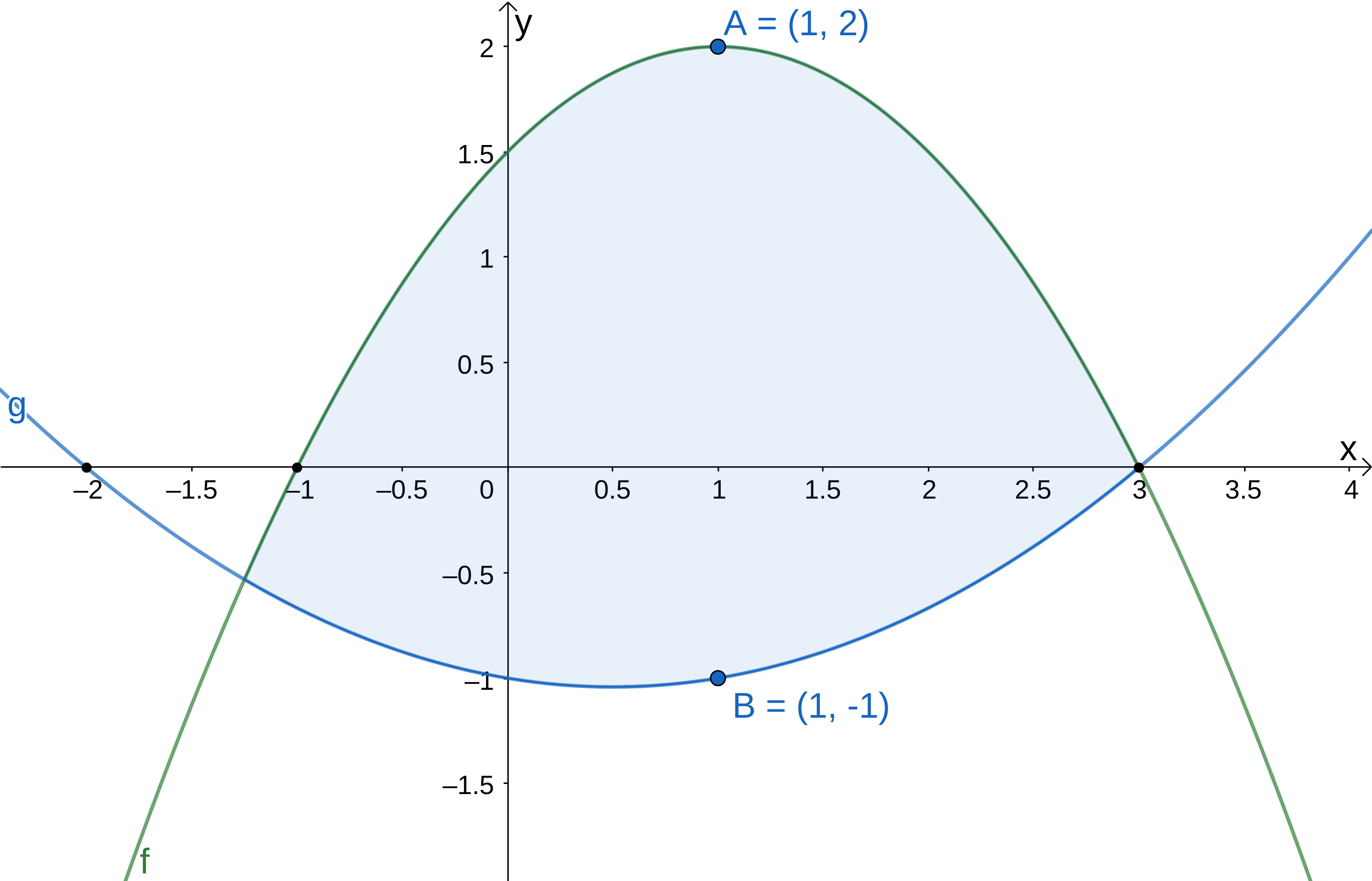
- Find the area enclosed by the two polynomials and of degree , where
-
has the -intercepts and , and the -intercept
-
has the -intercepts and , and the graph passes through the point .
-
Solution
-
It is and , and they intersect at and . We have to determine the antiderivative of
which is
Thus, we have
-
Find the point of intersection between the graphs. First the left one: Find with
We guess the right one: (symmetry argument). Verify that this is correct: Indeed: .
We have to find the antiderivative of
which is
Thus we have
-
-
We first need to find the function equations of and . As is a polynomial of degree and has the -intercepts and , we write
Because of it follows and thus . Thus, we have
As is also a polynomial of degree with the -intercepts and , we write
Because of it follows and thus . Thus, we have
-
We need to find the point of intersections between and . So find with
Using the midnight formula, we get and .
-
With
and
we get
The antiderivative is
The area is therefore
-
-
Draw the figure. For a change, we do not use the formula, but solve it directly by moving the region up by e.g. , so that the region will be above the -axis. But first, find the equations of and :
- Find : and because of it follows .
- Find : and because of , we get
Moving the region up by , we thus get
We need to find the point of intersection between and (or between and ). So find with :
Expanding and using the midnight formula, we get two intersection points with -coordinates and . Thus, the area of the region is