The intersection between a line and a plane

Consider a straight line gg that passes through the point UU and has direction vector v\vec{v}, and a plane EE that contains the point AA and has normal vector n\vec{n}. What is the relationship between gg and EE? There are basically two possibilities:

Parallel

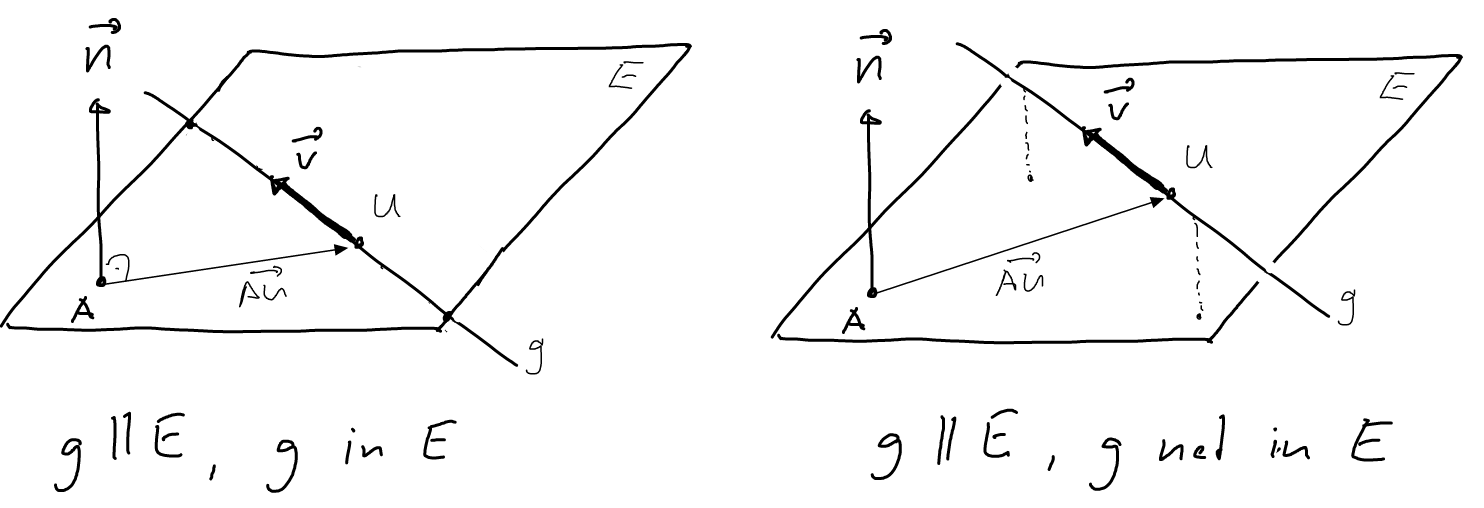
gg is parallel to EE, in which case it is (see figure)

vn\vec{v} \perp \vec{n}

Assume now that gEg || E. We can now check if gg is actually in the plane, or not. All we have to check is if UEU\in E. If this is the case then the whole line has to be in EE (because gg is parallel to EE). If U∉EU\not\in E, then gg is not in EE.

Intersecting

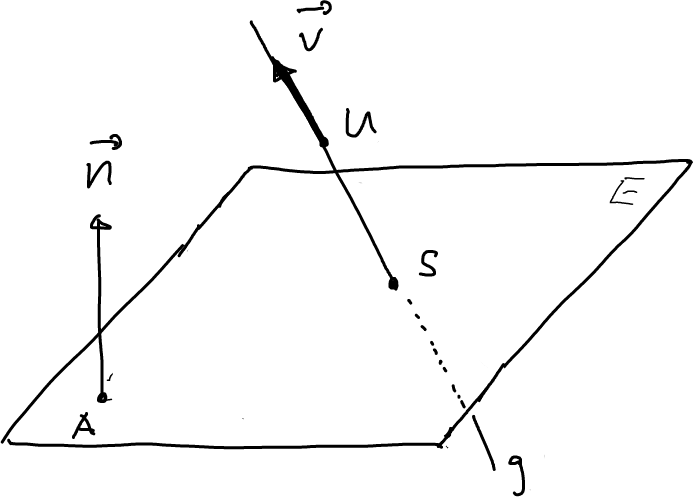
gg is not parallel to EE, in which case there is an intersection point SS between gg and EE.

Let us find the intersection point SS. As SS is on gg as well on EE, we know that SS must fulfil the following condition:

USv and ASn\boxed{\overrightarrow{US} \parallel \vec v \text{ and } \overrightarrow{AS} \perp \vec n}

In principle, this is enough to determine SS, but let us make this more explicit by unpacking the equations that are hidden behind these two conditions. To do so, we first set S(xyz)S(x\vert y \vert z). As SS is on EE, it has to fulfil the normal equation of EE:

nxx+nyy+nzz=dn_x x + n_y y + n_z z=d

and because SS is also on gg, it must fulfil the equation of the straight line as well:

(xyz)=(UxUyUz)+c(vxvyvz)\left(\begin{array}{ccc} x \\ y\\ z \end{array}\right) = \left(\begin{array}{ccc} U_x \\ U_y\\ U_z \end{array}\right)+c\cdot \left(\begin{array}{ccc} v_x \\ v_y\\ v_z \end{array}\right)

Thus, we end up with four equations:

nxx+nyy+nzz=dx=Ux+cvxy=Uy+cvyz=Uz+cvz\left\vert\begin{array}{rll} n_x\cdot x + n_y \cdot y + n_z \cdot z &=& d\\ x &=& U_x+c v_x\\ y &=& U_y+c v_y\\ z &=& U_z+c v_z\\ \end{array}\right\vert

Solve this system of equations to find SS. We demonstrate this using an example.

Example 1

Plane EE contains the point A(009)A(0\vert 0\vert 9) and has normal vector n=(143)\vec{n}=\left(\begin{array}{r} 1\\ 4\\ -3 \end{array}\right). Straight line gg passes through the point U(729)U(7\vert 2\vert 9) and has direction vector v=(234)\vec{v}=\left(\begin{array}{r} -2\\ 3\\ 4 \end{array}\right). Find the intersection point SS between gg and EE.

Solution

gg is not parallel to EE, as vn=2+1212=20\vec{v}\bullet \vec{n}=-2+12-12=2\neq 0, so there is a single intersection point S(xyz)S(x\vert y\vert z). The coordinates of SS must fulfil the equation of the plane and the equation of the straight line:

x+4y3z=27x+4y-3z=-27

and

(xyz)=(729)+c(234)\left(\begin{array}{ccc} x \\ y\\ z \end{array}\right) = \left(\begin{array}{ccc} 7 \\ 2\\ 9 \end{array}\right)+c\cdot \left(\begin{array}{ccc} -2 \\ 3\\ 4 \end{array}\right)

Thus we have the four equations

x+4y3z=27x=72cy=2+3cz=9+4c\left\vert\begin{array}{rll} x + 4y -3z &=& -27\\ x &=& 7-2c\\ y &=& 2+3c\\ z &=& 9+4c\\ \end{array}\right\vert

Let us first find out the value cc by inserting the lower three equations into the first one:

72c+4(2+3c)3(9+4c)=277-2c+4\cdot (2+3c)- 3\cdot (9+4c)=-27

And it follows c=7.5c=7.5. It follows

x=8y=24.5z=39\begin{array}{lll} x &=&-8\\ y &=& 24.5\\ z &=& 39 \end{array}

The intersection point is S(824.539)\underline{S(-8\vert 24.5\vert 39)}.

Exercise 1

Plane EE contains the point A(442)A(4\vert 4\vert 2) and has normal vector n=(223)\vec{n}=\left(\begin{array}{r} -2\\ -2\\ 3 \end{array}\right). Straight line gg passes through the point U(123)U(1\vert 2\vert -3) and has direction vector v=(112)\vec{v}=\left(\begin{array}{r} 1\\ 1\\ 2 \end{array}\right). Find the intersection point SS between gg and EE.

Solution

gg is not parallel to EE, as vn=20\vec{v}\bullet \vec{n}=2\neq 0, so there is a single intersection point S(xyz)S(x\vert y\vert z). As SS is on both gg and EE, its coordinates must fulfil the equation of the plane and the equation of the straight line:

2x2y+3z=10-2x-2y+3z=-10

and

(xyz)=(123)+c(112)\left(\begin{array}{ccc} x \\ y\\ z \end{array}\right) = \left(\begin{array}{ccc} 1 \\ 2\\ -3 \end{array}\right)+c\cdot \left(\begin{array}{ccc} 1 \\ 1\\ 2 \end{array}\right)

Thus we have the four equations

2x2y+3z=10x=1+cy=2+cz=3+2c\left\vert\begin{array}{rll} -2x-2y+3z &=& -10\\ x &=& 1+c\\ y &=& 2+c\\ z &=& -3+2c\\ \end{array}\right\vert

Inserting x,yx, y and zz into the first equations, we get

2(1+c)2(2+c)+3(3+2c)=10-2(1+c)-2(2+c)+3(-3+2c)=-10

and thus 2c=52c = 5, from which follows c=2.5c=2.5. We get

x=3.5y=4.5z=2\begin{array}{lll} x &=&3.5\\ y &=& 4.5\\ z &=& 2 \end{array}

The intersection point is S(3.54.52)\underline{S(3.5\vert 4.5 \vert 2)}.

Exercise 2

Plane EE contains the point A(009)A(0\vert 0\vert 9) and has normal vector n=(043)\vec{n}=\left(\begin{array}{r} 0\\ 4\\ -3 \end{array}\right). The straight line gg passes through the point U(729)U(7\vert 2\vert 9) and has direction vector v=(234)\vec{v}=\left(\begin{array}{r} -2\\ 3\\ 4 \end{array}\right). Find the intersection point between gg and EE.

Solution

There is no intersection point, as gg and EE are parallel (vn=0+1212=0\vec{v}\bullet \vec{n}=0+12-12=0) and gg is not in EE (AUn=0+8+00\overrightarrow{AU} \bullet \vec{n} = 0+8+0 \neq 0). Note that if you try to calculate the coordinates of the intersection point, you end up with the equation

0+12c+812c=08=0???0 + 12c+8 -12c = 0\rightarrow 8=0 \,???

In other words, there is no such cc, so no intersection point.

If gg is on EE, we would get an equation of the form

c=cc=c

or

0=00=0

Thus, there is no condition for cc and we can choose any value we want (the equation is always correct). In other words, there are infinitely many intersection points. To find one, just choose an arbitrary value for cc.