Distance problems

Smallest distance between a point and a plane

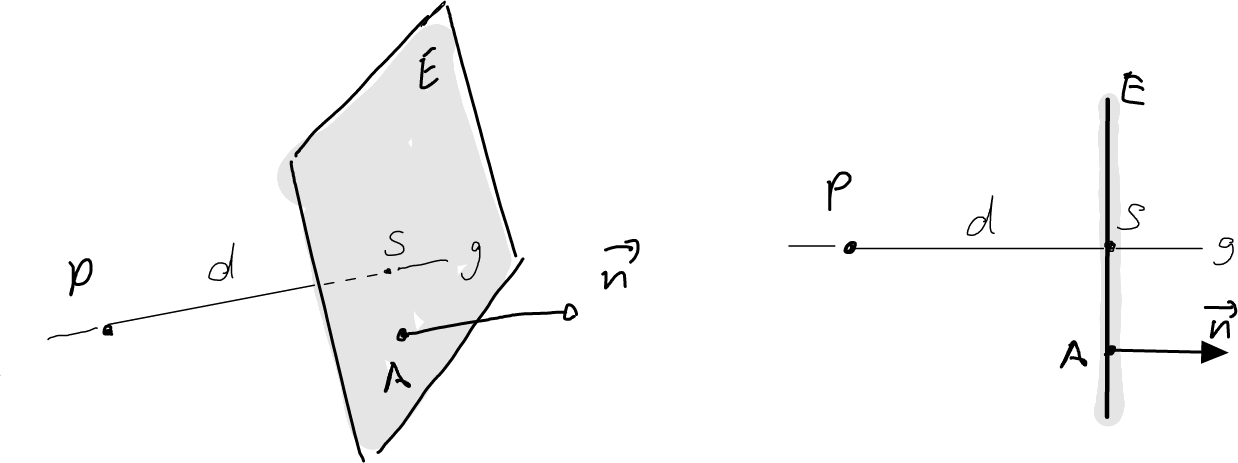
The plane EE contains the point AA and has normal vector n\vec{n}. Also given is a point PP. Find the shortest distance d(P,E)d(P,E) between PP and plane EE.

Recipe 1

Idea:

  1. Find the straight line gg that passes through PP and is orthogonal to EE.
  2. Intersect gg with EE to get the intersection point SS.
  3. It is d(P,E)=PSd(P,E)=\vert \overrightarrow{PS}\vert (see figure).
Example 1

Plane EE contains the point A(523)A(5\vert 2\vert -3) and has normal vector n=(231)\vec{n}=\left(\begin{array}{r} 2\\ 3\\ 1 \end{array}\right). Find the shortest distance between point P(112)P(1\vert -1 \vert -2) and plane EE.

Solution
  1. Determine gg: gg passes through point PP and has direction vector v=n\vec v = \vec{n} (as it is orthogonal to EE). The equation of the straight line is

    (xyz)=(112)+c(231)=(1+2c1+3c2+c)\left(\begin{array}{ccc} x \\ y\\ z \end{array}\right) = \left(\begin{array}{ccc} 1 \\ -1\\ -2 \end{array}\right)+c\cdot \left(\begin{array}{ccc} 2 \\ 3\\ 1 \end{array}\right)=\left(\begin{array}{ccc} 1+2c \\ -1+3c\\ -2+c \end{array}\right)
  2. Intersect gg with EE to get S(xyz)S(x\vert y\vert z): The normal equation of the plane is

    2x+3y+z=132x+3y+z = 13

    Thus we have to solve the linear system of equations:

    2x+3y+z=13x=1+2cy=1+3cz=2+c\left\vert\begin{array}{rll} 2x+ 3y + z &=& 13\\ x &=& 1+2c\\ y &=& -1+3c\\ z &=& -2+c\\ \end{array}\right\vert

    which results in

    2+4c3+9c2+c=132+4c-3+9c-2+c=13

    and thus c=87c=\frac{8}{7}. It follows S(23717767)S(\frac{23}{7}\vert \frac{17}{7}\vert -\frac{6}{7}).

  3. The shortest distance is therefore d(P,E)=PS=(23/7117/7+16/7+2)=896/49d(P,E)=\vert\overrightarrow{PS}\vert=\left\vert\left(\begin{array}{r} 23/7-1\\ 17/7+1\\ -6/7+2 \end{array}\right)\right\vert = \sqrt{896/49}

Smallest distance between a point and a straight line

Consider a straight line gg that passes through point AA and has direction v\vec v. Also given is a point PP. Find the shortest distance d(P,g)d(P,g) between gg point PP and gg.

Recipe 2

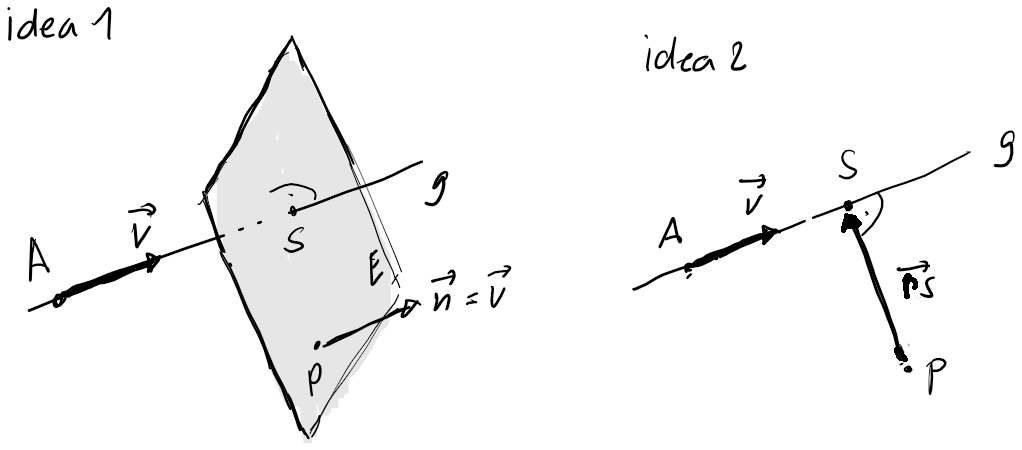
Idea 1:

  1. Find the plane EE that contains PP and has normal vector n=v\vec n = \vec v.
  2. Intersect EE with gg to get the intersection point SS.
  3. It is d(P,g)=PSd(P,g)=\vert \overrightarrow{PS}\vert.

Idea 2:

  1. Find a point SS on gg such that PSv\overrightarrow{PS} \perp \vec{v}.
  2. It is d(P,g)=PSd(P,g)=\vert \overrightarrow{PS}\vert.

Both ideas lead to the same calculations.

Example 2

The straight line gg passes through the point A(235)A(2\vert 3\vert -5), and has direction vector v=(201)\vec{v} = \left(\begin{array}{r} 2\\ 0\\ -1 \end{array}\right). Find the shortest distance between the point P(124)P(-1\vert -2\vert 4) and line gg.

Solution

idea 1

  1. Find EE containing PP: Normal vector is n=v\vec n =\vec v, thus

    2x+0yz=d2x+0y-z=d

    where

    d=2+04=6d=-2+0-4=-6

    Thus, the normal equation is

    2xz=62x-z=-6
  2. Find the intersection point S(xyz)S(x\vert y\vert z) between gg and EE. The equation of the straight line is

    (xyz)=(235)+c(201)=(2+2c35c)\left(\begin{array}{ccc} x \\ y\\ z \end{array}\right) = \left(\begin{array}{ccc} 2 \\ 3\\ -5 \end{array}\right)+c\cdot \left(\begin{array}{ccc} 2 \\ 0\\ -1 \end{array}\right)=\left(\begin{array}{ccc} 2+2c \\ 3\\ -5-c \end{array}\right)

    Thus, we need to solve the linear system of equations

    2xz=6x=2+2cy=3z=5c\left\vert\begin{array}{rll} 2x-z &=& -6\\ x &=& 2+2c\\ y &=& 3\\ z &=& -5-c\\ \end{array}\right\vert

    We get 4+4c+5+c=64+4c+5+c=-6 and thus c=3c=-3 and therefore S(432)S(-4 \vert 3\vert -2).

  3. The shortest distance is

    d(P,g)=PS=(356)=70d(P,g)=\vert \overrightarrow{PS}\vert = \left\vert \left(\begin{array}{r} -3\\ 5\\ -6 \end{array}\right) \right\vert =\sqrt{70}

idea 2

  1. Find S(xyz)S(x\vert y\vert z) with SgS\in g and PSv=0\overrightarrow{PS} \bullet \vec{v}=0

    SgAS=cv(x2y3z+5)=(2c0c)x=2c+2,y=3,z=c5S\in g \rightarrow \overrightarrow{AS} = c\cdot \vec v \rightarrow \left(\begin{array}{r} x-2\\ y-3\\ z+5 \end{array}\right) = \left(\begin{array}{r} 2c\\ 0\\ -c \end{array}\right) \rightarrow x=2c+2, y=3, z=-c-5

    PSv=0(x+1y+2z4)(201)=2(x+2)(z4)=0\overrightarrow{PS} \bullet \vec{v}= 0 \rightarrow \left(\begin{array}{r} x+1\\ y+2\\ z-4 \end{array}\right) \bullet \left(\begin{array}{r} 2\\ 0\\ -1 \end{array}\right) = 2(x+2)-(z-4) = 0

    Inserting the expressions for x,yx, y and zz from above, we obtain the equation

    2(2c+2+1)(c54)=5c+15=0c=3S(432)2(2c+2+1)-(-c-5-4)=5c+15=0 \rightarrow c=-3 \rightarrow S(-4 \vert 3\vert -2)
  2. The shortest distance is

    d(P,g)=PS=(356)=70d(P,g)=\vert \overrightarrow{PS}\vert = \left\vert \left(\begin{array}{r} -3\\ 5\\ -6 \end{array}\right) \right\vert =\sqrt{70}

Smallest distance between parallel planes

This is related to "distance between a point and a plane": Just pick a point on one of the planes, and find the shortest distance between this point and the other plane.

Smallest distance between parallel lines

This is related to "distance between a point and a straight line": Just pick a point on one of the lines and find the shortest distance between this point and the other straight line.