Harmonic oscillations
A function of the form
is called harmonic oscillation. , , and are parameters that are typically specific to a given problem. The harmonic oscillation often occurs in physics and describes the position of oscillating objects (in the simplest case a pendulum) as a function of time. then takes the role of time, and describes the deflection from the starting position.
In the following, we will examine the meaning of the parameters in more detail. We will discover many parallels to the parameters we have used to shift and stretch a quadratic function or, more generally, power functions.
Let's start our investigation by drawing some harmonic oscillations.
Using the unit circle, sketch the following graphs and compare with the simple sine function :
-
und
-
und
-
und
-
und
Solution
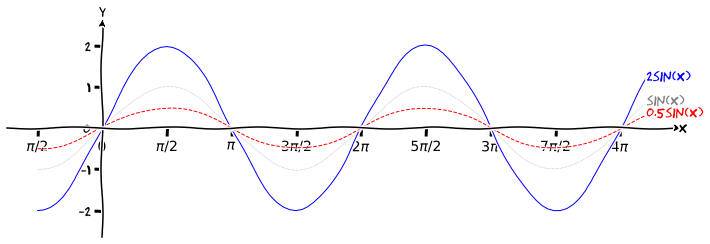
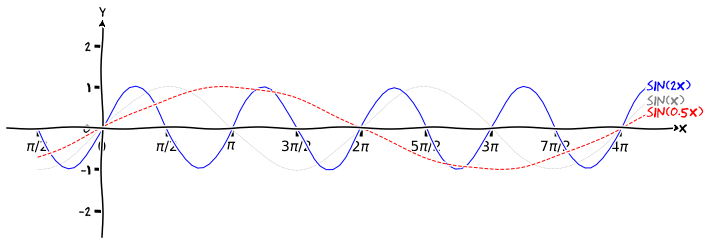
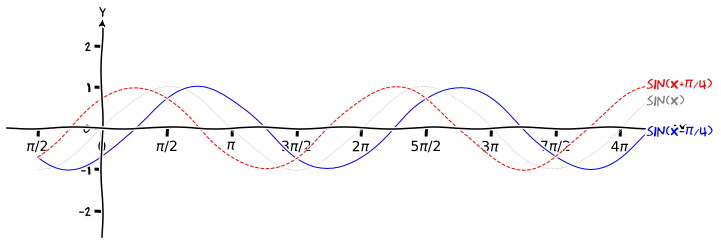
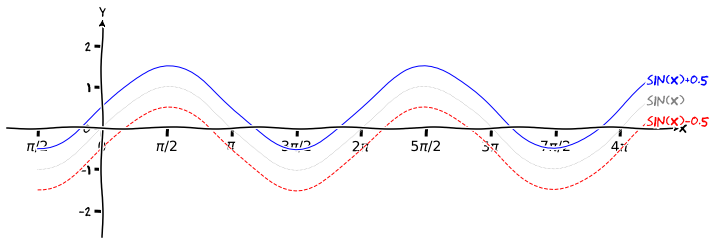
The following can be seen from the sketches. Let and . The parameters and describe geometric transformations to get from the graph to the graph , where applies:
- stretches the graph of by the factor in the -direction.
- : Graph is stretched by a factor of .
- : Graph is stretched by the factor (compression).
- stretches the graph of by the factor in the -direction.
- : Graph is stretched by the factor (compression).
- : Graph is stretched by a factor of .
- shifts the graph of by units in the direction.
- : Shift by units to the right.
- : Shift units to the left.
- shifts the graph of by units in the direction.
- : Shift by units upwards.
- : Shift by units to down. Das gleiche gilt auch für die Graphen der Funktionen und . Und in der Tat gilt es für den Graphen jeder Funktion.
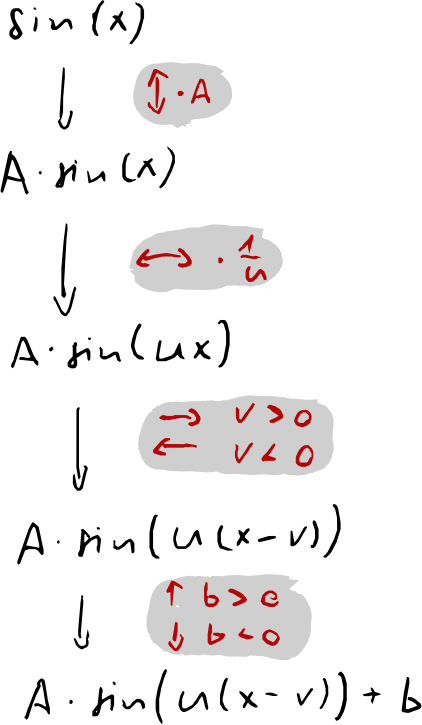
Indeed, we have the following general theorem:
The interpretation of the parameters and in the function
are as follows:
- : stretch by factor in the direction
- : stretch the new graph by the factor in the -direction
- : Shift the resulting graph by to the right () or to the left ().
- : Move the resulting graph up () or down () by .
The above sequence of transformations must be observed in order to get from the graph of to the graph of .
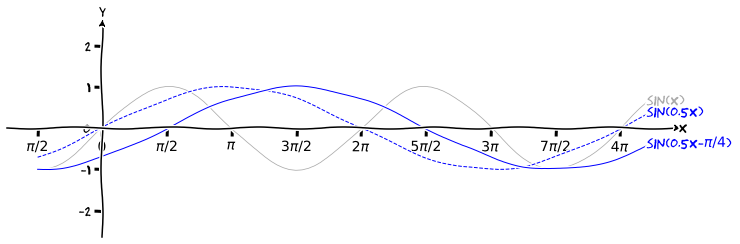
We illustrate this using the graph of the function
This is the blue solid line in the sketch below. It is and . We can see that the graph is not stretched in -direction. It is stretched by the factor in the direction (blue dashed line), then shifted to the right by . There is no shift in -direction.
We can also write the function like this:
In this form, however, we cannot read off the shift in the direction directly.
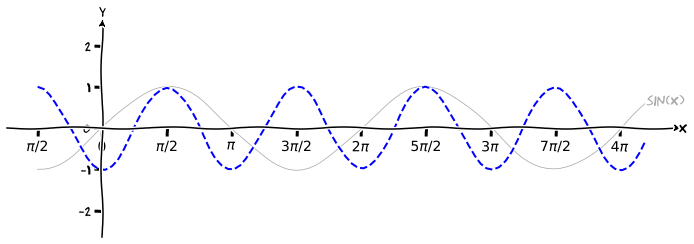
Find the transformations that lead from the sine curve to the dashed line and write the functional equation of the dashed line. The dashed line intersects the -axis at .
Solution
Stretch the sine curve by the factor in the direction () and shift to the right by .
The following therefore applies .
Which transformations are used to transform the graph of the function into the graph of the function ?
Then draw the graph of by applying the transformations to the graph of .
Solution
Bring to the correct format: , i.e. , i.e. starting from :
- stretch by a factor of in the direction, then
- stretch by a factor of in the -direction, then
- shift by units to the right, then
- shift upwards by one unit.
Find the -intercepts of the function in two different ways:
-
by calculation.
-
by considering how the -intercepts of the function are transformed.
Solution
- has the -intercepts at . So find with , , and we see that .
- because we see that is stretched by the factor in the -direction, and then shifted to the right by . The points are therefore first stretched by , i.e. , and then shifted to the right by , i.e. .
If not explicitly mentioned, all problems are to be solved without calculator.
-
Describe the geometric transformations to get from the graph of the sine or cosine to the graph of the function . Then sketch the graph of in which the transformations are carried out.
-
The graph of the function is stretched by a factor of in both the and directions and then shifted to the left by 2 units. Determine the functional equation of the resulting graph.
-
The graph of the function is first stretched by a factor of in the -direction and then shifted to the right by units. Sketch the graph by applying the transformations and determine the functional equation of the resulting graph.
-
Repeat the transformation from above, but in reverse order. Sketch the graph by applying the transformations and compare with above. Do the two graphs match? Determine the functional equation.
-
How can the transformation for also be called? And for ?
-
Use sketches to determine which equations are correct. If an equation is not correct, correct the right-hand side so that it is correct.
-
Determine at least two -intercepts of the function .
-
Determine at least two -intercepts of the function .
-
The graph of the function is to be mirrored about the horizontal line at height $y=2. Determine the functional equation of the mirrored graph.
-
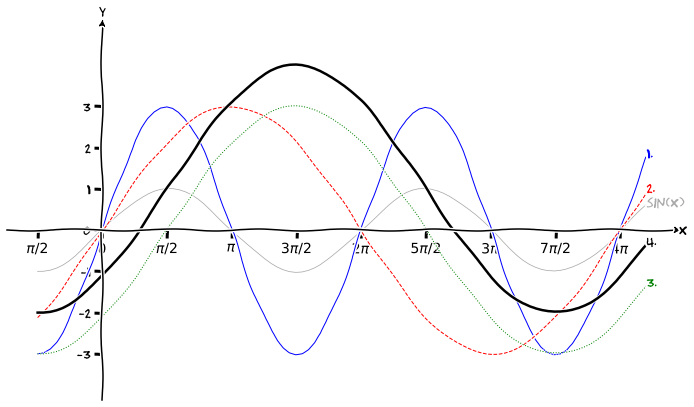
Determine the functional equations of the following graphs:
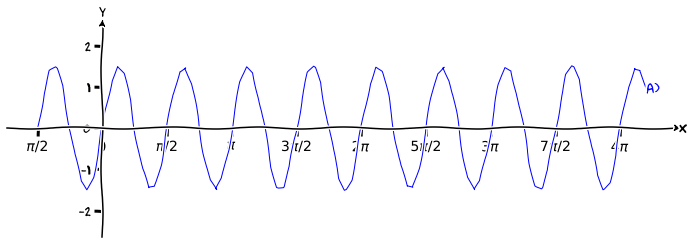
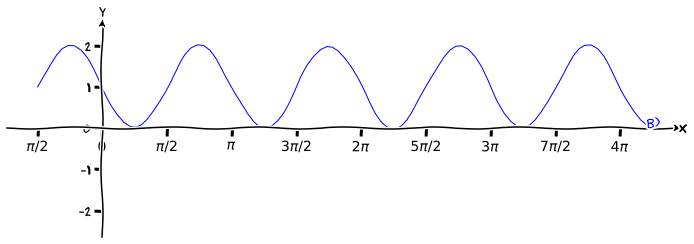
-
What transformations are needed to convert the graph of the function to the graph of the function ? Sketch the graph of .
-
The following transformations are successively applied to the graph of the function :
- stretches in the -direction by a factor of
- stretching in the -direction by a factor of
- shift to the left by
- shift downwards by
Determine the function equation of the resulting graph .
Solution
-
we have
- stretching in -direction with factor , then shifting upwards by 3.
- stretching in -direction with factor , then stretching in -direction with factor .
- stretching in -direction with factor , then stretching in -direction with factor , then shifting by to the left and shifting by downwards.
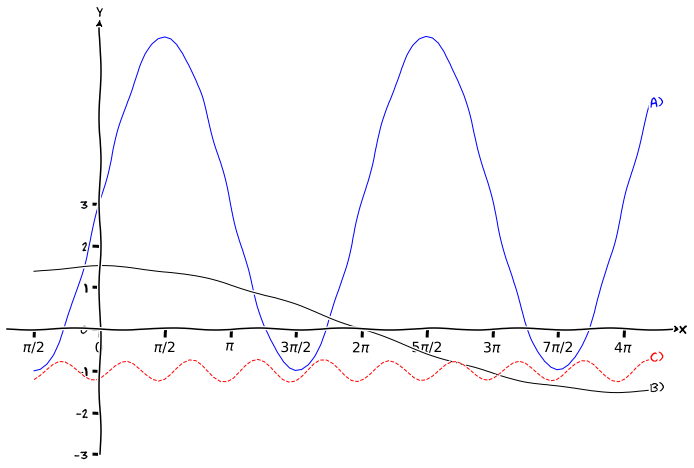
-
, , . Also .
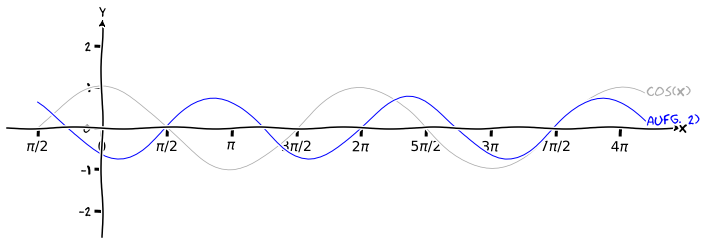
-
, .
-
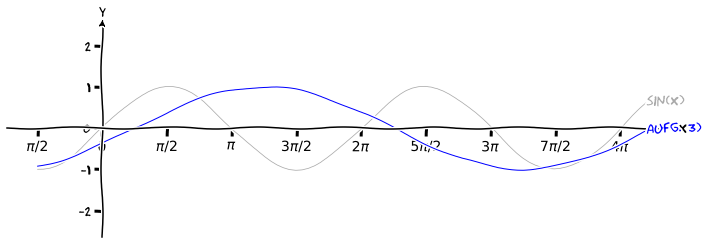
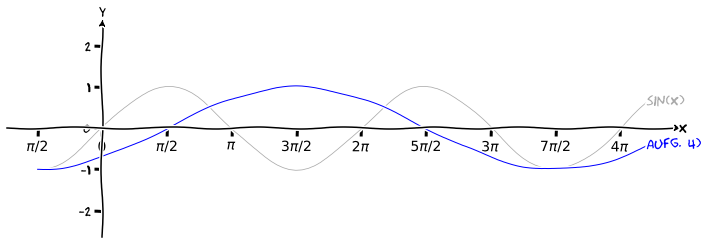
If the graph of is first shifted to the right by and then stretched by a factor of in the -direction (so not in the usual order), we obtain the following graph (shown below). It is not the same graph as the one shown in exercise 3. Starting from and executing the transformations in the right order, we obtain the graph below by stretching it by a factor of in the -direction and then shifting it to the right by . So and and therefore .
-
It is
- , thus : the graph is reflected about the -axis.
- , thus : the graph is reflected about the -axis.
-
Sketch the left and right functions, and compare the two graphs to see if the are the same:
- is correct
- is false, it is
- is false, it is
- is false, it is
-
Find with . The sine function has the -intercepts , thus find with
-
Find with , thus
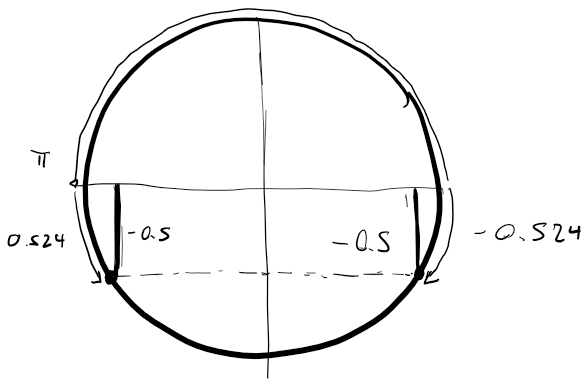
We therefore have to find out for which radians the sine equals (see unit circle below). We can calculate a value using the arcsine
Another value is
(see unit circle below). Thus we have and therefore , and , and it follows . Let's check: (rounding error), and (rounding error).
-
Idea: First draw the mirrored graph and then think about which transformations are needed to get from to the mirrored graph. It then follows that we can first mirror on the -axis, , and then shift it upwards by (). We therefore have .
-
We start with in each case, and think about how we get to the graph shown by stretching and then shifting.
- stretch in the -direction by a factor of (), and in the -direction by a factor of (). So .
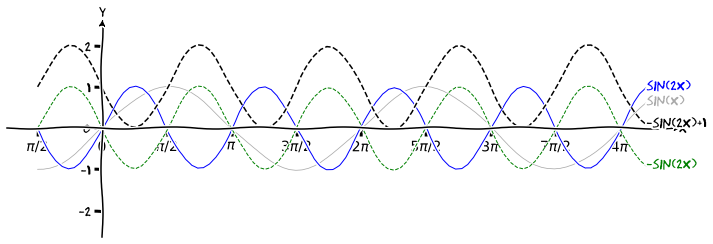
- stretch in the -direction by a factor of (), mirror on the -axis (), shift upwards by (). We therefore have (see image below).
-
We write in a better form:
So . It follows:
- stretch in -direction by , then
- stretch in the -direction by , then
- shift to the right by , then
- shift upwards by

-
It is , and . So