Trigonometric functions
Recall the three trigonometric relationships in right-angled triangles (SOHCAHTOA):
See the figure below (left). Here, , and denote the hypotenuse, opposite side and adjacent side. Note that for the relationships to make sense. At the moment it is not clear what means, as there is no right angled triangle with such an angle. But ultimately we want to be able to calculate and for , or for any other angle of any size. This will lead to the trigonometric functions.
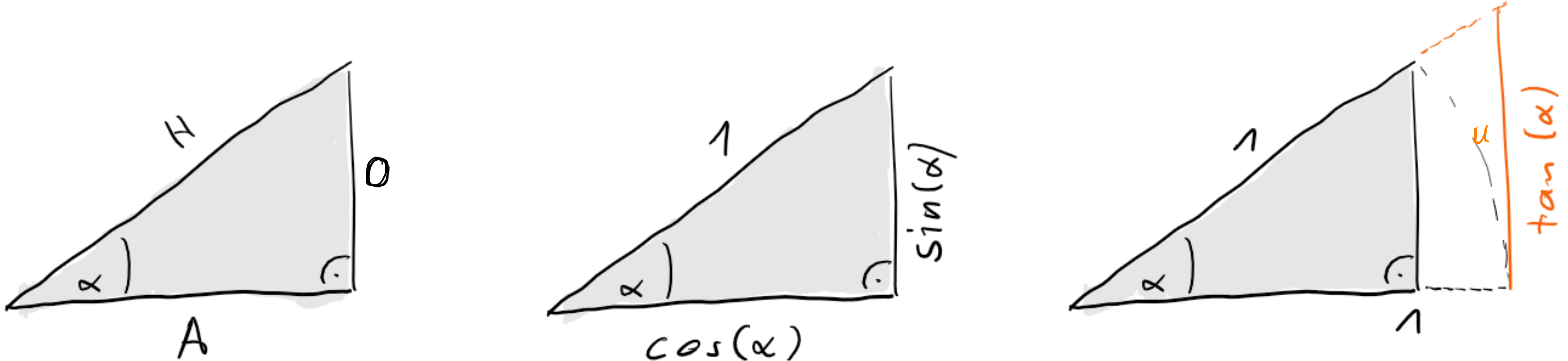
First, let's start by considering again right-angled triangles, but this time with hypotenuse (figure above, middle). We then have
and
Thus, if , the sine is the length of the vertical side, and the cosine is length of the horizontal side. By the way, we can also represent as a side length. To do so, we have to extend the triangle so that the horizontal side has length (figure above, right). The vertical side of the new triangle is then , because
Extending the definition of the sine and cosine
To extend the and to arbitrary values of , we focus on the fact we have observed above, namely that for the is the vertical side length and the is the horizontal side length. So let us introduce a new definition of the sine and cosine. It involves the unit circle.
-
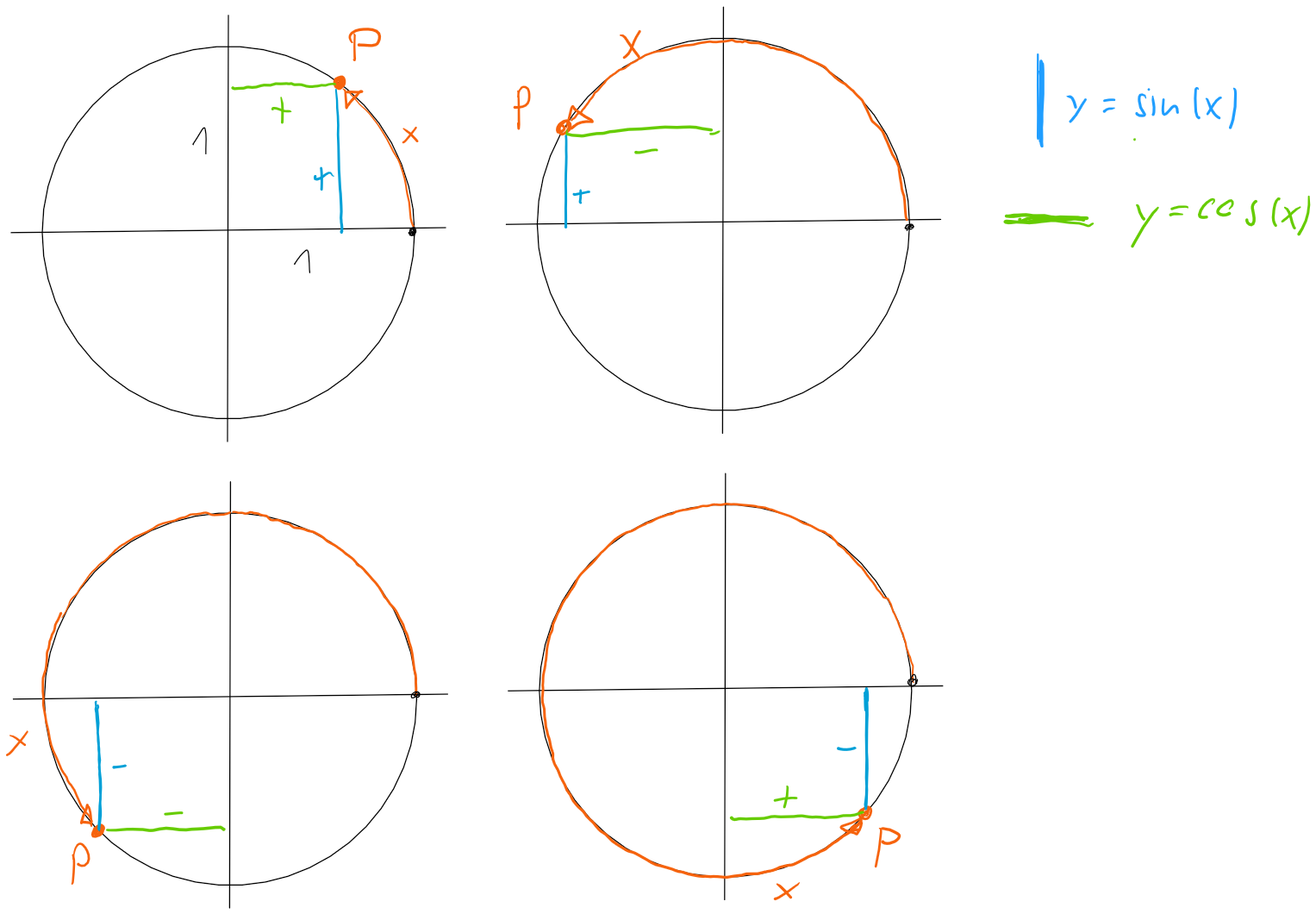
Draw a unit circle, and indicate a vertical and a horizontal axis, both passing through the centre of the circle (see figure below). Each arbitrary angle defines the position of a point on the unit circle. From now on we use the arc length rather than the angle to describe the position of this point .
-
For a given value of (the input to the machine) determine the corresponding point on the unit circle, and define the following output :
In addition, "rise" is negative if is below the horizontal axis, and "run" is negative if is on the left side of the vertical axis (figure below, right).
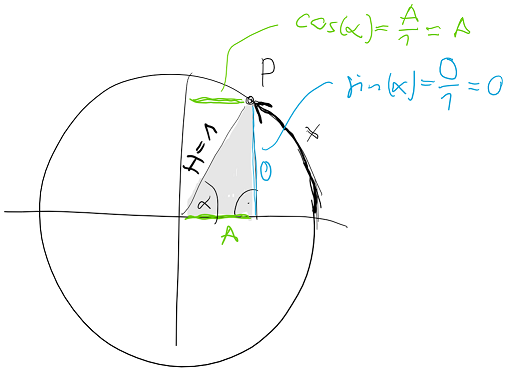
It should be clear that for between and , or for between and , these definitions are simply the original trigonometric relationships SOHCAHTOA where :
The function can be defined by the length of the vertical line of the extended triangles (see top of section). Or we can simply set
As a summary, we represent the three trigonometric functions and as machines. The input is interpreted as the arc length (radians):
-
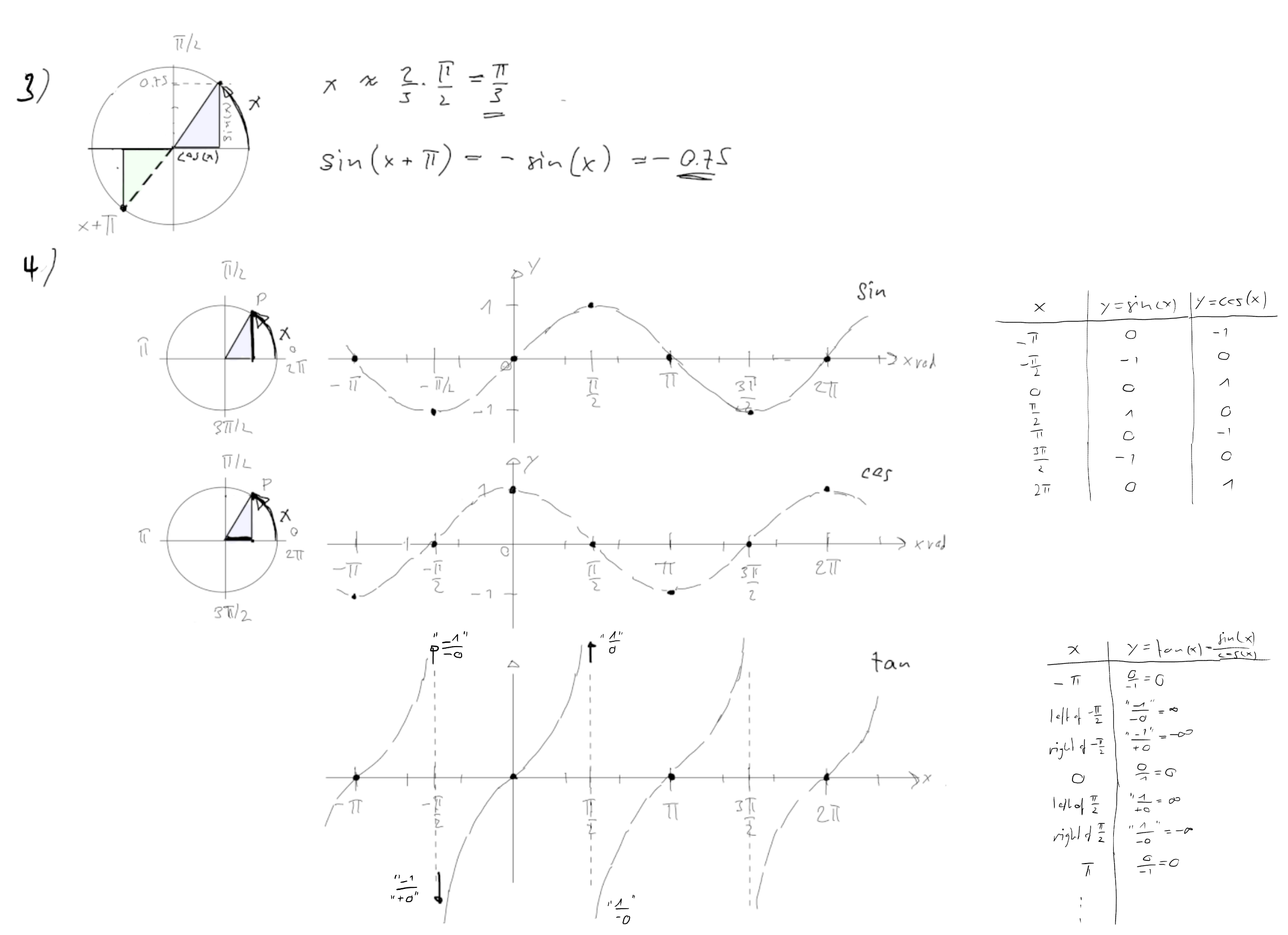
No calculator. Determine , , and for the following -values: , , , , , , .
-
Without using the trigonometric function keys
sin,cos, andtanon the calculator, determine , , and for the following -values: , , , . Verify your results using the calculator. -
Without using trigonometric function keys
sin^-1andcos^-1on the calculator, give an estimate of such that . Also, if , what is the exact value of ? -
No calculator: sketch the graph of the three trigonometric functions. Use the unit circle and indicate the points on the graph at and . Check the graphs using Geogebra. An animation illustrating the relationship between the unit circle and the graph of the sine and cosine functions can be found here: animation. Note: recall that and and .
-
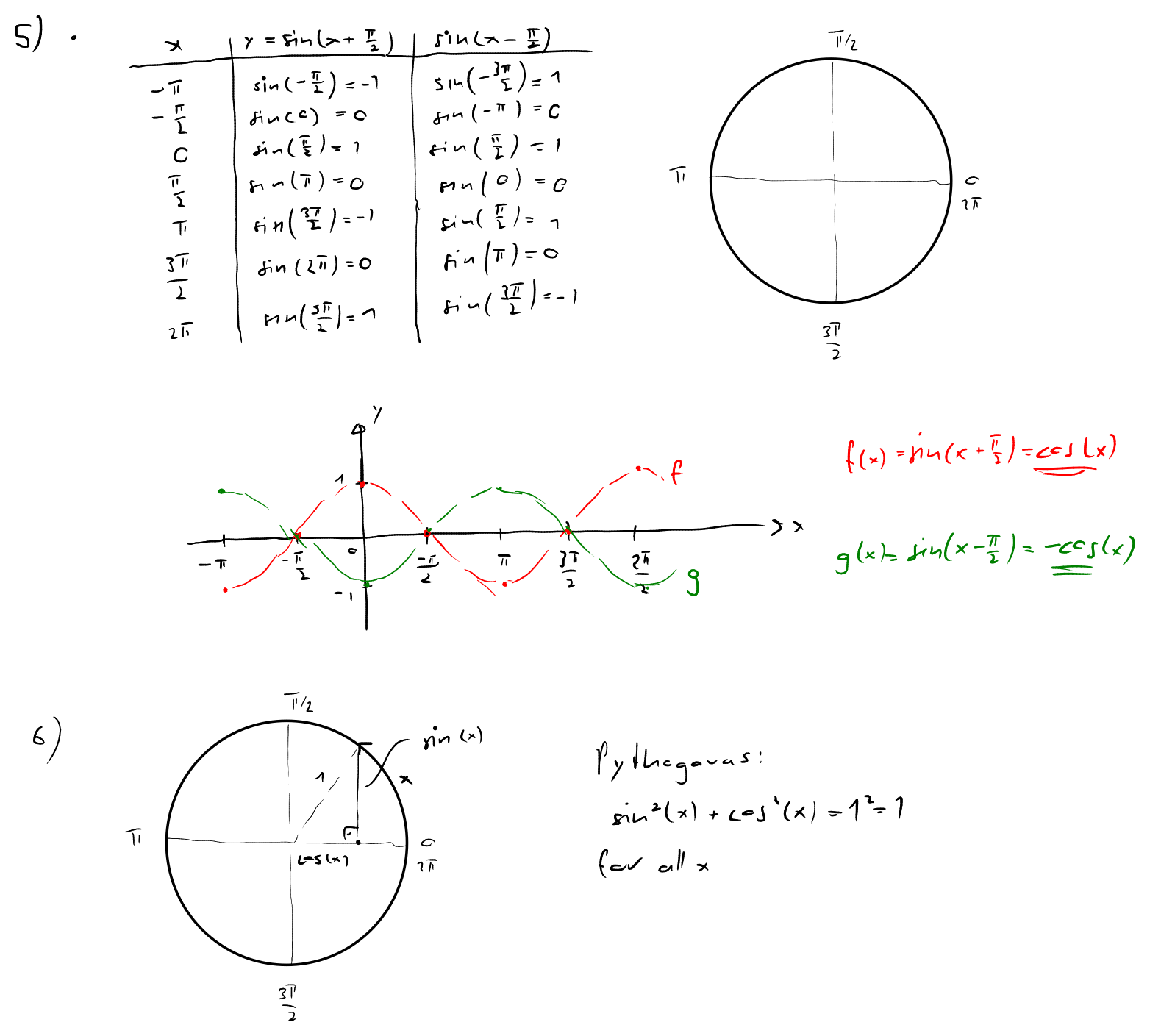
No calculator. Express the functions and using .
-
No calculator. What is for every ? Note: the notation is a short form for .
-
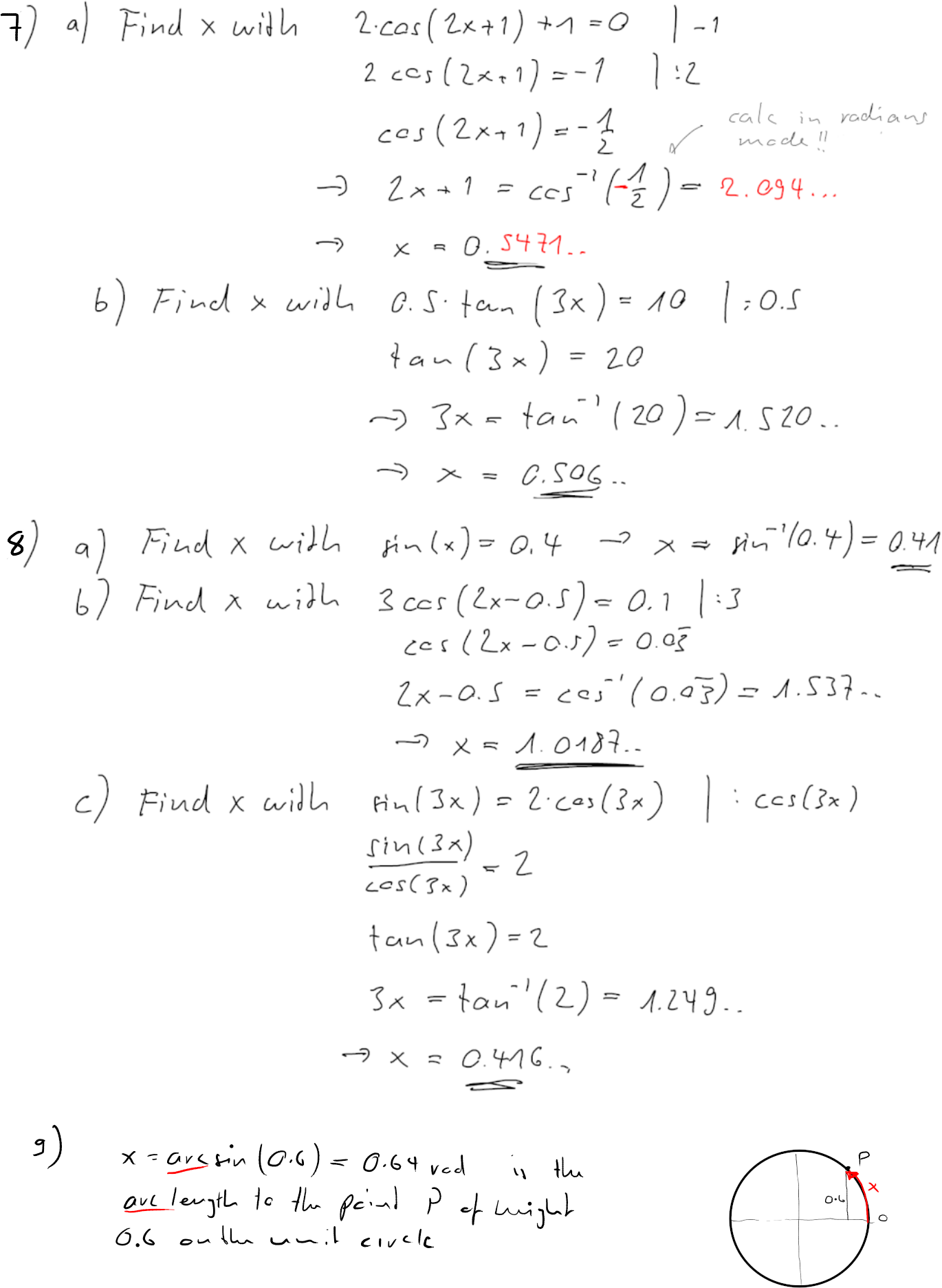
With calculator. Find an -intercept of the functions and by solving the equations and .
-
With calculator. Find an intersection point between the functions and
- ,
- ,
- ,
-
Given , we need the arc sine to find :
Why is there the name "arc" in the name? Argue with the unit circle.
-
Without calculator. Find the solutions of
-
Solution
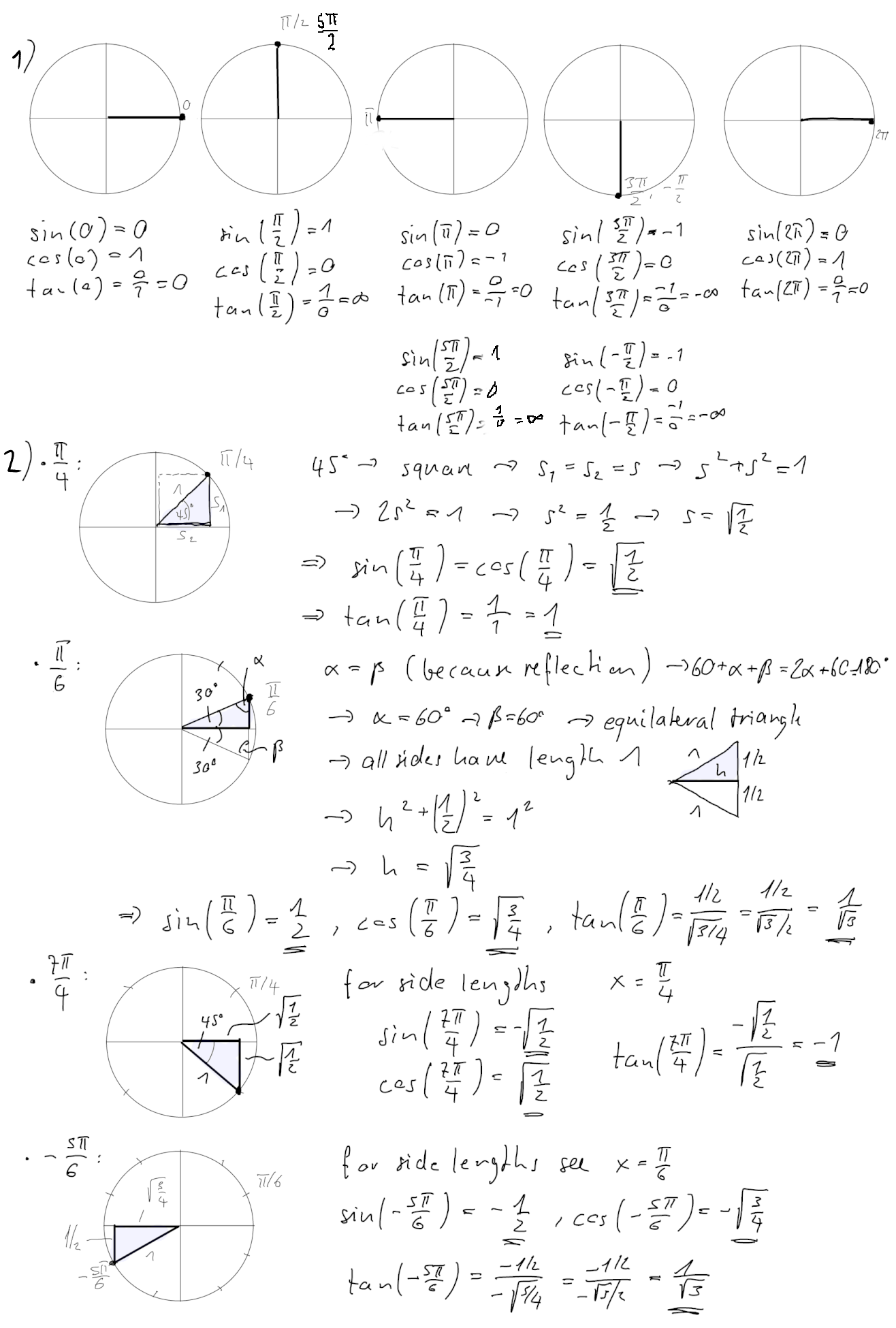
10
- Find with , or , and so on, so , or , ...
- Find with or , ..., so , or , ... .