Sketching the derivative
Recall that is the function or formula with which we can calculate the slope of the tangent to the graph of a given function :
Both and are functions, and we can draw their graphs (given that we have their algebraic expressions). Here is an example:
Example 1
Consider the function . The derivative is .
And we can draw their graphs as usual. Note that the height of the graph at is just the slope of the tangent to at .
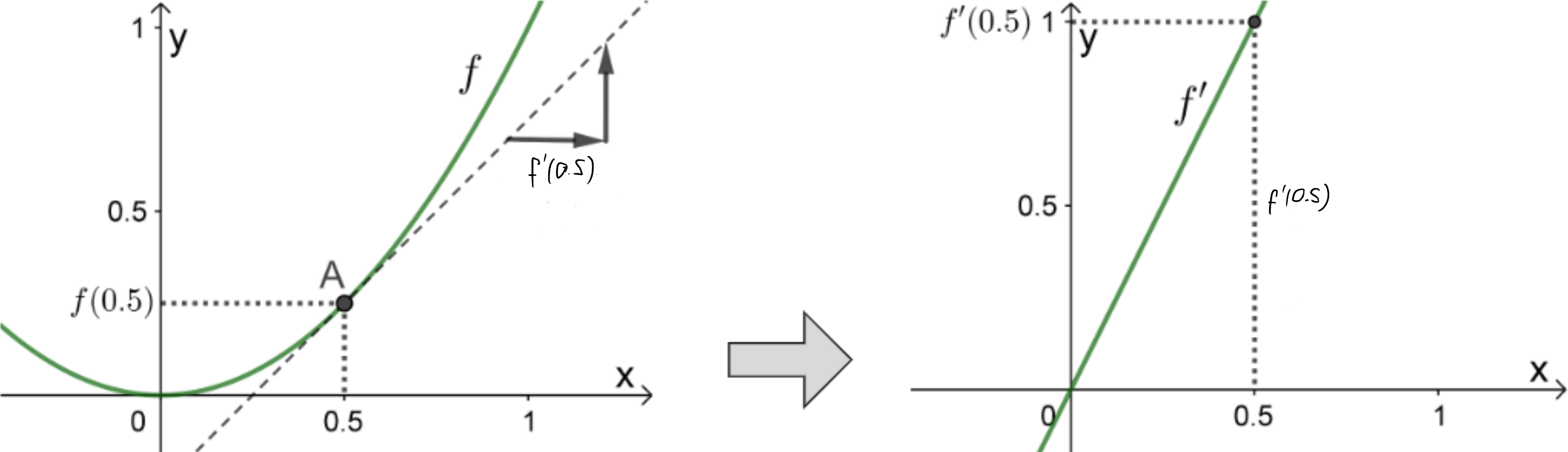
So, given a graph of a function , it is no problem to sketch the graph of :
- select a point on the -axis.
- draw the tangent to the graph of at this point.
- estimate the slope of this tangent (you can use the slope triangle), this is an estimate of the height of the graph of at .
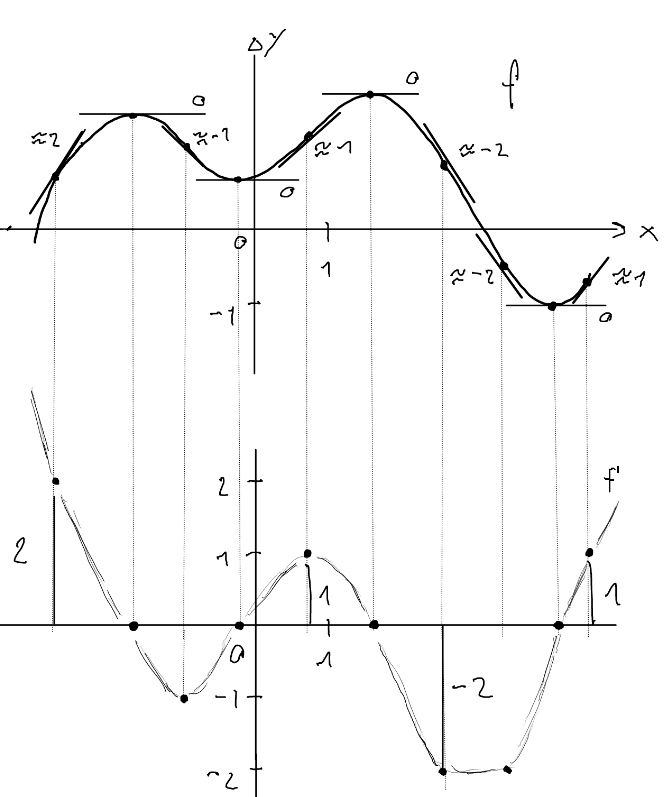
If you do this for several positions , we can sketch the graph of . An example is shown below.
Example 2
A graph of a function is given (upper graph in the figure below). Use this graph to sketch the graph . Note:
- Often it is useful to start with the horizontal tangents, as these are the -intercepts of , and easy to find.
- Then choose a couple of points between these horizontal tangents and estimate their slope (for example with the slope triangle). It does not have to be super exact.