Sums and sigma notation
Integral calculus is about summing lot's of numbers. So let's talk about sums, and a convenient notation for expressing sums. We want to sum over many numbers, so let's start with lists of numbers.
A list of numbers in a given order
is called a sequence, and the numbers are often called terms. The small number attached to each letter is called the index of and tells you the position of the number in the sequence.
These numbers can be totally arbitrary, such as
(here it is ). However, often there is some pattern present:
Consider "the first seven even numbers": . In this case we could also write
So using this formula we have
Now let's introduce a notation for adding the terms of a sequence.
Given is a sequence of terms . We use the [sigma notation} notation to indicate the sum of those numbers:
Sigman notation for adding numbers
Note that the sigma notation does not help to find the sum of the values. It is pure notation, helping to write an expression of the form a bit shorter.
The "" beneath and the "" above the sigma indicate that start term and the end term of the sequence over which we form the sum. We can change this. For example, if we want to form the sum starting with the second term and ending with the -th term, that is , we can write this using the sigma notation as follows:
Consider the sequence
Then we have
Consider the sequence of numbers , and the function . Thus
-
Write the terms of the sequence give by the following rule:
- (where )
- (where )
- (where )
- (where )
- (where )
-
Determine the following sums:
-
Write with the help of the sigma notation:
-
Consider the sequence for , and the function . Determine the sum
-
Sum of first natural numbers. Prove, that
Hint:
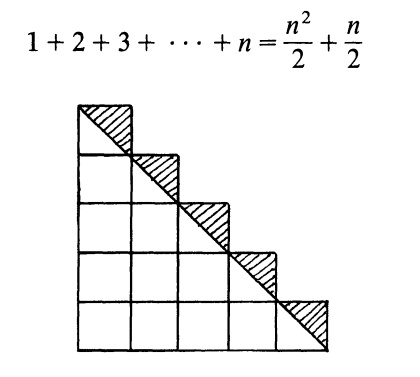
-
Sum of first square numbers. Prove, that
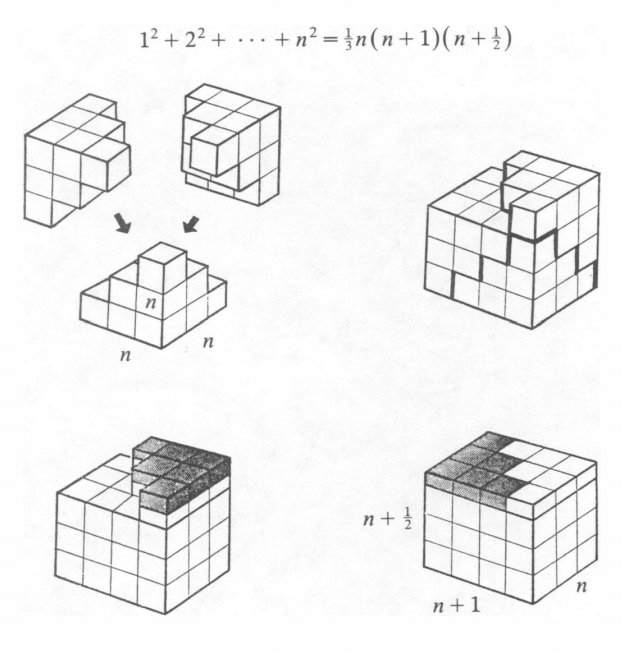
Solution
-
- (first ten squares)
-
-
-
-
-
-
-
-
-
-
-
- See hint. The number of squarea areas is
and note that
- See hint. The number of cubes depicted is
and note that