The integral is an area
In differential calculus the starting question was how to find the slope of a tangent to a curve. Later we saw that this "slope" can have many different interpretations (speed, acceleration, rate of change, ...), depending on the context and the problem at hand. The same will be the case for integral calculus. The question here is how to find the area between the -axis and a curve, where the curve is given by the graph of a function:
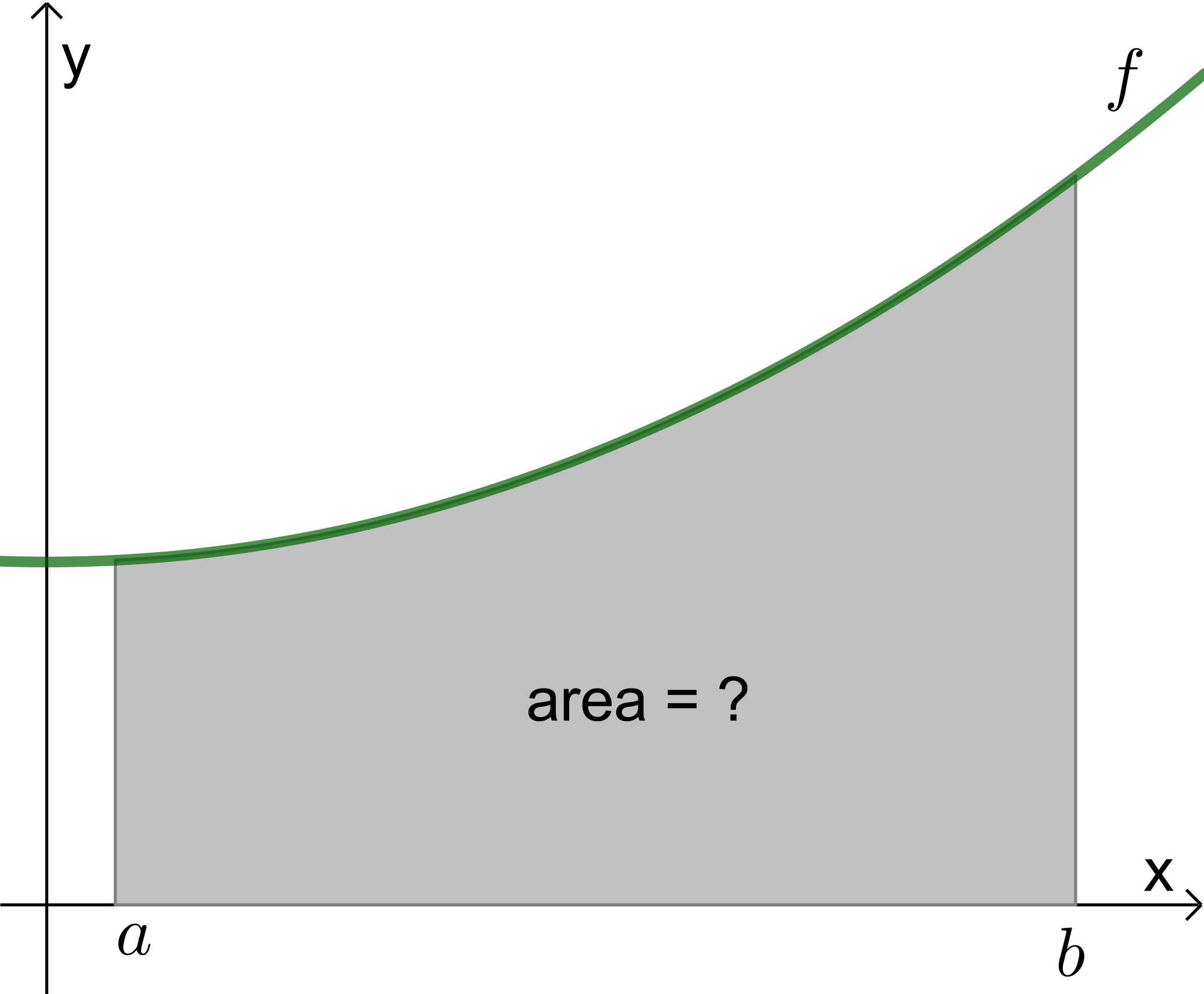
The "area" also has many interpetations, like the physical work, the distance moved, or the total current through a cross section of wire. One little oddity is that what we are actually interested in is not the normal area, but the signed area — that is, regions below the -axis count as negative.
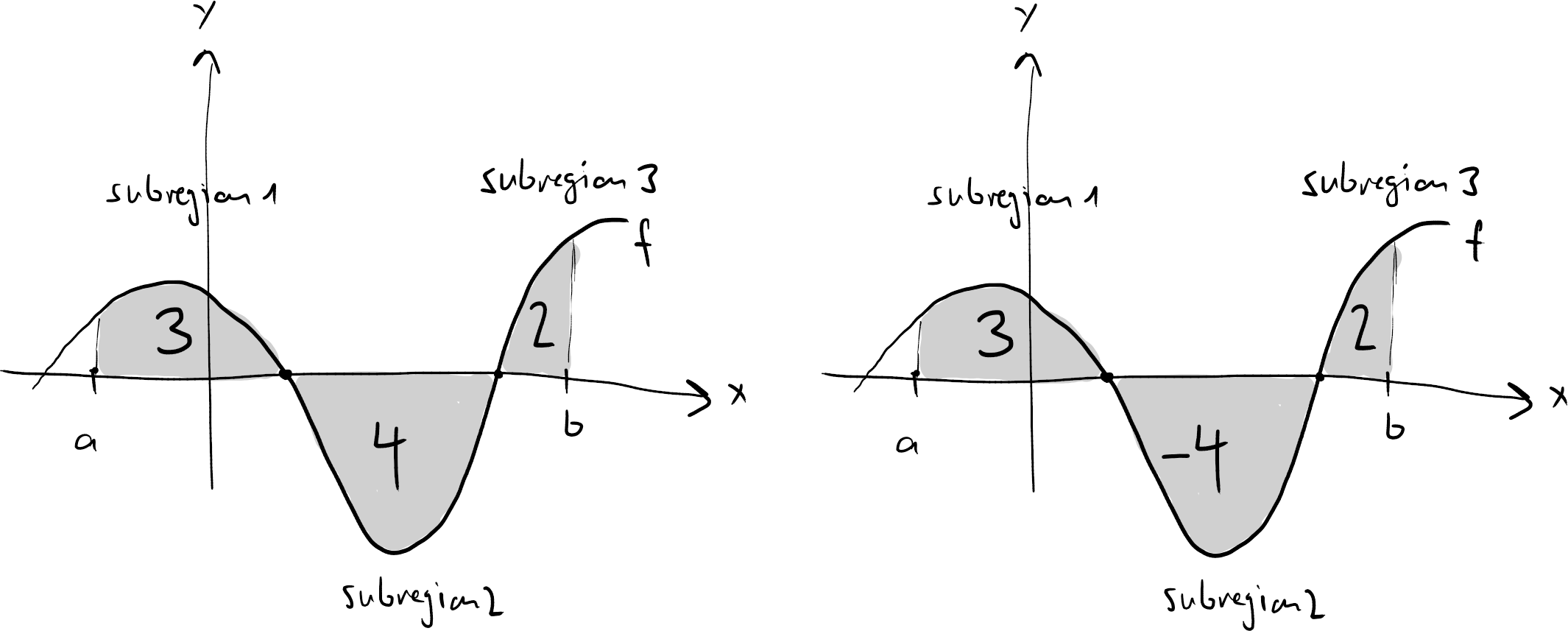
In the gray shaded region above, there are two values we can assign the shaded area, depening on how we deal with the part of the region that is below the -axis: the normal area (left) is , while the signed area (right) is . Signed areas are interesting because physical constants like work or current can also be negative, translating in negative areas.
Consider a function and two values and on the -axis, where . The signed area of the region bounded by the graph of , the -axis, and the vertical lines and is denoted by
Integral of from to
(read as ":defthe integral of f from a to b). The values and are called the limits of integration (specifically, the lower and upper limits, respectively).
- Determine if the integral below is positive or negative
- Determine the value of the integral below:
Hint: Draw the graph.
Solution
Draw the graphs!
-
- positive
- negative
- In both cases the signed area is , because both subregions are the same, but one is above, the other below the -axis. Thus the sum of the two areas equals .