Elevation and depression
A note about measuring angles. Trigonometry is often used to determine the height of an object (e.g. a building), or the depth of an object (e.g. a valley). This involves measuring angles relative to a horizontal (that's where the observer making the measurements is located).
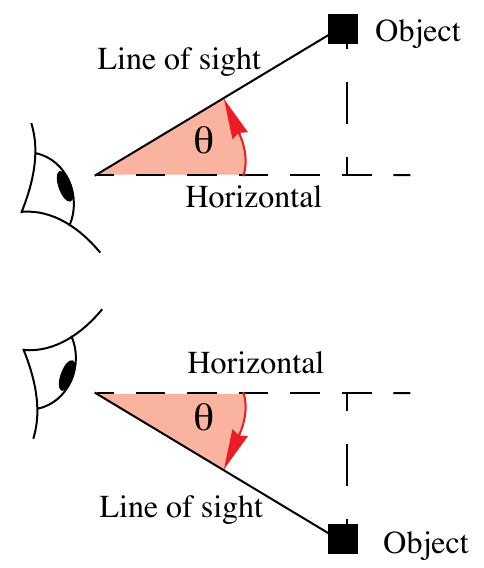
If the object is above the horizontal, the angle (say “theta”, ) between the horizontal and the line of sight is called the angle of elevation (elevation means "Erhöhung").
If the object is below the horizontal, the angle between the horizontal and the line of sight is called the angle of depression (depression means "Einsenkung").
-
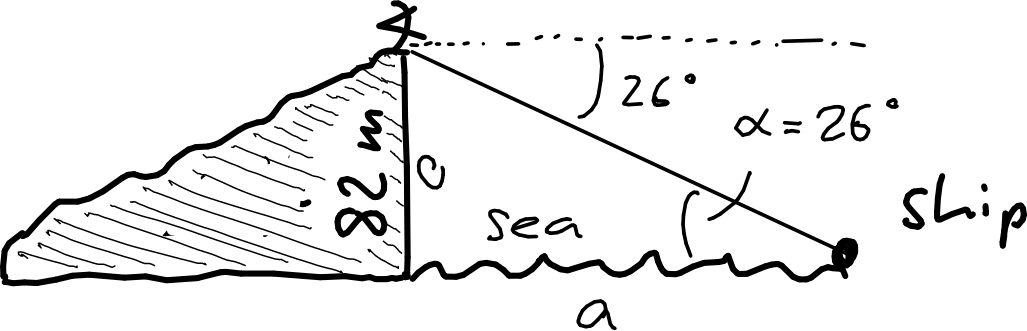
An observer standing on the edge of a cliff above sea level sees a ship at an angle of depression of . How far from the base of the cliff is the ship situated?
-
From a point A on the ground, the angle of elevation to the top of a tree is . If the tree is away from point A, find the height of the tree.
-
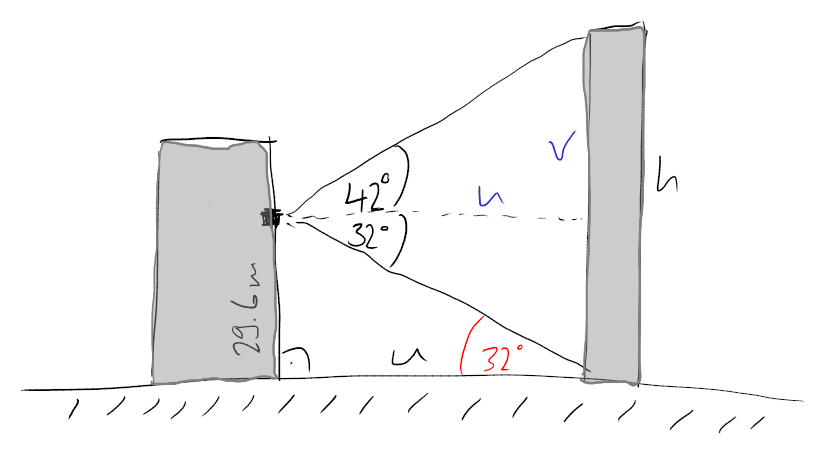
From a window in a building, above the ground, you can see a tower. You see the roof of the tower at an angle of elevation of , while the angle of depression to the foot of the tower is . Find the height of the tower.
Solution
-
-
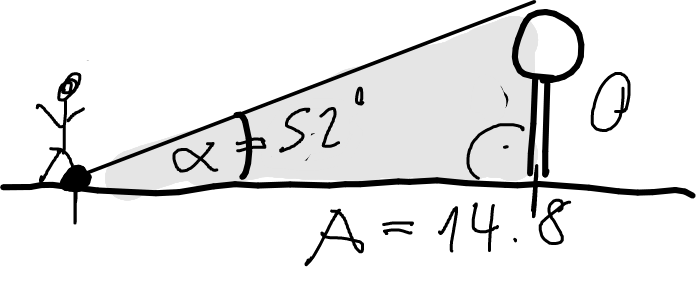
- See figure below.
, thus .
, thus .
It follows that .