Arcsin, arccos, and arctan

Consider a right-angled triangle, where we want to know the reference angle α\alpha, but all we know is the length ratio OH\frac{O}{H}. For example, assume that OH=0.32\frac{O}{H}=0.32. Can we find the angle α\alpha? So, the question is, for what angle α\alpha is

sin(α)=0.32\sin(\alpha)=0.32

Indeed, this is possible using the calculator. We need the function arcsin\arcsin (say "arc sine") or sin1\sin^{-1} (say "inverse sine"). Depending on the calculator you will see one or the other notation. We then have

sin(α)=0.32α=arcsin(0.32)=18.66\sin(\alpha)=0.32 \rightarrow \alpha=\arcsin(0.32)=18.66^\circ

We can check if this is true by inserting 18.6618.66^\circ into the sine: sin(18.66)=0.32\sin(18.66^\circ)=0.32.

Similarly,

To summarise, we have

Definition 1

Finding the angle of given side length ratios:

sin(α)=OH givenα=arcsin(OH)cos(α)=AH givenα=arccos(AH)tan(α)=OA givenα=arctan(OA)\begin{array}{lll} \sin(\alpha) = \frac{O}{H}\text{ given} &\rightarrow& \alpha=\arcsin(\frac{O}{H})\\[4pt] \cos(\alpha) = \frac{A}{H}\text{ given} &\rightarrow& \alpha=\arccos(\frac{A}{H})\\[4pt] \tan(\alpha) = \frac{O}{A}\text{ given} &\rightarrow& \alpha=\arctan(\frac{O}{A}) \end{array}
Exercise 1

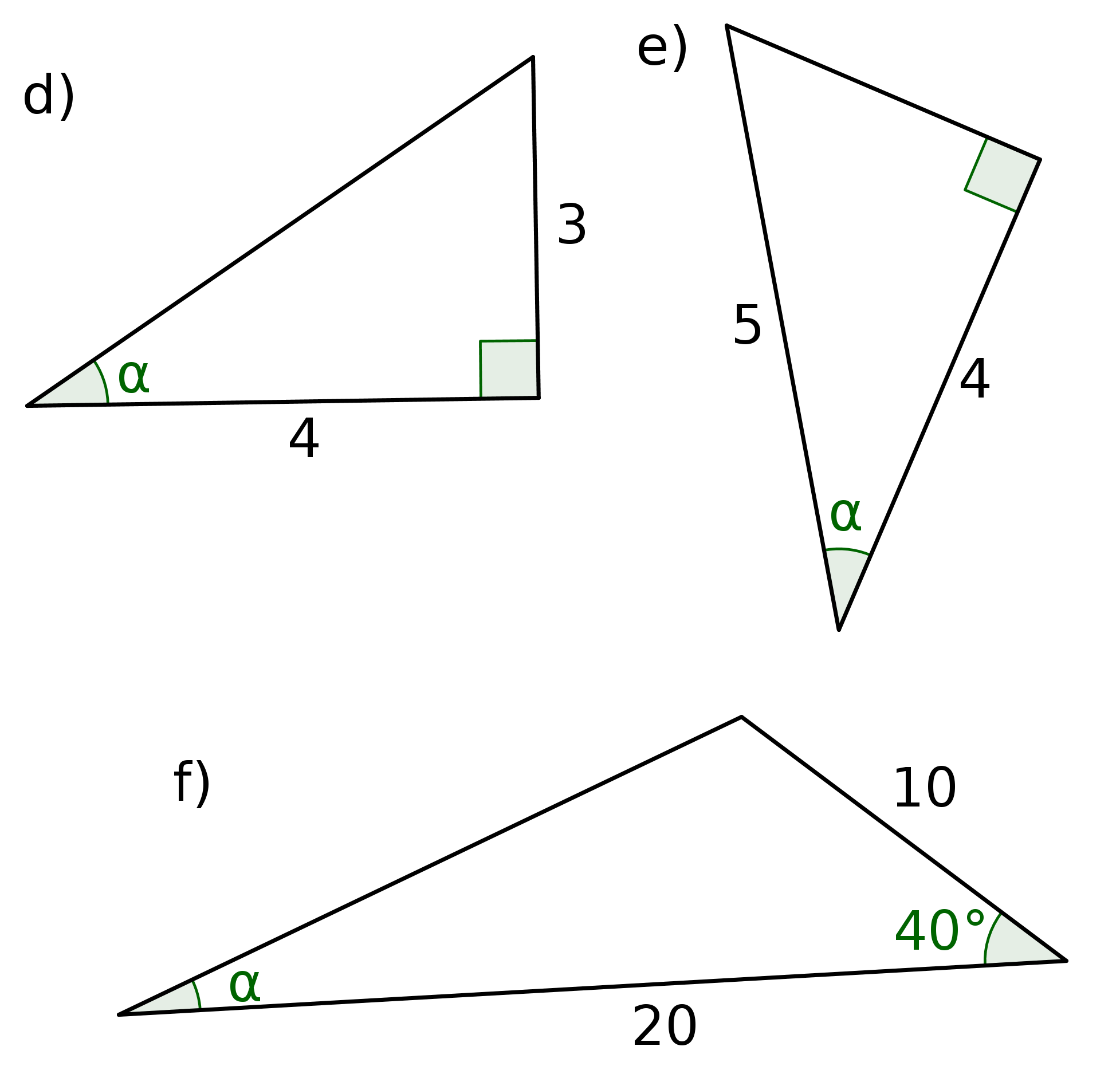
Determine the angle α\alpha in the triangles shown below.

Solution
  • (d) tan(α)=34=0.75α=arctan(0.75)=36.86...\tan(\alpha)=\frac{3}{4}=0.75 \rightarrow \alpha=\arctan(0.75)=36.86...^\circ
  • (e) cos(α)=45=0.8α=arccos(0.8)=36.86...\cos(\alpha)=\frac{4}{5}=0.8 \rightarrow \alpha=\arccos(0.8)=36.86...^\circ
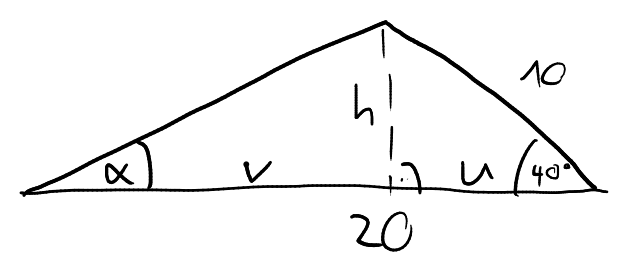
  • (f) See the figure below. It is h=10sin(40)=6.428h=10\cdot \sin(40^\circ)=6.428 u=10cos(40)=7.66u=10\cdot \cos(40^\circ)=7.66 v=20u=12.34v=20-u=12.34 Thus, we have tan(α)=hv=0.52\tan(\alpha)=\frac{h}{v}=0.52 and therefore α=arctan(0.52)=27.47\alpha=\arctan(0.52)=27.47^\circ
Exercise 2
  1. Determine all angles and side lengths.
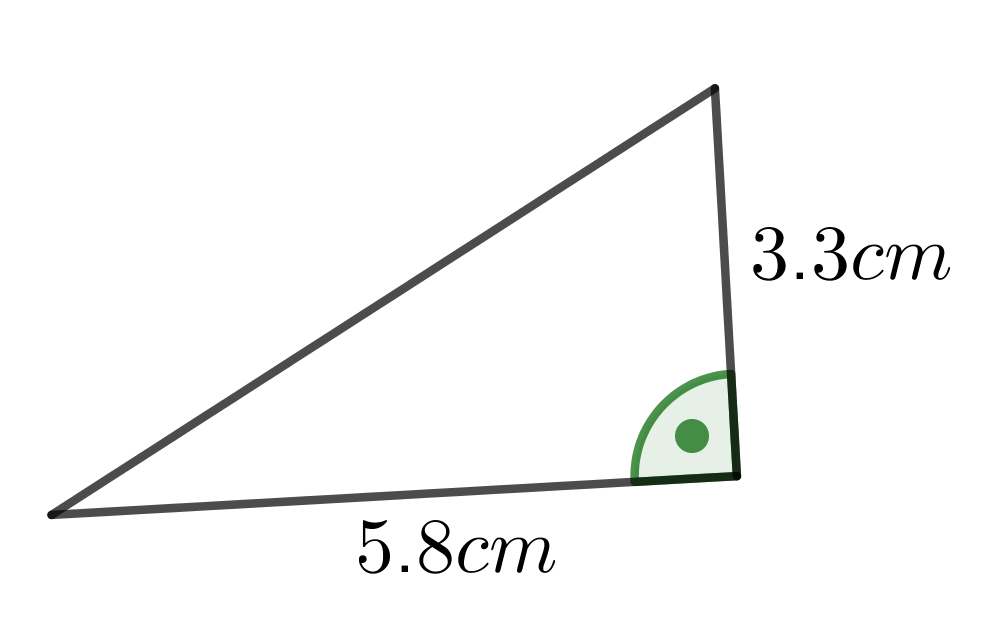
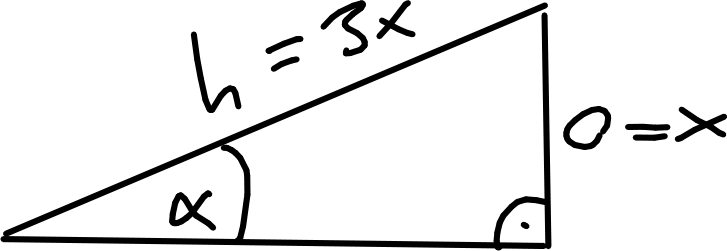
  2. A right-angled triangle has a hypotenuse that is three times longer than the smaller of the other two sides. Determine the exact angles.

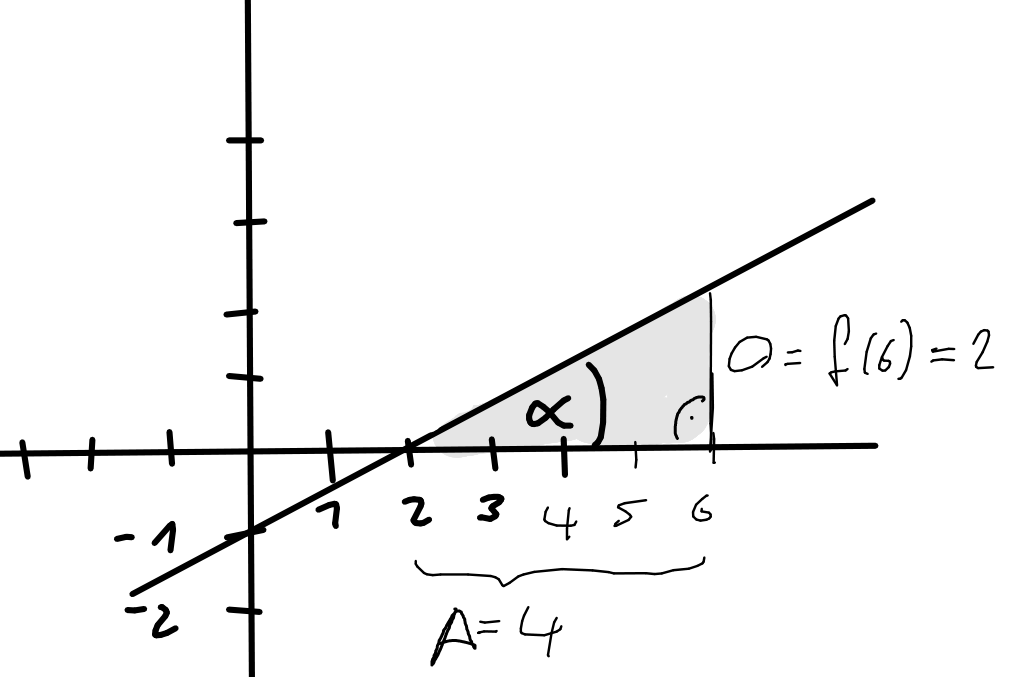
  3. Determine the angle of intersection between the graph of the function f(x)=12x1f(x)=\frac{1}{2}x-1 and the xx-axis.

Solution
  1. OA=3.35.8=0.569α=arctan(0.569)=29.64\frac{O}{A}=\frac{3.3}{5.8}=0.569 \rightarrow \alpha=\arctan(0.569)=\underline{29.64^\circ}. the other angle is β=1809029.6=60.36\beta=180^\circ-90^\circ-29.6^\circ=\underline{60.36^\circ}. The longest side can be determined using Pythagoras: H=3.32+5.82=6.67H=\sqrt{3.3^2+5.8^2}=\underline{6.67}.
  2. OH=x3x=13arcsin(13)=19.47\frac{O}{H}=\frac{x}{3x}=\frac{1}{3} \rightarrow \arcsin(\frac{1}{3})=\underline{19.47^\circ}. The other angle different from 9090^\circ is 9019.47=70.5390^\circ-19.47^\circ=\underline{70.53^\circ}.
  3. We can select a right-angled triangle as shown in the figure below, and it follows OA=24=12α=arctan(12)=26.565\frac{O}{A}=\frac{2}{4}=\frac{1}{2}\rightarrow \alpha=\arctan(\frac{1}{2})=\underline{26.565^\circ}