Polynomials
A quadratic function
is also called a polynomial of degree 2. polynomials with larger degrees can be formed by adding terms of the form , and so on. The term with the largest power determines the degree of the polynomial.
- is a polynomial of degree .
- is a polynomial of degree
- is a polynomial of degree (a linear function)
- for all is a polynomial of degree (a constant function). Why of degree ? Because we can write , since .
- is a polynomial of degree .
- is still a polynomial of degree .
The numbers in front of the -terms are called (as always) coefficients. They can assume all values. So, let's give a general definition of polynomials:
In general, a polynomial of degree (where can have the value ) has the following form:
where for the coefficient must hold (otherwise the degree of the polynomial is not ).
A few more remarks:
-
We usually write down the polynomials sorted by descending power. So rather like this:
we write
-
All -terms occurring in the polynomial must have the form . If several such -terms occur, they are combined. For example:
is summarised to
-
If -terms with other powers occur, for example
or
then these are not polynomials.
It is often possible to transform a function into a polynomial.
Can the following functions be converted into a polynomial? If so, what is the degree? Use the correct notation (sorted, same terms combined, see comments above).
Solution
- no polynomial.
- , polynomial of degree
- polynomial of degree
- polynomial of degree
- , polynomial of degree
- , polynomial of degree
- polynomial of degree
- polynomial of degree .
The graph of polynomials of a degree or higher can often be compared to a landscape, with hills and valleys (see picture below).
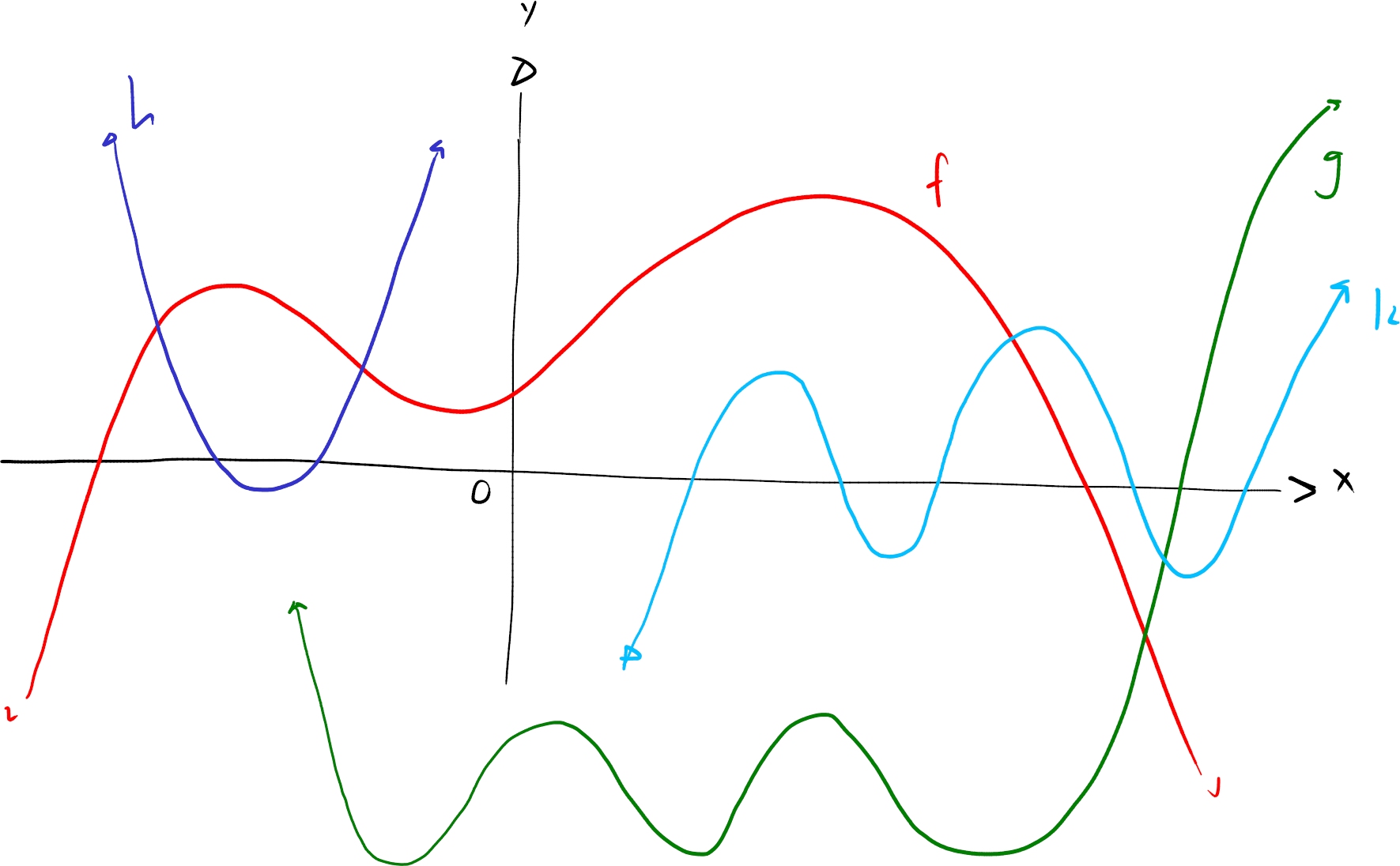
We already know the graph of some polynomials:
- constant function, e.g. (horizontal line)
- linear function, e.g. (a straight line)
- quadratic function, e.g. ( or form, a parabola).
With the exception of the constant function, the graphs of polynomials always tend towards (upwards) or towards (downwards). This is indicated in the picture above with arrows on the graphs. So if we run sufficiently far to the right or to the left on the -axis, the hills and valleys will eventually stop and the graph will only go up or only down.
Whether the graph of a polynomial finally tends upwards or downwards can be seen from the term with the highest power (the degree). This is so because for -values far away from the zero point (to the left or to the right) this term dominates all other terms. By this we mean that all other terms are so much smaller that they can be neglected. To illustrate this, consider the function
For large -values (say ) or for large negative -values (say ) the following applies
that is, all other terms can be neglected. In fact we have
and
thus
Using the function it is easy to read the behaviour of the graph, hence whether it tends upwards or downwards (upwards). Indeed, the graph of the function is a power function , scaled in -direction by .
In general, we have the following:
For large positive or large negative -values, a polynomial of degree is basically a power function of degree :
The following tasks are to be solved without calculator.
Q1
Determine whether for the following polynomials the graph tends upwards or downwards for large positive and negative values.
Q2
Is the power function a polynomial? If so, determine the degree, and the behaviour of the graph for large positive and negative values.
Solution
A1
-
, so for large positive values the graph goes down, and for large negative values it goes up.
-
We have
so for large positive -values the graph goes down, and for large negative -values as well.
-
It is
so for large positive values the graph goes down, and for large negative values it goes up.
A2
It is
and thus it follows that is a polynomial of degree . Because
it follows that the graph tends upwards for large positive -values as well as for large negative -values.