The derivative of exponential functions

Recall: Prior Knowledge

The exponential function has the general form f(x)=bxf(x)=b^x, where bb is the base. An often used base is e=2.71828182845...e=2.71828182845... (Euler's number), that is, f(x)=exf(x)=e^x. It turns out that the derivative of this exponential function is particularly simple.

Also recall that logb(b)=1\log_b(b)=1 for all bases bb, and in particular that ln(e)=1\ln(e)=1, as ln\ln is a shorthand for loge\log_e.

Theorem 1

The derivative of an exponential function is the same exponential function, but multiplied by some constant:

Equation 1
f(x)=bxf(x)=ln(b)bxf(x)=b^x \overset{\prime}{\rightarrow} f'(x)=\ln(b)\cdot b^x

Derivative of exponential function

In particular, it follows from this rule that

Equation 2
f(x)=exf(x)=exf(x)=e^x \overset{\prime}{\rightarrow} f'(x)= e^x
Proof

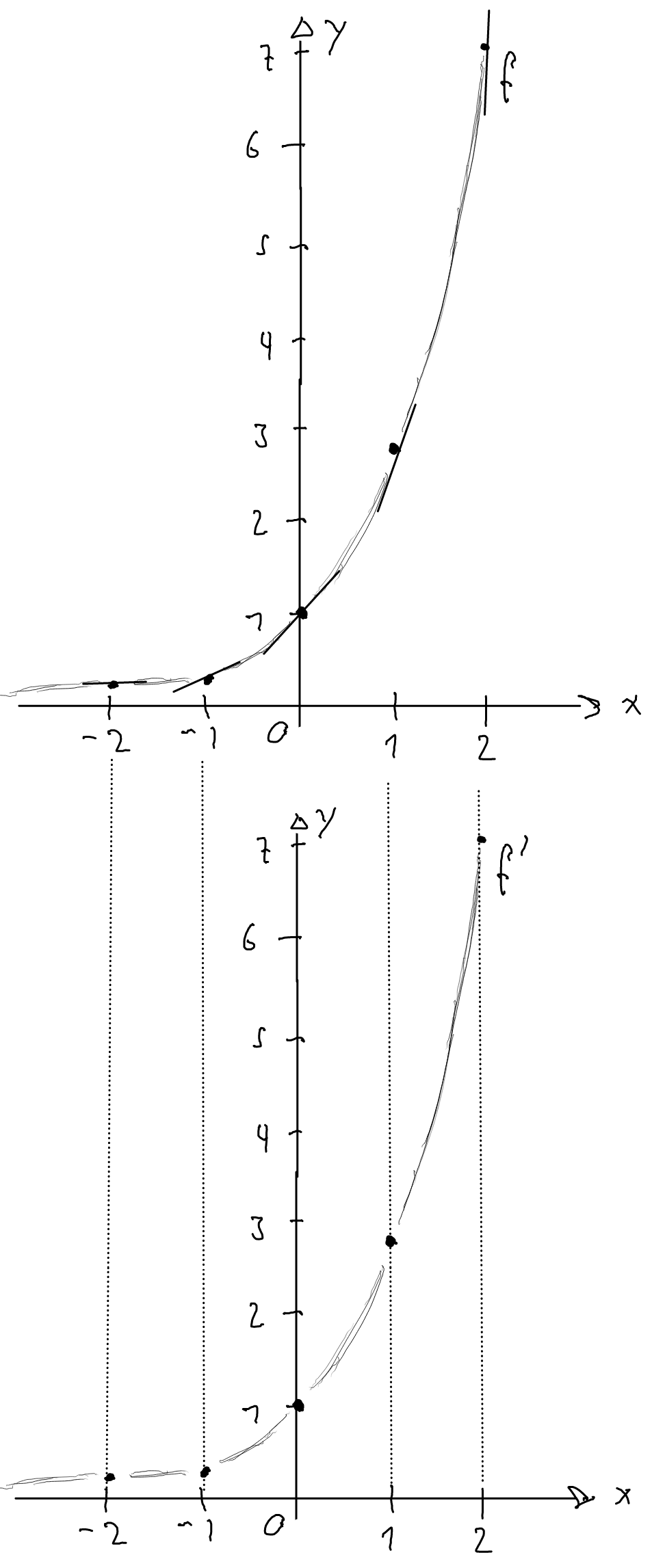
We just give an argument why this is plausible, using graphical differentiation. We use a concrete example: f(x)=exf(x)=e^x. Sketching the graph of f(x)=exf(x)=e^x and then determining graphically the graph of the derivative ff', we see that the graph of ff' looks very similar to the graph of ff; that is, we suspect that f(x)=exf'(x)=e^x as well. A more formal, mathematical proof is shown in the collapsed exercise below, but it is not expected to know it.

The reason for the appearance of the factor ln(b)\ln(b) will be explained later.

Figure 1

The graphical derivative of f(x)=exf(x)=e^x suggests that the derivative of exe^x is also exe^x.

Warning

A common mistake is to apply the power rule for the exponential function; for example, for f(x)=2xf(x)=2^x, you might incorrectly write f(x)=x2x1f'(x)=x\cdot 2^{x-1}. Always check if the function you want to derive is an exponential function (2x2^x) or a power function (x2x^2).

Example 1

Calculate the derivative using the exponential rule we just learned about:

  • f(x)=2xf(x)=ln(2)2x=0.69314...2xf(x)=2^x \rightarrow f'(x)=\ln(2)\cdot 2^x = 0.69314... \cdot 2^x
  • f(x)=exf(x)=ln(e)=1ex=exf(x)=e^x \rightarrow f'(x)=\underbrace{\ln(e)}_{=1} \cdot e^x = e^x

So we can use the general rule as well to see that the derivative of exe^x is again exe^x.

Here are some more formal arguments for proving the exponential rule, but you can skip them and read them later.

Show
Exercise 1

Use the differential quotient to show that the derivative of f(x)=exf(x)=e^x is f(x)=exf'(x)=e^x.

Hint:

eh1h1(for h0)\frac{e^h-1}{h} \rightarrow 1\quad (\text{for } h\rightarrow 0)
Solution

The differential quotient is

f(x)=limh0f(x+h)f(x)hf'(x)=\lim_{h\rightarrow 0} \frac{f(x+h)-f(x)}{h}

We have

f(x+h)f(x)h=ex+hexh=exehexh=ex(eh1)h=eh1hex\begin{aligned} \frac{f(x+h)-f(x)}{h} & = \frac{e^{x+h}-e^x}{h} \\ & = \frac{e^x\cdot e^h-e^x}{h} \\ & = \frac{e^x\cdot (e^h-1)}{h} \\ & = \frac{e^h-1}{h}\cdot e^x \end{aligned}

Now we have a problem because if we insert h=0h=0, we get eh1h=00\frac{e^h-1}{h}=\frac{0}{0}, and there is no obvious way to get rid of the hh in the denominator. So let us find out numerically what is going on. Inserting smaller and smaller values for hh, we see that the quotient eh1h\frac{e^h-1}{h} converges towards 11.

Thus we see that

eh1h1(for h0)\frac{e^h-1}{h} \rightarrow 1\quad (\text{for } h\rightarrow 0)

and therefore it is indeed f(x)=exf'(x)=e^x.

Exercise 2

Use a similar proof to show that

f(x)=2xf(x)=ln(2)2xf(x)=2^x \rightarrow f'(x)=\ln(2)\cdot 2^x

Hint: ln(2)=0.6931471805599453...\ln(2)=0.6931471805599453...

Solution

The difference quotient is

f(x+h)f(x)h=2x+h2xh=2x2h2xh=2x(2h1)h=2h1h2x\begin{aligned} \frac{f(x+h)-f(x)}{h} & = \frac{2^{x+h}-2^x}{h} \\ & = \frac{2^x\cdot 2^h-2^x}{h} \\ & = \frac{2^x\cdot (2^h-1)}{h} \\ & = \frac{2^h-1}{h}\cdot 2^x \end{aligned}

Inserting smaller and smaller values for hh, we see that the quotient 2h1h\frac{2^h-1}{h} converges towards ln(2)\ln(2).

Thus we have f(x)=ln(2)2xf'(x)=\ln(2)\cdot 2^x.

Exercise 3
  1. Determine the derivative of ff:
    1. f(x)=7xf(x)=7^x
    2. f(x)=10exf(x)=10 e^x
    3. f(x)=2ex46xf(x)=2 e^x-4\cdot 6^x
    4. f(x)=x44xf(x)=x^4-4^x
  2. Find the equation of the tangent with slope 0.50.5 to the graph of f(x)=35xf(x)=3\cdot 5^x.
  3. Consider the function f(x)=3ex4f(x)=3e^x-4:
    1. Where does the graph of ff intersect the xx-axis, and where the yy-axis?

    2. What is the angle of intersection between the graph of ff and the xx-axis (xx-intercept)?

    3. What is the angle of intersection between the graph of ff and the yy-axis (yy-intercept)?

Solution
    1. f(x)=ln(7)7xf'(x)=\ln(7)\cdot 7^x
    2. f(x)=10exf'(x)=10e^x
    3. f(x)=2ex4ln(6)6xf'(x)=2 e^x - 4\ln(6)\cdot 6^x
    4. f(x)=4x3ln(4)4xf'(x)=4x^3-\ln(4)\cdot 4^x
  1. First, we need to find the point A(xy)A(x\vert y) where the tangent touches the graph. Thus, find xx with

    f(x)=3ln(5)5x=0.5f'(x)=3\ln(5)\cdot 5^x = 0.5

    and thus

    5x=0.53ln(5)5^x=\frac{0.5}{3\ln(5)}

    Taking the logarithm base 5 on both sides, we get

    x=log5(0.53ln(5))1.409x = \log_5\left(\frac{0.5}{3\ln(5)}\right) \approx -1.409

    Thus, y=f(1.409)=351.4090.311y=f(-1.409)=3\cdot 5^{-1.409} \approx 0.311 and A(1.4090.311)A(-1.409\vert 0.311).

    Second, to find the equation t(x)=ax+bt(x)=ax+b of the tangent, we note that a=0.5a=0.5, and therefore

    t(1.409)=0.5(1.409)+b=0.311t(-1.409)=0.5\cdot (-1.409)+b = 0.311

    and it follows b1.02b \approx 1.02. Thus, we have t(x)=0.5x+1.02t(x)=\underline{0.5x+1.02}.

  2. f(x)=3exf'(x)=3e^x

    (a)+(c): yy-intercept: f(0)=3e04=34=1f(0)=3e^0-4=3-4=\underline{-1}. The slope of the tangent at this point is a=f(0)=3e0=3a=f'(0)=3e^{0}=3, which corresponds to an angle of α=arctan(a)=arctan(3)71.565\alpha=\arctan(a)=\arctan(3) \approx 71.565^\circ with respect to the xx-axis. With respect to the yy-axis, the angle is β=90α=18.435\beta=90^\circ - \alpha=\underline{18.435^\circ}.

    (a)+(b): xx-intercept: Find xx with f(x)=3ex4=0ex=43x=ln(4/3)0.288f(x)=3e^x-4=0 \rightarrow e^x=\frac{4}{3} \rightarrow x=\ln(4/3) \approx \underline{0.288}. The slope of the tangent there is a=f(ln(4/3))=3eln(4/3)=4a=f'(\ln(4/3))=3e^{\ln(4/3)}=4, which corresponds to an angle of α=arctan(a)=arctan(4)75.964\alpha=\arctan(a)=\arctan(4) \approx \underline{75.964^\circ} relative to the xx-axis.