Derivative of logarithmic functions
Consider the logarithmic function where is the base (e.g. , or ). The following is true:
Derivative of Logarithmic Function
In particular it follows
Proof
We just give a plausibility argument. Sketching the derivative of , we see that its graph indeed looks similar to the graph of the function .
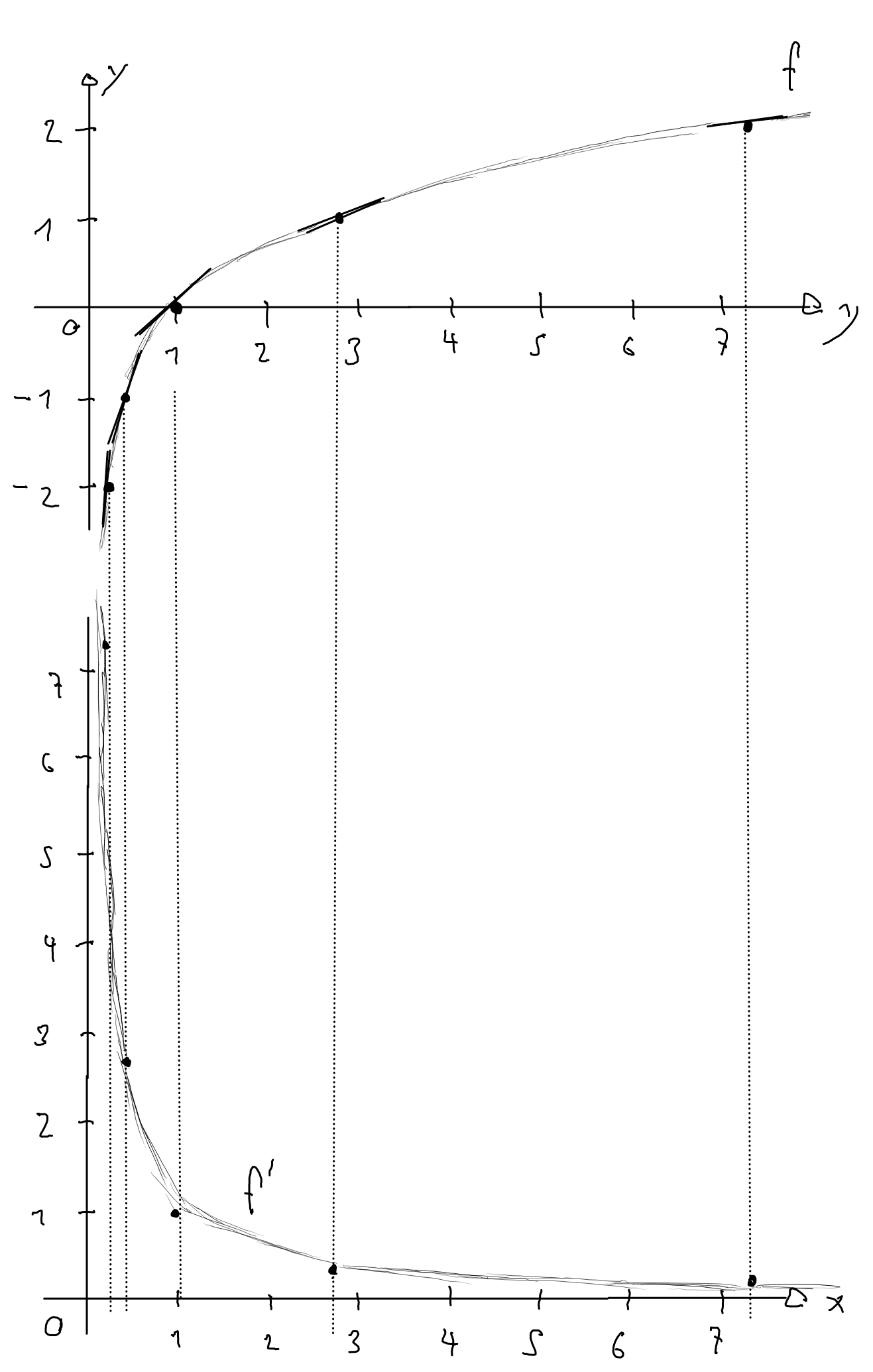
So we can argue (but it is not a proof, of course), that the derative of is . And this turns out to be true. The more general case for will be proven later with the chain rule.
A more formal proof of the theorem is given in the exercise (uncollapse) but can be skipped. The graphical argument is more important.
Show
Prove that the derivative of is . To do so, answer the questions below. You can also use the rule that the derivative of is . Let's use some small exercises for this:
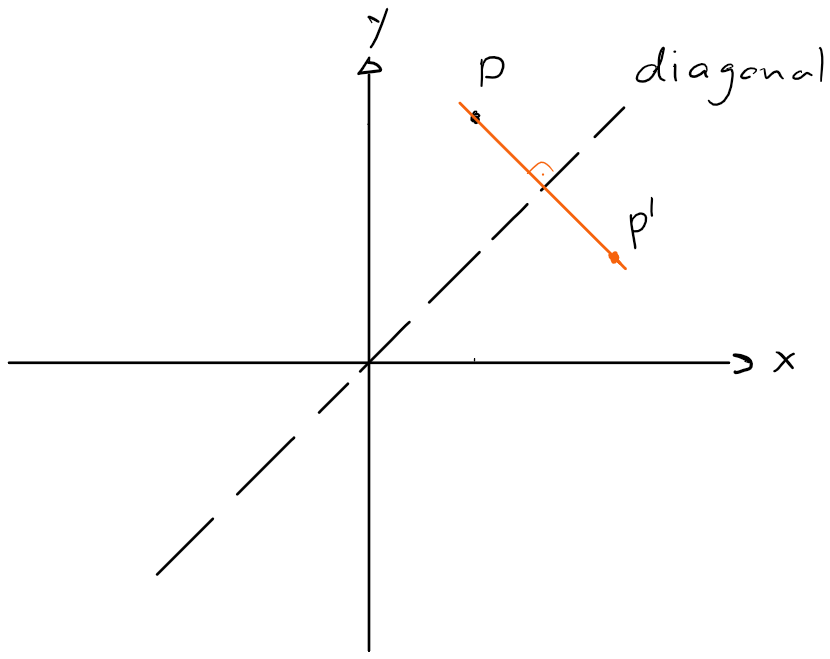
Consider a point . If is reflected about the diagonal, what are the coordinates of the new point ?
Solution
Reflect some points, and you will see that the order of the coordinates switches:
A straight line with slope . If is reflected about the diagonal, what is the slope of the new line ?
Solution
The slope of is .
To see this, pick to points and on and form the slope triangle between these two points. The slope of is . The reflected points and are on and have the coordinates switched, that is, and . Thus, the slope of is .
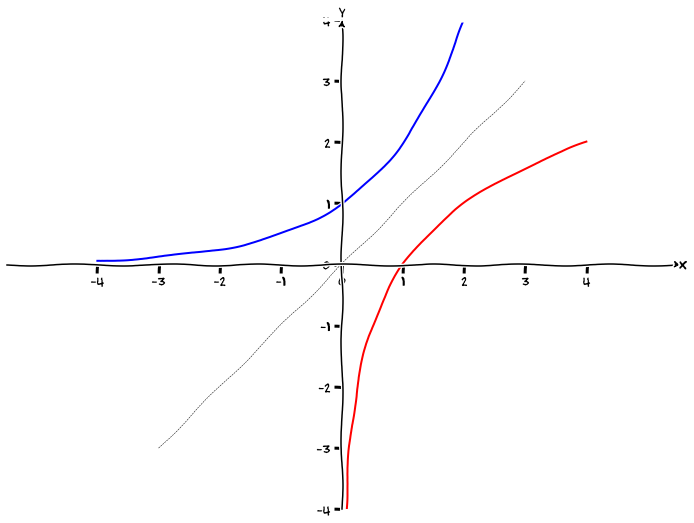
The graphs of the functions and are shown below. Observe that if we reflect the graph of about the diagonal, we obtain the graph of . Can you show this with a calculation? For example, take the point with coordinate on the graph of . Why must the reflected point be on the graph of , and what are its exact coordinates?
Solution
Note that a point is on the graph of a function , if . As is on the graph of , it must have the coordinates .
The reflected point has therefore the switched coordinates . To check if this point is on , we have to show that . And this is indeed the case, because if we set it follows from the definition of the logarithm that . So we have
Put all the pieces together. Can you show that ? More generally, can you show that ? Hint: Use the already proven rule
Solution
Consider the tangent to the graph of at and denote its slope by , that is, . We want to find the value of .
To do so note that the reflected tangent passes through the point (see Q1 and Q3) and is the tangent to the graph of . As the slope of is (see hint), and because (see Q2) we get .
The argumentation for the general rule is similar.
-
Consider the function .
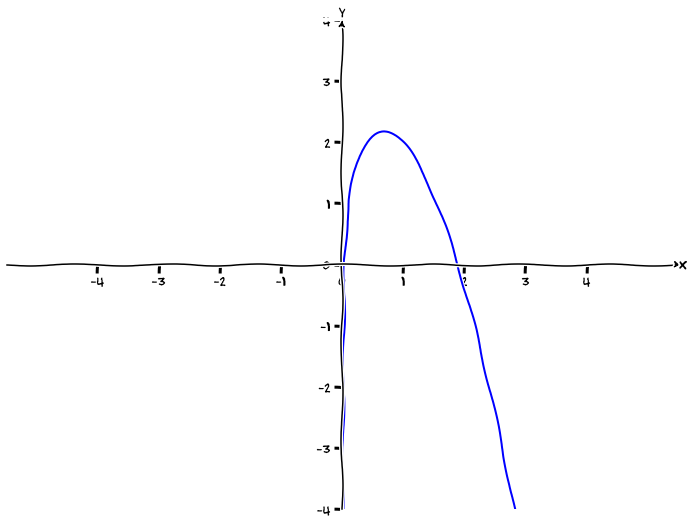
- Sketch the graph of (you can use the calculator).
- Find the coordinates of the highest point of the graph.
-
A straight line passes through the origin and touches the graph of the function at point .
-
Find the coordinates of .
-
Find the angle of intersection between and the -axis.
-
Solution
-
-
To draw the graph, use a table of values (hint: use powers of for the -values). The graph is shown below.
-
The tangent at the highest point of graph has slope , that is, we have to find with . It follows and thus .
-
-
Assume has the (unknown) -coordinates , thus we have . We need to find . Create a figure. You will note that we can express the slope of the line in two different ways:
- Because passes through the origin and through , we can form a slope triangle with and . Thus has slope
- Because is the tangent to the graph of at , we also have .
Taken together, we have two expression for and therefore an equation for :
Multiplying both sides by , we get
In other words, , thus and . The slope of is , the angle of intersection between and the -axis is therefore