The intercepts of graphs
Consider the graph of a function . Each point on the -axis where the graph touches or crosses is called an x-intercept (-Achsenabschnitt), and likewise, each point on the -axis where the graph touches or crosses is called a y-intercept (-Achsenabschnitt).
For example, the graph below has -intercepts at , , and , and a -intercept at .
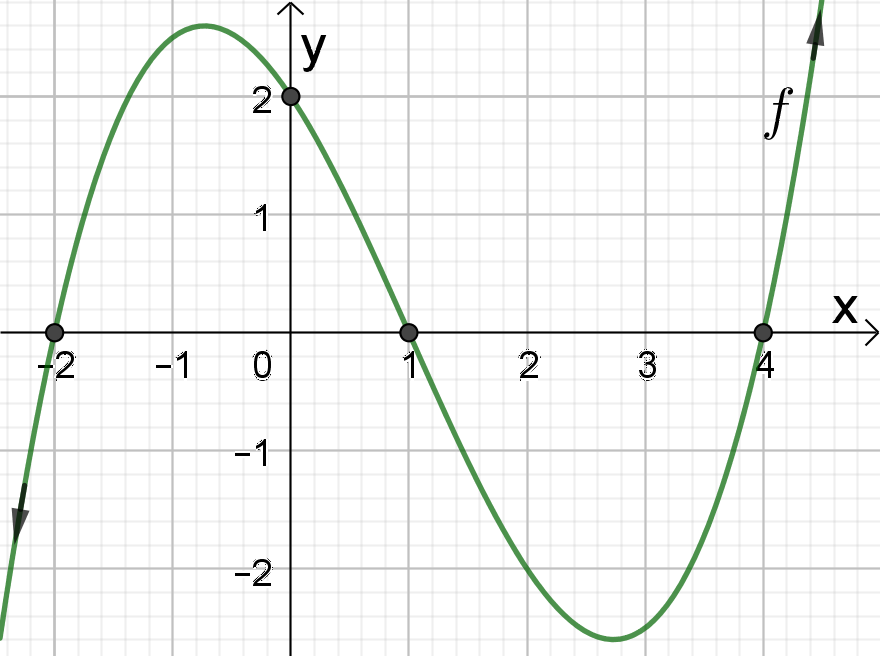
What is the lowest and highest number of possible -intercepts and -intercepts?
Solution
You can have any number of -intercepts, including none. The number of -intercepts, however, is either or . Why is it not possible to have more than one -intercept? Because it's a function! If there is more than one -intercept, the input will have more than output. But then the graph does not represent a function any more.
Now, consider a function whose function equation is known, e.g.
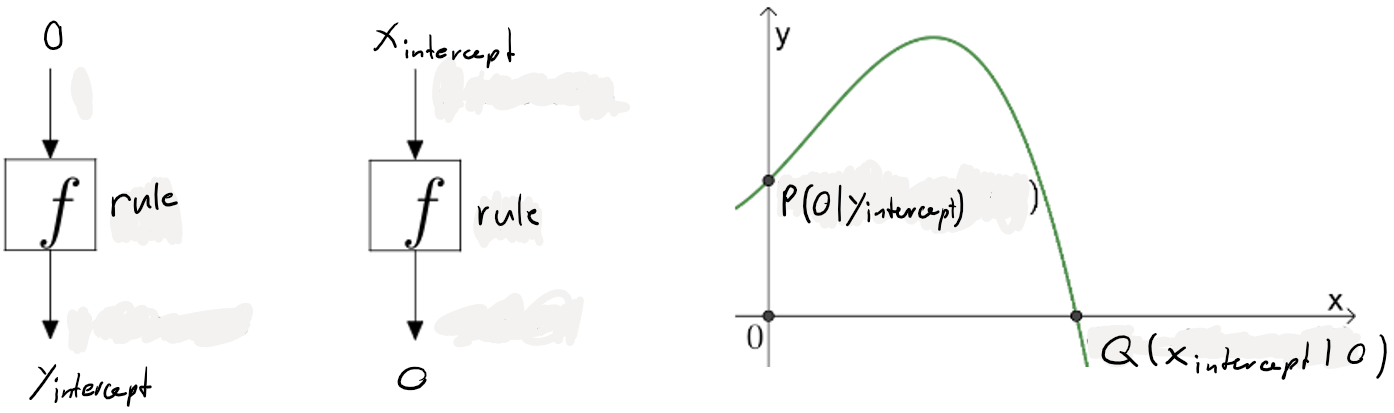
How can we find the -and -intercepts of its graph? The -intercept is on the -axis and therefore is the output to the input . Thus, the -intercept is
Each -intercept is an input value such that the output is :
Because -intercepts indicate the inputs where the output of the function is zero, we also call them the zeros of .
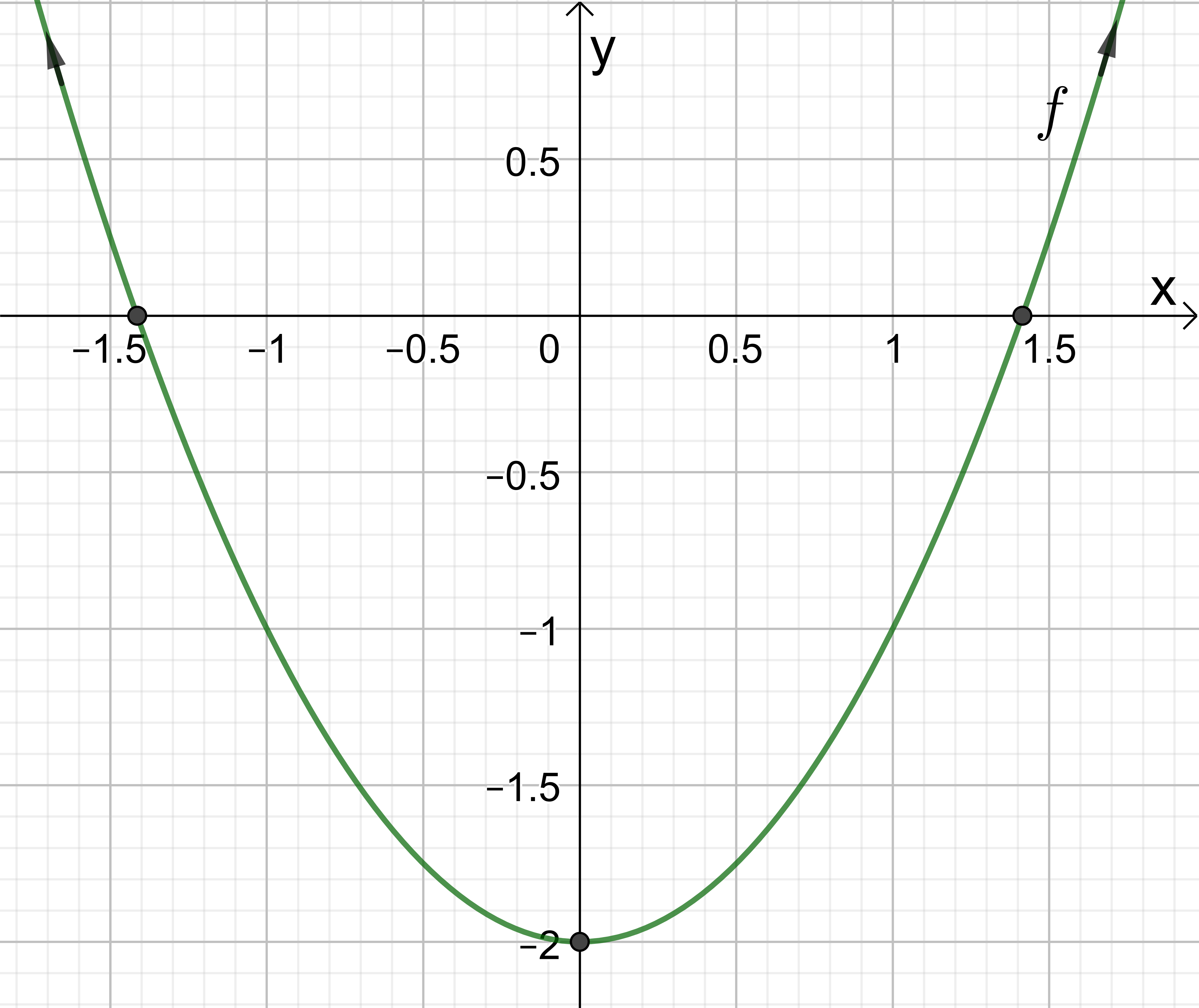
Find the - and -intercept of .
- The -intercept is
- The - intercepts are found by solving the equation , that is
It follows that , that is, we have the two -intercepts and
Indeed, a plot of the graph shows exactly this (uncollapse)
Solution
Q1
Consider the function .
- Draw the graph of .
- Based on the graph, estimate the -intercepts and the -intercept.
- Calculate the -intercepts and the -intercept.
Q2
Calculate the -intercept(s) and the -intercept of the following functions
Q3
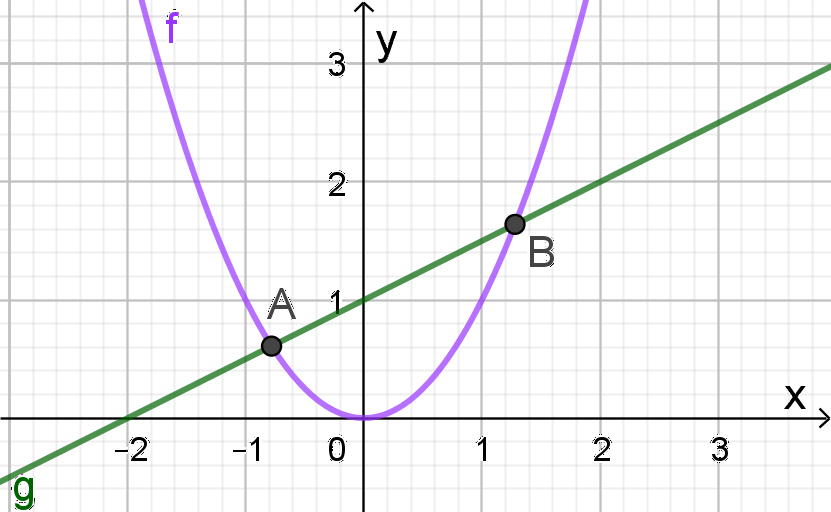
Consider the functions and .
- Draw the graphs of the two functions into the same coordinate system.
- Calculate their -intercepts and -intercept.
- The two graphs intersect. Estimate the points of intersection (- and -coordinates).
Q4
Find the zeros of the following functions:
Solution
A1
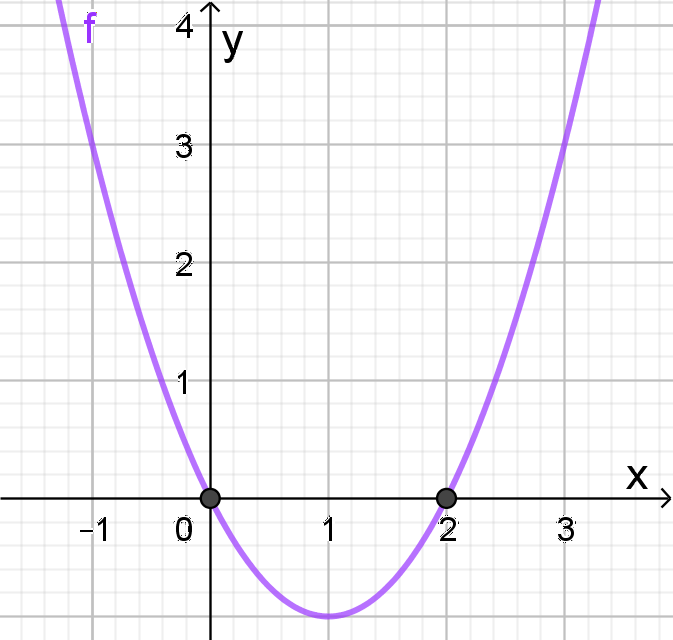
- The graph is shown below
- Graph and
- -intercepts: find with and . -intercept: .
A2
- -intercepts: . -intercept:
- -intercepts: . -intercept:
- -intercepts: no solution, so no -intercept. -intercept:
- -intercepts: and . -intercept:
- -intercepts: and and (each factor has to be zero). -intercept:
- -intercepts: no solution, so no -intercept. -intercept: . As division by is infinity, so no real number, there is also no -intercept.
A3
- The graph is shown below.
- -intercepts of : . -intercept of : . -intercepts of : . -intercept of :
- Estimates based on figure: , .
A4
- Find with . So each factor has to be zero. It follows .
- Find with . Square on both sides, so we get and thus . Taking the root, we get the two zeros .
- Find with . Let's factor out an , thus we get and because each factor has to be zero, we get .