The intersection point between graphs
Consider two functions, e.g.
and
If we draw the graphs, we see that they intersect at two points and (see below). How can we find the coordinates of these points?
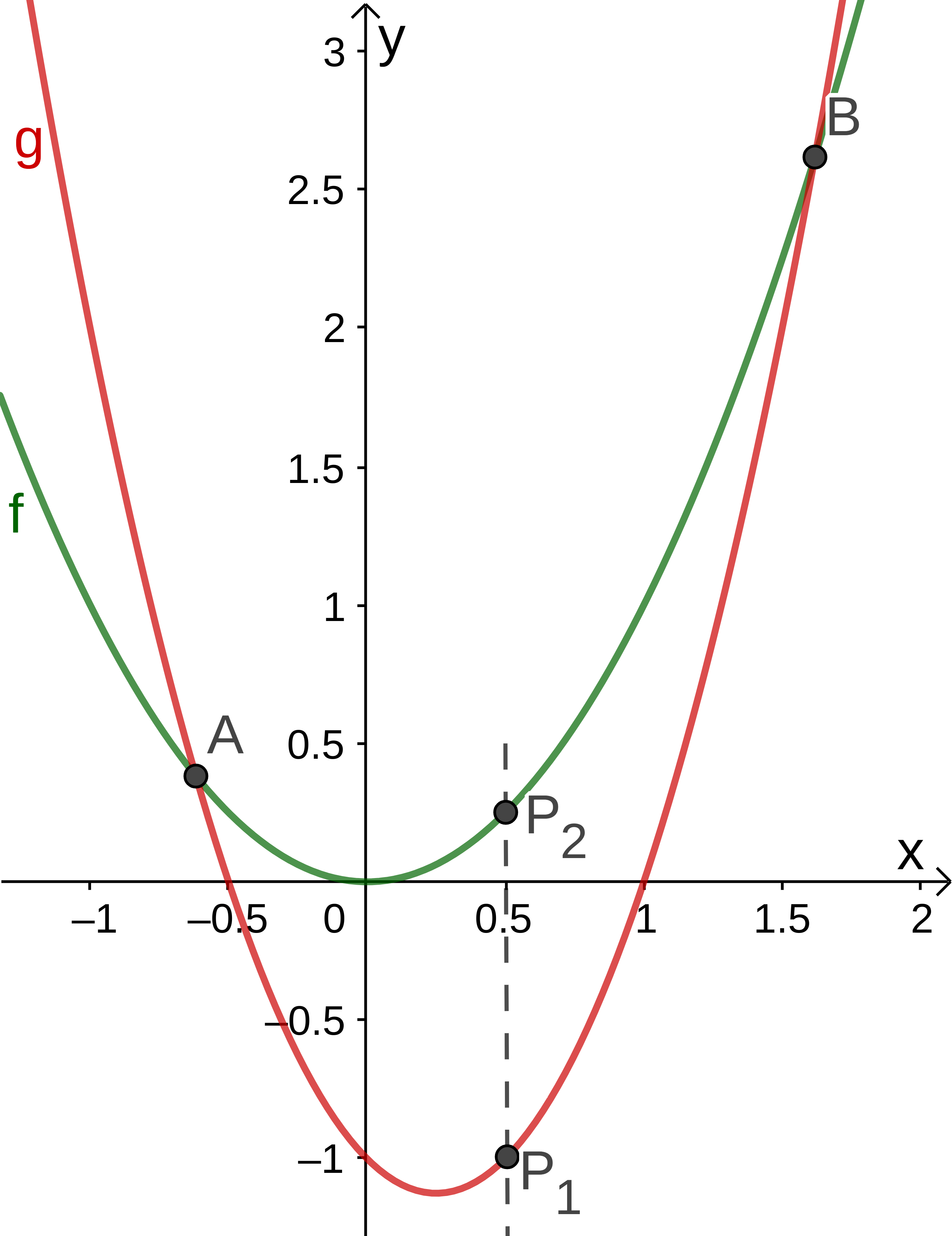
Let's start by noting once more that the values along the -axis represent input values to the machines and , and the values along the -axis are their output values. For example, if we choose input , machine has the output
and machine has the output
giving raise to the two points and on the graph of and . In particular note that although they have the same input, the output (or -coordinate) of the machines are different. This, of course, is to be expected, as they are different machines. Note, however, that at the point of intersection, , machine and machine produce for the same input the same output or -coordinate, and this is also true for point .
A short animation is shown below (uncollapse) ...
Show
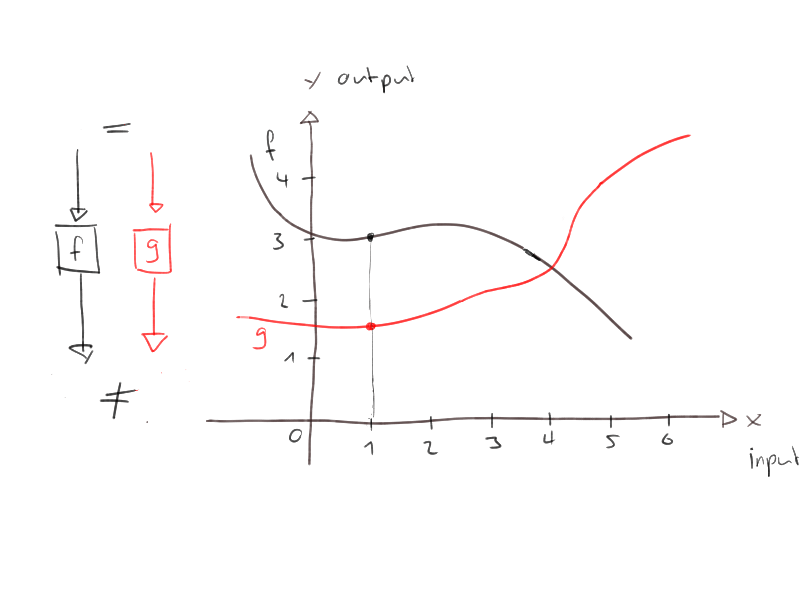
So to find the -coordinate of a point of intersection between and , we have to search for those input values for and which produce the same output:
As and , finding the -coordinate amounts to solving the equation
At the moment we cannot solve this particular type of equation, but it turns out that this equation has the two solutions and (verify it!). So the intersection point has the -coordinate , and has the -coordinate . How do we find out -coordinates of these points? Well, as is on the graph of , the -coordinate of must be
and the -coordinate of must be
As and are also on graph , we could find their -coordinate by using as well:
and the -coordinate of must be
Thus, the points of intersections have the coordinates and .
Find the intersection point(s) between the graphs of and :
-
,
-
,
-
,
-
,
Solution
Find with , then solve the equation to get the -coordinates of the intersection points.
- no solution, so no intersection point!