Calculus - Typical problems
Q1: Curve sketching, area beneath a curve
- Consider the function
- Determine the
- -intercepts,
- -intercept,
- stationary points (classify them)
- inflections points of .
Note: For the inflection point you do not have to calculate the third derivative.
- Determine the area enclosed by , the -axis and the vertical lines passing through the points of the inflection of .
Hint: It can be shown that the derivative of the function is . This does not need to be proved .
- Consider the function . Determine
- -intercepts of
- stationary points of (- und -coordinate)
- Consider the function . Determine at least one
- -intercept,
- one stationary point (- und -coordinate)
- and one inflection point
of the function
Show
A1
- Draw the graph first!
- As we will need the derivatives of , let's calculate them here:
To find the second derivative, we apply the product rule to :
Note that to determine the derivative of we have to apply the chain rule, where the inner function is and the outer function is .
- -Intercept: There is no with , as for all . So no -intercept.
- -intercept:
- stationary points: Find with , that is
This is only possible for . So is the only stationary point. Because of we see that is a local maximum.
- Inflection point: Find with , thus
We actually would have to check if , but we will skip this step. Actually it is the case. So are the inflection points.
- As the graph is always above the -axis, we can simply take the integral for finding the area. From the hint we know that is an antiderivative of (see 2). Thus we have
- It is
- -intercept: find with As for all , it must be . So there is one -intercept at .
- Stationary points: find with :
As for all , it is . Factoring out , we get
and it follows and . The stationary points are therefore and
- It is
- -intercept: . Divide both sides of the equation by
Thus
- Stationary point: , also
- Inflection point: , also
Q2: Parameters
Consider the parametrised functions and (where is a parameter, that is, a fixed number). Find such that the functions and intersect orthogonally. Hint: Two straight lines and are orthogonal if (or if ).
Show
A2
- Step 1: Let's find the point of intersection, that is, find with , that is,
It follows (for ). So independent of the value of , the two graphs always intersect at .
- Step 2: The slope of at is
and the slope of at is
(you must treat as a normal number). Thus, at , the slope of the tangents are
To find such that the two tangents intersect at a right angle, we need to find such that (see hint)
and it follows .
Q3: Determining polynomials
Find the polynomial of degree that touches the -axis in the origin, intersects the -axis at under an angle of .
Show
A3
Q4: Optimisation
Consider the function . Determine the point on the graph of which is closest to the point .
Show
A4
Draw the graph of , chose an and draw the point on the graph of at . It has the coordinates .
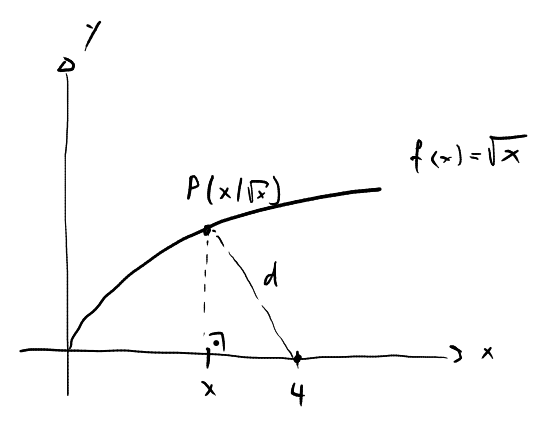
From the theorem of Pythagoras follows that
and thus we have
So find which minimises , that is, find a local minimum of , that is, find with (the gives us the stationary points).
Applying the chain rule to find the derivative of , we get
And because the first factor can never be zero, the only possible solution is that
Plot the graph of to determine if there is a local minimum at , or (more difficult), use the second derivative of to show that . It actually is a local minimum, so we get
Q5: Solid of revolution
The curve , where , is rotated about the x-axis to form a solid of revolution. Find the volume of the solid.
Show
A5
Q6: Area between two graphs
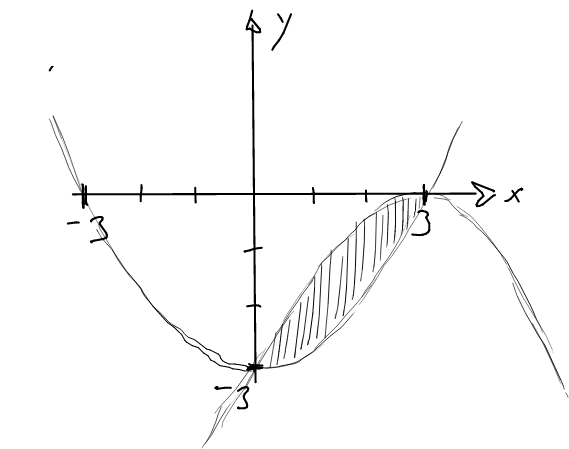
Determine the indicated area. The polynomials have minimal order.
Show
A6
and because of we get , so we have
and because of we get , so we have
To find the area, we need to integrate, so let's find the antiderivatives of and first:
and
The area of the shaded region is then
Q7: Rotated area between two graphs
Rotate the area bounded by and about the -axis.
Show
A7
We can calculate the two solids of revolution of and and subtract one from the other.
First, we need the intersection points:
Which has the solutions and .
If we call the volumes of the solids of revolution and , respectively, we get:
The resulting volume is .
Q8: Angle of intersection
Determine the angle of intersection between the graphs of and .
Show
A8
The intersection point is at , the angle of intersection (angle between tangents at and at ) is (or ).