The vector product of two vectors
Consider two vectors and . The vector product (or cross-product) of and , written is a new vector that is defined as follows
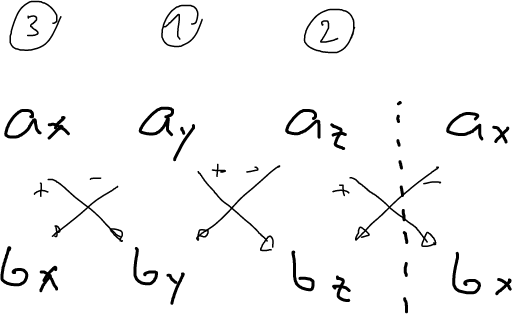
There are several methods for finding the components of the new vector. Here is one:
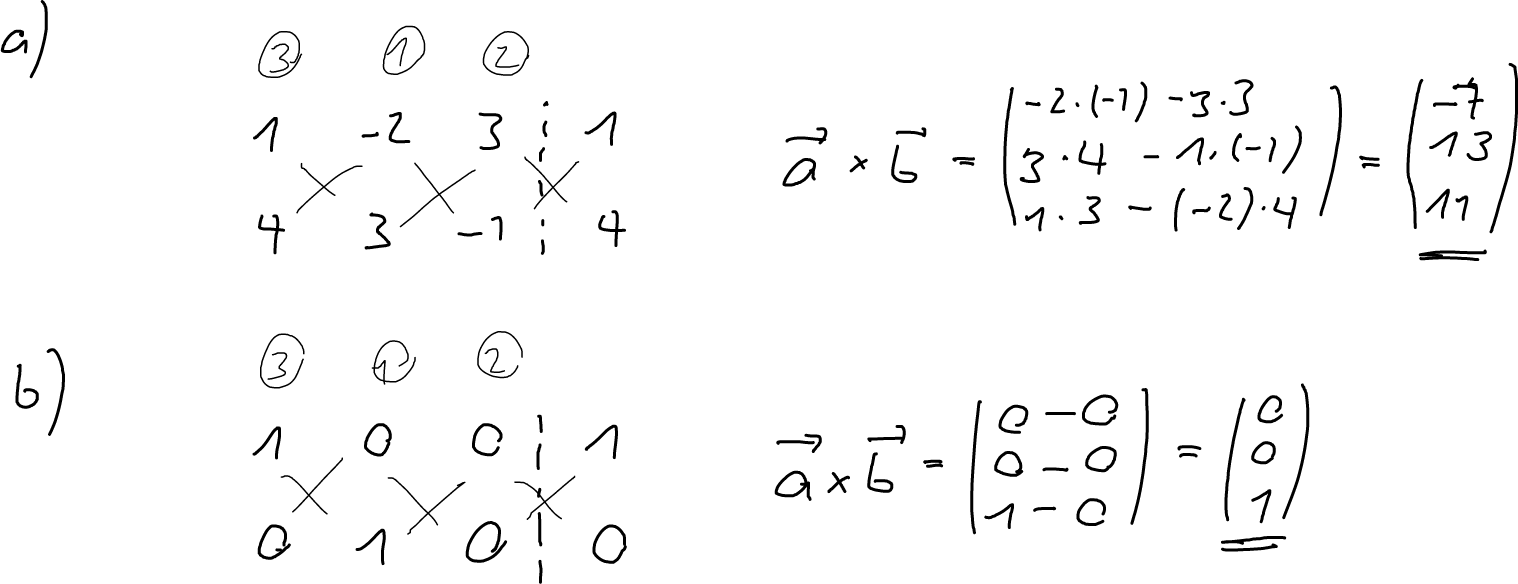
Determine the vector product :
-
,
-
,
Solution
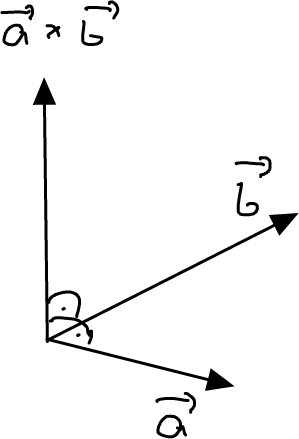
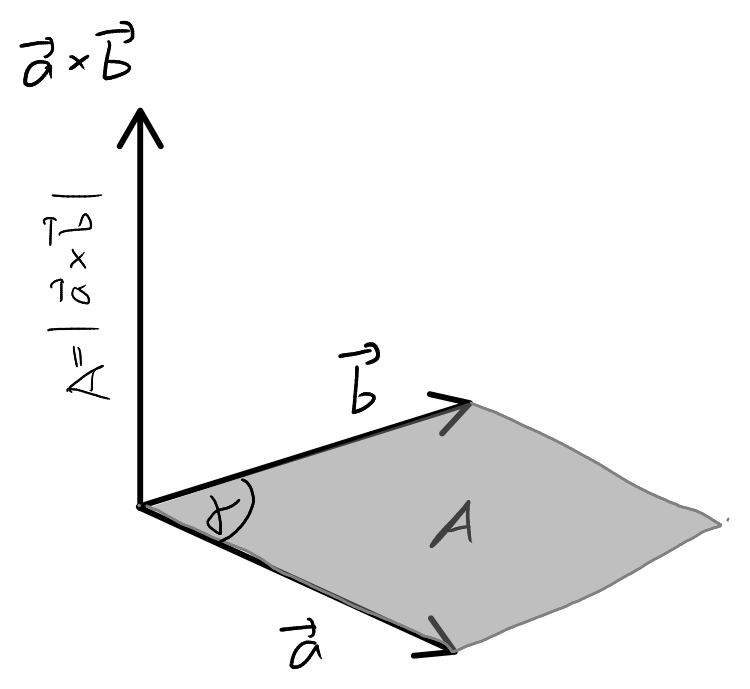
The most important property of the vector product is that the vector is orthogonal to both vectors and (see figure below):
The prove is left as an exercise below.
A typical use case of the first property is to find the normal vector of a plane that is given by three points and (see figure below).
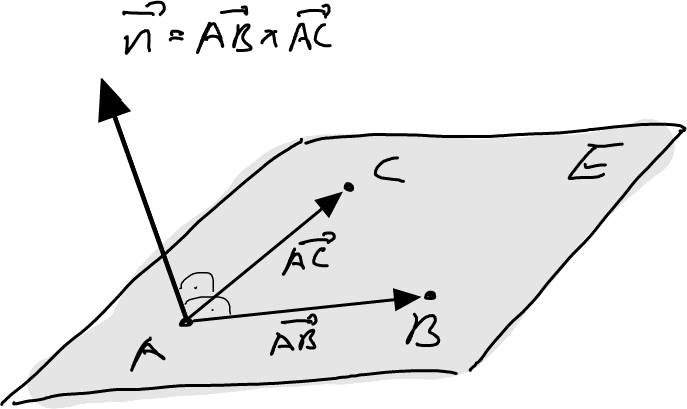
Clearly we have
A plane contains the three points and . Find the normal equation of .
Solution
We first find a normal vector of :
We can choose this vector, or any other that is collinear to this one, e.g.
We take the latter one, as there is less to calculate.
We need a point on to find the normal equation. With point we get and therefore the normal equation is
Note that we could have taken or as well, with the same result.
Another useful property concerns the magnitude of :
Note that the right side of this equation is simply the formula for calculating the area of the parallelogram whose sides are and (see figure below). This proof is rather technical, and is omitted.
Consider the points and .
-
Determine the area of the parallelogram .
-
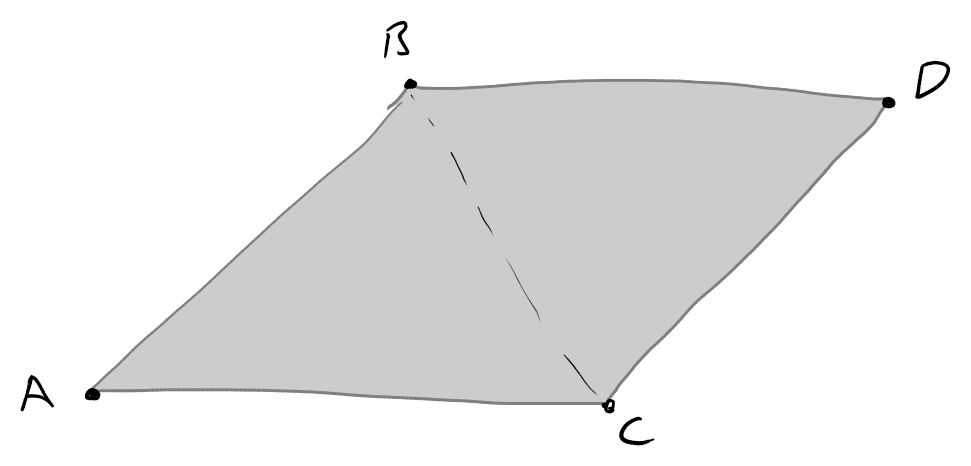
Determine the area of the triangle .
Solution
-
First we calculate the vector product
Thus, the area of the parallelogram is
-
The triangle area is just halve the area of the parallelogram (see figure below), so we have
Q1
Proof that and
Q2
A plane contains the three points , , and . Determine
-
the normal equation of .
-
the area of the triangle .
Solution
A1
We have to show that .
A similar calculation shows that .
A2
-
A normal vector of is
With point in , we get . Thus, the normal equation is
-
We use the magnitude of the vector product: