Derivative of trigonometric functions
We have the following derivatives of the trigonometric functions:
Derivative of trigonometric functions
Note: The input variable must be in radians, otherwise the derivatives above will not be correct!
Proof
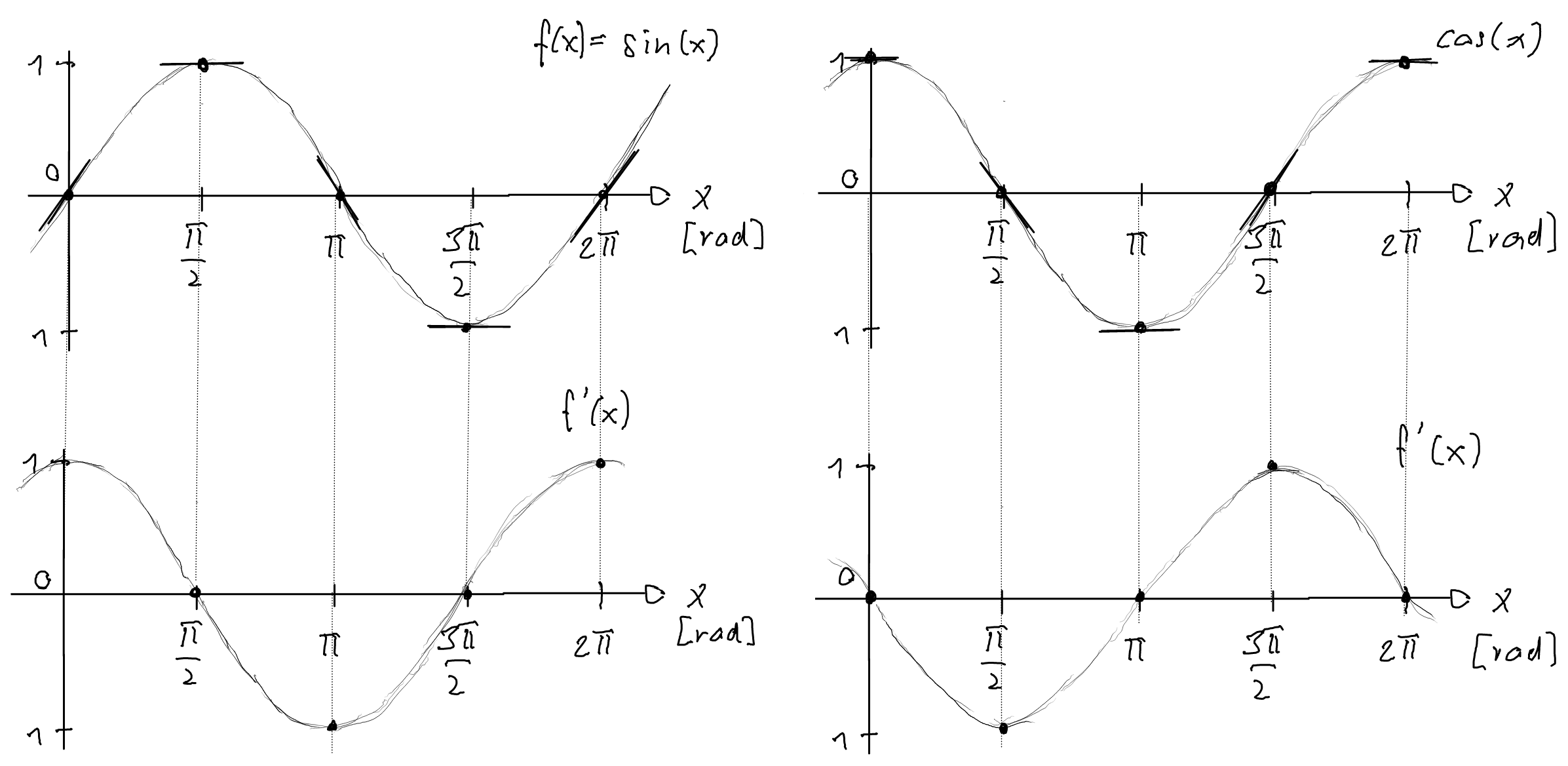
The only justification we give for the correctness of the derivatives of and is a graphical one (see the exercise below). The prove for the derivative of the tangent will be postponed, as we first need to learn about another differential rule (quotient rule).
To find the derivative of and we graphically differentiate those. And we then see imediately that the formulus above must be correct.
If you want to learn more about the for in radians and in degrees, uncollapse.
Show
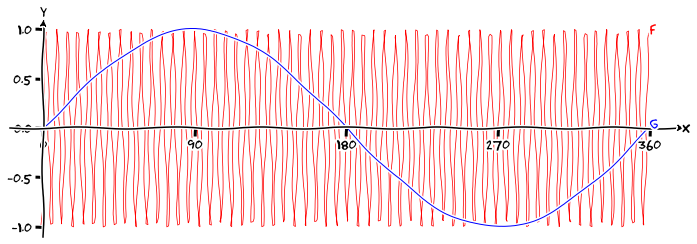
The shape of the graph of , with in radians, differs from the graph of , with in degrees. The two graphs are shown in the figure below.
-
Describe the geometrical operation (shift, rotation, reflection, dilation, ...) to get from the graph of to the graph of .
-
Determine the slope of the tangent to at . Given this value, can you find the slope of the tangent to at ? An intuitive geometrical argument is enough. Hint: Think about what happens to the tangent of a graph if you apply the geometrical transformation identified in (1).
-
Use the result in (1) and (2) to determine .
Solution
- The graph of crosses the -axis at , and the graph of at . This indicates that by the graph of in -direction by the factor we get the graph of .
- Let's denote the tangents at to the two graphs and by and , and their slopes by and . It is . To find , we can argue intuitively as follows: We already know that by stretching the graph of in -direction, we get the graph of . Intuitively, this has to be true for their tangents as well: stretching in -direction we get . And because the stretching factor is , the slope must be times smaller than (make a figure and compare the slope triangles). Thus .
- The argument in (2) is valid for the tangents and at every , so we have
-
Determine the slope of the tangent to the graph of the function at :
-
At what angle does the Sine intersect the Cosine?
-
A tangent to the graph of forms a angle with the -axis. Where does this tangent intersect the -axis?
Solution
- We have
- , thus
- , thus
- Note that for all (horizontal line at ), so everywhere.
- , . Intersection point: find with and thus . Angle between and axis: , angle between Cosine and axis: . From a figure(!) we see that the smallest angle between the two graphs is
- First, we find the point where the tangent touches the graph. The slope of the tangent at is . Find with thus and . It follows . Second, to find the intersection of the tangent with the -axis, we find the equation of the tangent, which is , and with it follows and thus ( is the -intercept, that is, the position where the tangent intersects the -axis.)