Further problems 5
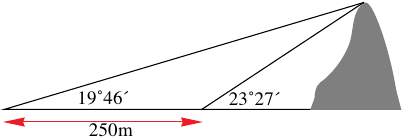
A surveying team are trying to find the height of a hill. They take a "sight" on the top of the hill and find that the angle of elevation is They move a distance of on level ground directly away from the hill and take a second "sight". From this point, the angle of elevation is . Find the height of the hill, correct to the nearest metre. Note: With we mean the angle is and minutes, where a degree has minutes. We can express this angle with a decimal number. For example, should then mean and minutes. So we have
So equal .
Solution
A triangle is formed by two straight lines and and the x–axis. Determine the angles and the area of the triangle.
Solution
, , . Area .
A rectangle has side lengths and . Find the angle of intersection between the two diagonals.
Solution
An isosceles triangle with base has an angle of at the top (vertex).
-
Two points are placed onto the base such that the points divide the base into three equal parts, and two lines are drawn from these two points to the vertex. Determine the three angles at the vertex.
-
The angle at the vertex is divided into three equal parts, forming three triangles. Find the bases of these triangles.
Solution
We have
Consider the two straight lines given by and . Determine the angle of intersection between
-
and the -axis.
-
and .
Solution
It is
Consider a diagonal of a cube. Determine the angle between this diagonal and
-
the side of the cube
-
the other diagonal
Solution
It is
Measured along the surface of the Earth, the distance between Hamburg and München is . What is the maximal depth of a straight tunnel connecting the two cities? Assume Earth is a perfect sphere with radius .
Solution
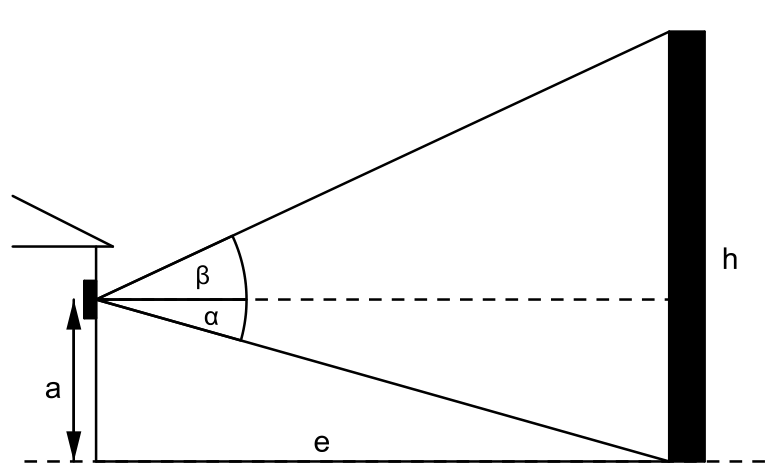
Two buildings, a house and a tower (see figure below). From a window in the house (height is the angle of elevation to the top of the tower . The angle of depression from the window to the base of the tower is . Determine the distance to the tower and the height of the tower.
Solution
Simplify:
Solution
It is