Approximating the integral
While our goal is to find the exact value of an integral, let's start with a less ambitious goal by simply approximate it reasonably well. Let's discuss the method we use with the integral shown below:
Consider the integral
where
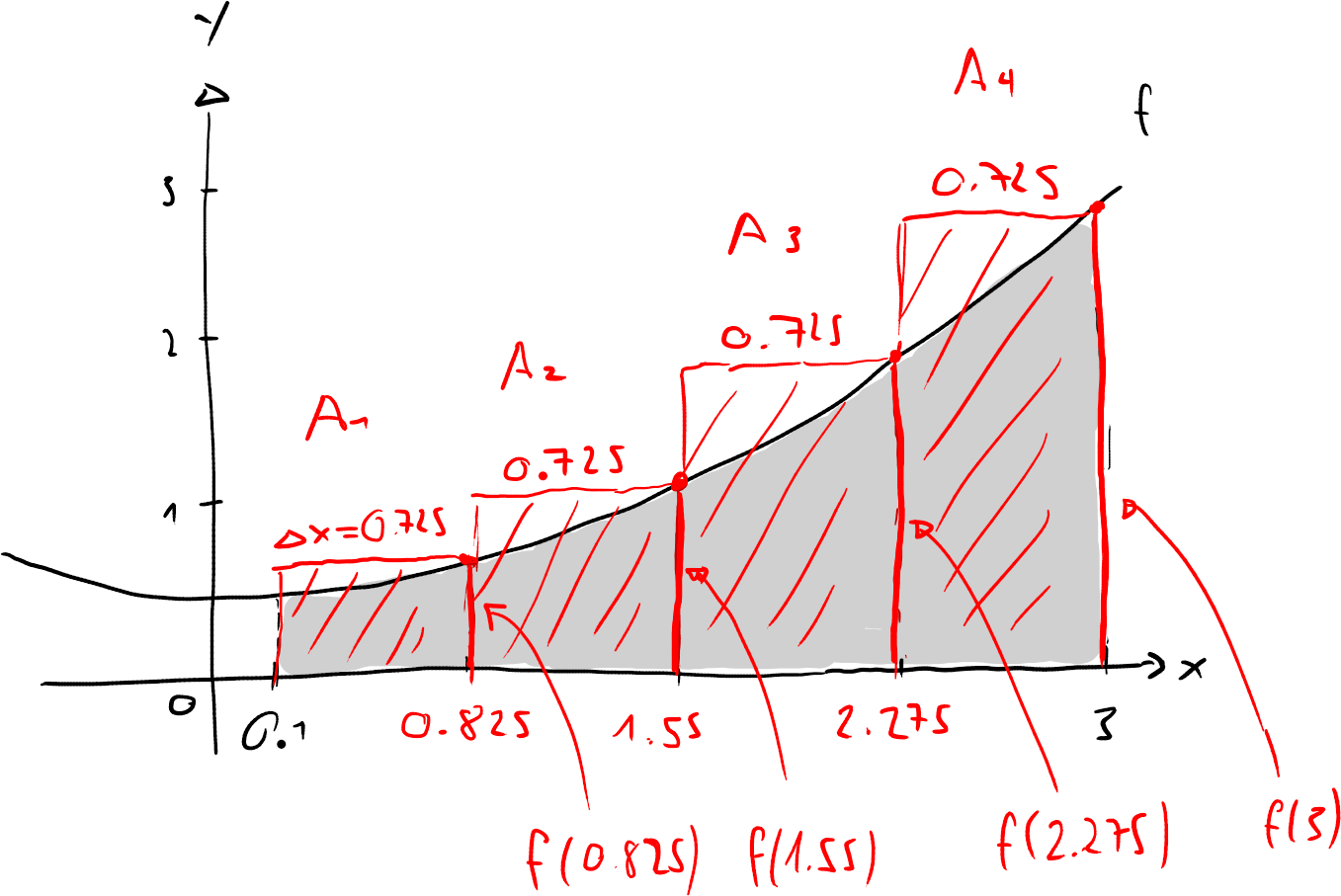
In the example above we used bars. If and are the areas of each bar, we see that sum of these bar areas approximates the integral
Any other number of bars is also okay, and intuitively it should be clear that the more bars we take, the better the approximation will be (see next chapter for a discussion of this). Observe how we draw the bars, which also gives them their width and height:
- Each bar starts on the -axis, and has equal width, which we typically denote by .
- Calculating the bar width : As the bars have to span the segment from to , it has to be and thus It follow
- Calculating the right edge position of each bar: The height of each bar is defined by its right edge, we furst need to find out where those right edges start on the -axis. Let's denote those positions by and . As the first bar starts at , and each bar has width , we see that the positions are
- Calculating each bar area: The bar area is bar width times bar height, where the height can be calcultated using the function . Thus, we have
Thus, a reasonable approaximation is
Let's summarise all this for general bar numbers.
Any integral can be approximated by a sum of bars or equal width
Integral approximated by the Rieman sum, using the sigma notation.
or without the sigman notation
Integral approximated by the Rieman sum, without using the sigma-notation.
where
- is the bar width
- are the positions of the right edges of the bars, that is,
- are the bar heights
- are the bar areas
The sum of bar areas is also called the Riemann sum.
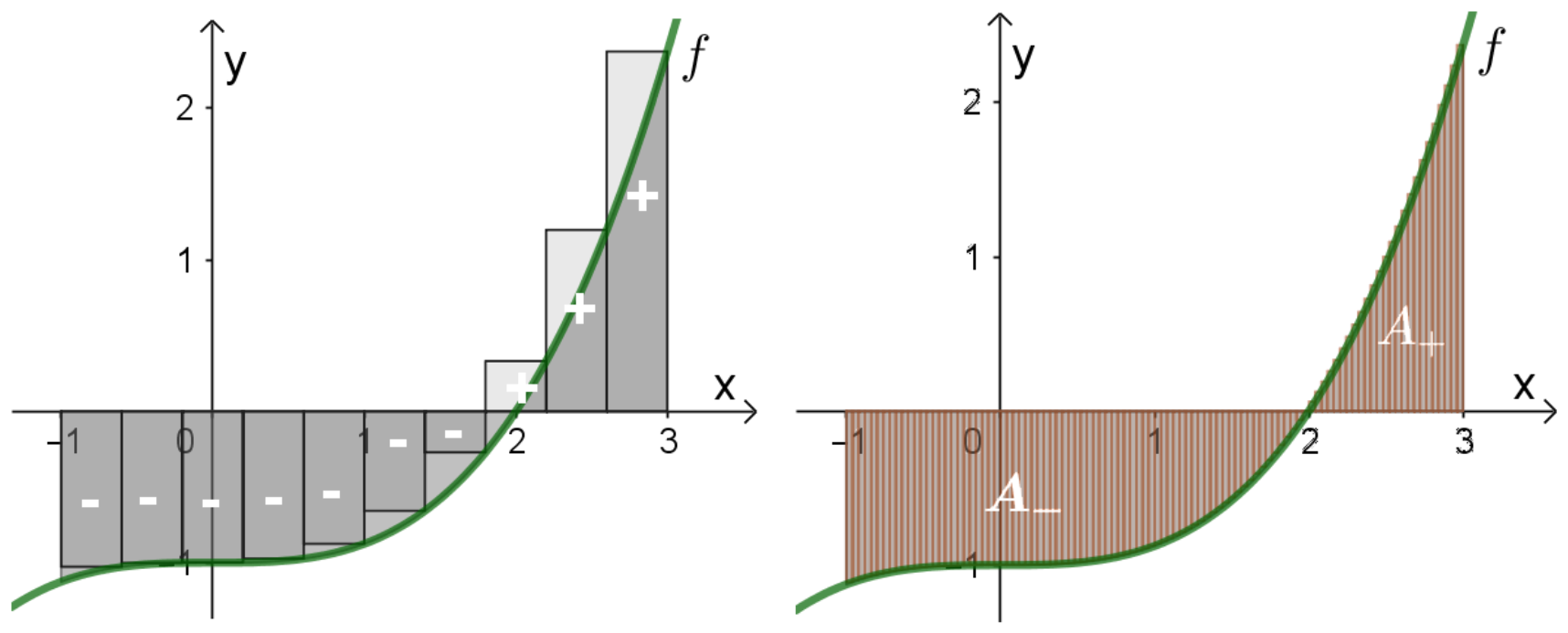
The sum of bars (Rieman sum) actually approximate signed areas, not normal areas, which is good news for us, as integrals are defined as signed areas. To see why, observe the figure below, in the region on the -axis where the graph goes below the -axis. The following is true for this region:
- A bar has to be drawn downwards, as the bar is always from the -axis to the graph.
- Because for an in this region, we also have that the bar area . That is, the bars count negative as soon as the graph goes below the xis.
-
Use bars to approximate the integrals below. Always create a figure and indicate the bars accurately. For (a)-(c) also calculate the exact integral using basic geometry, and compare.
- , use bars (we integrate over the contant function for all ).
- , use bars.
- , use n=5 bars (we integrate over the half circle of radius with center at coordinate origin).
- , use bars.
- , use bars.
-
Use bars to approximate .
Hint: You need the formula for summing the first square numbers, see last exercise in the sigma-notation chapter.
-
A car moves along a straight line. The instantaneous speed at time can be described by some function . We approximate the area from time to time beneath the graph of using bars. In this context, what is the meaning of the sum of bar areas
So what is the integral actually calculating in physics terms?
Solution
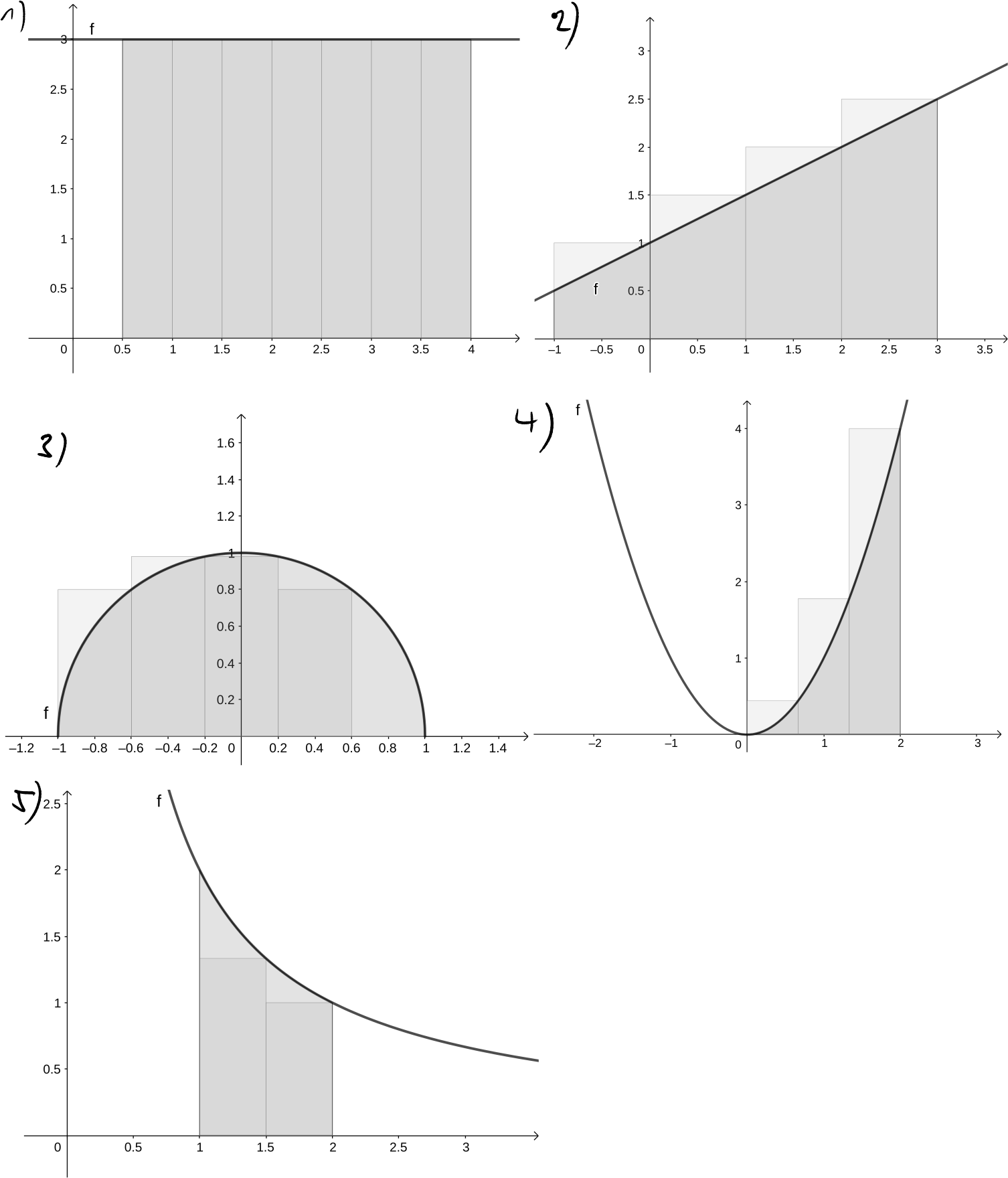
- The graphs are shown below.
- (see exercise in previous section)
- (see exercise in previous section).
- (see exercise in previous section).
- (, but you do not know how to calculate this yet).
-
(, but you do not know how to calculate this yet)
- We have Thus, and therefore Note that we have a formula for finding the first square numbers (see section 25): For , we get Thus, the sum of bars is The exact area, by the way, is , but you do not know how to calculate this presently.
- Each bar area is the product of a speed and a time , thus each bar area is the distance travelled by the car during the time (at least an approximation of it). The sum of bars between the times and is therefore the approximate distance travelled of the car in the time interval from to . The integral is therefore the exact distance travelled.