Further problems 3
Exercise 1
Q1
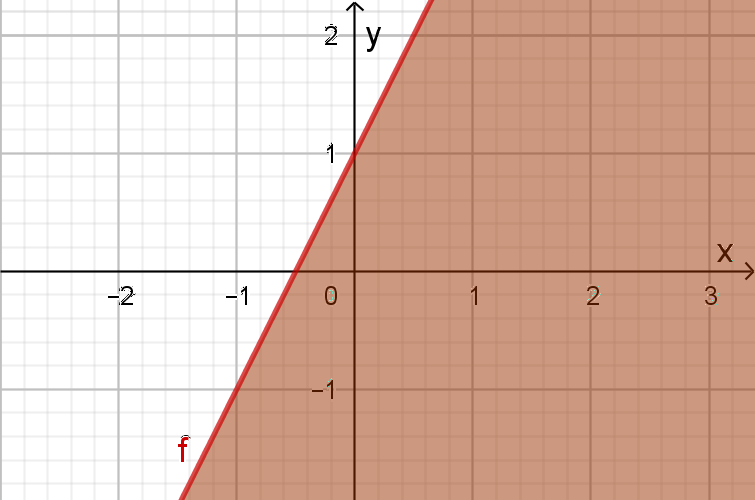
Draw all the points with in a 2d-coordinate system.
Hint: first, indicate the points with y=2x+1, and then try out other points on both side of this curve.
Q2
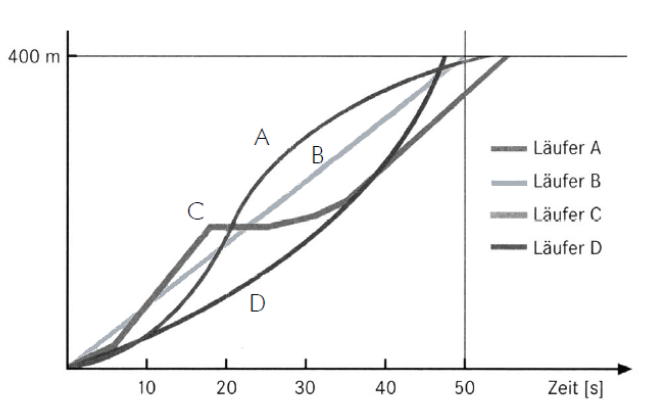
The four graphs below describe a running competition between four people.
- What is the distance they had to run?
- Create a ranking.
- Assign each graph to one of the following statements:
- takes a break in the middle of the race.
- starts quick and slows down towards the end.
- starts slow and increases the speed.
- runs with constant speed.
Q3
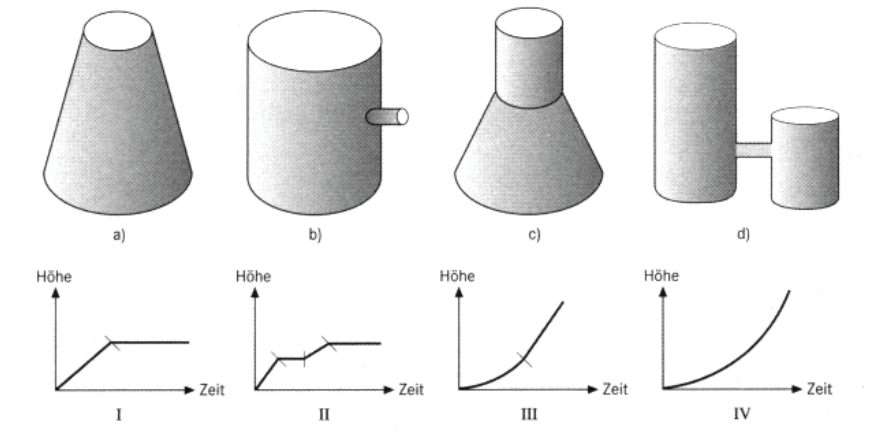
The vessels are filled with water from a tap. The height of the water is measured as a function of time and a graph is produced. Which graph corresponds to which vessel?
Q4
Consider the function .
- The point is on the graph of and has the -coordinate . Determine its -coordinate.
- The point is on the graph of and has the -coordinate . Determine its -coordinate.
Q5
Consider the functions and
- Draw the graphs into the same coordinate system.
- Calculate and .
- Calculate the - and -intercepts of and .
- Determine the points of intersections between and .
Q6
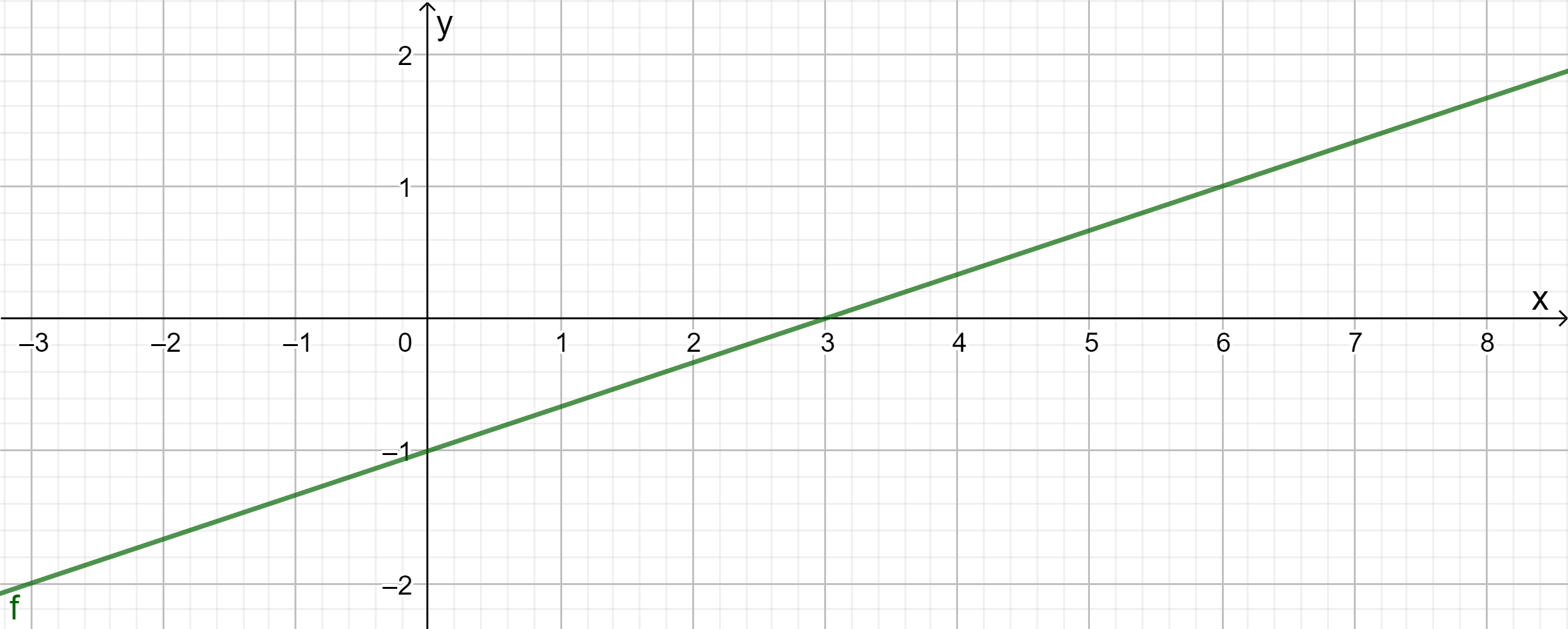
Shown below is the graph of a function .
- Based on the graph, estimate and .
- Based on the graph, find an with .
- Based on the graph, the - and -intercept.
- Determine . Hint: Find the function equation first.
Solution
A1
Shaded area, including the straight line.
A2
- D (fastest), B, A, C
- It is
- C: takes a break in the middle of the race.
- A: starts quick and slows down towards the end.
- D: starts slow and increases the speed.
- B: runs with constant speed.
A3
a: IV, b: I , c: III, d: II
A4
- Find with , that is, with . Squaring both sides, we get
A5
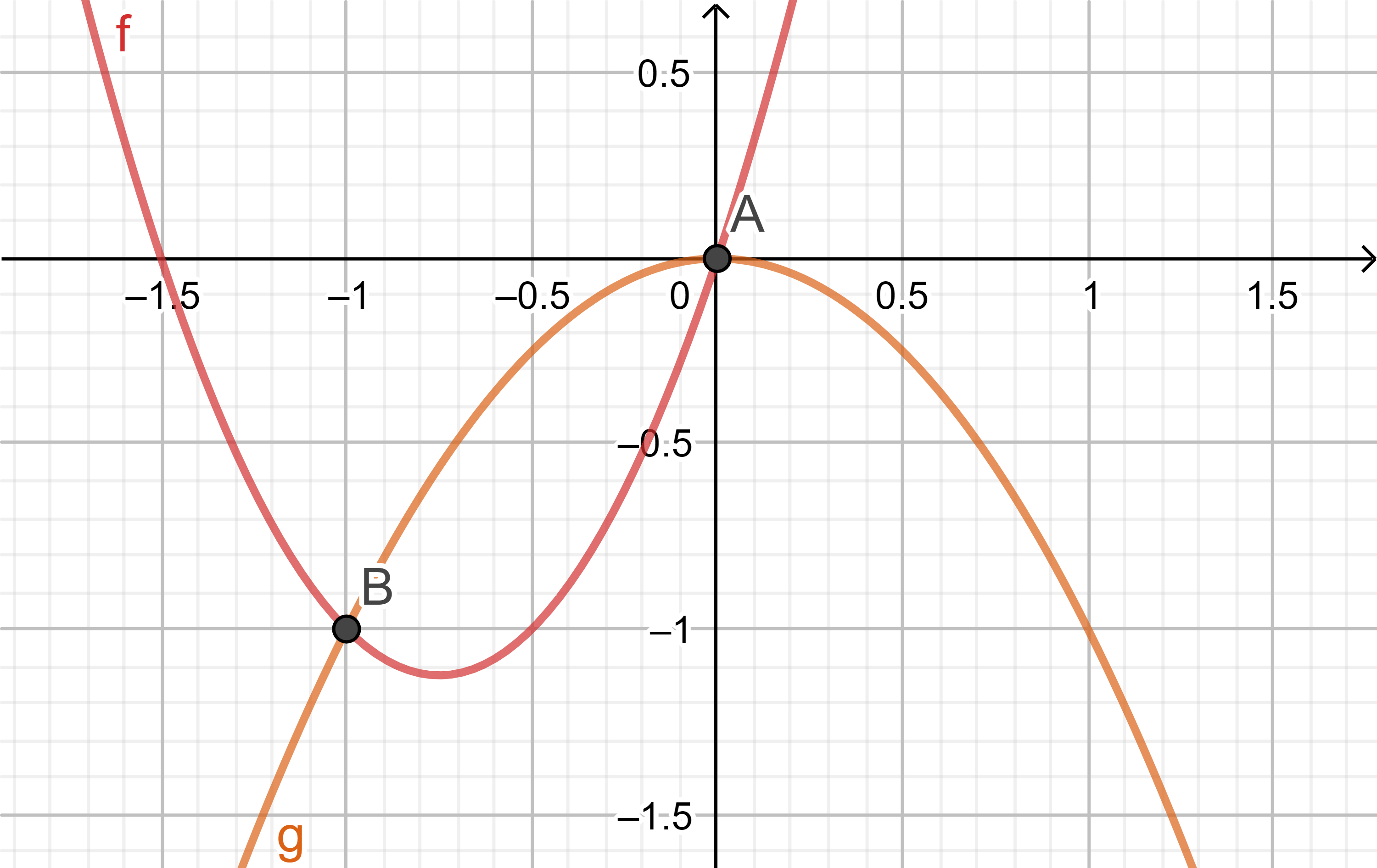
- The graphs are shown below.
- ,
- -intercepts of : find with We get and . -intercept of : . -intercepts of : find with It follows . -intercept of :
- To find the -coordinate of the intersection points and , find with . So solve the equation It follows , and . The corresponding -coordinates are and . Thus, the intersection points are and .
A6
-
-
-
-intercept is intersection with -axis, so .-intercept is intersection with -axis, so .
-
Create a table of values to find the rule:
Try some equations ... one that works is . So .